
Key Points
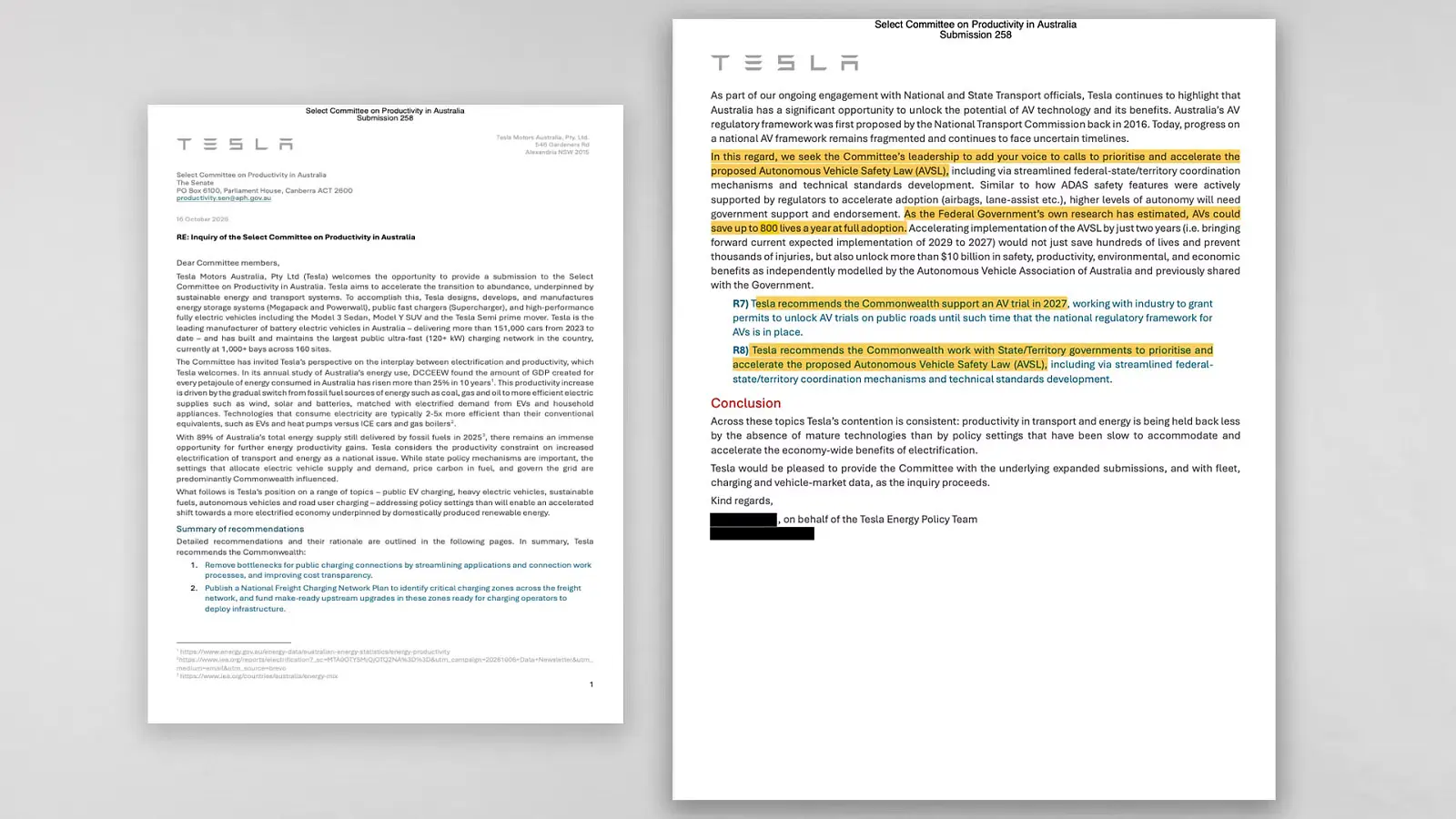
- Tesla is urging the Australian Government to approve fully autonomous vehicle trials on public roads from 2027, before national legislation is finalised.
- The company claims self driving technology could save 800 lives annually, although the specific figure could not be independently verified.
- A 2021 government commissioned report projected autonomous vehicles could save 8,000 lives by 2070 as adoption increases.
Australia could take another step towards autonomous driving as Tesla pushes the federal government to allow fully driverless vehicle trials on public roads from 2027.
The US electric vehicle manufacturer wants regulators to fast track plans for a national autonomous vehicle framework, arguing that self driving technology could improve road safety, reduce transport costs and boost the country's productivity.
In a submission to the Federal Parliament's Select Committee on Productivity in Australia, Tesla called for the government to support early trials while the proposed Autonomous Vehicle Safety Law is still being developed.
The proposal comes as interest in autonomous vehicles grows across Australia, with companies exploring how driverless technology could eventually change the way people travel.
However, Tesla's proposal also raises questions about safety evidence, regulatory oversight and how quickly Australia should allow vehicles to operate without a human driver behind the wheel.

Australia’s Autonomous Driving Regulations
Tesla is asking the Commonwealth Government to prioritise and accelerate the proposed Autonomous Vehicle Safety Law, which would establish a national regulatory framework for fully autonomous vehicles.
More importantly, the company wants permission to begin public road trials before the legislation is finalised.
In its parliamentary submission, Tesla recommended that the government work with industry to issue permits for autonomous vehicle trials during 2027. This would allow companies to test their technology under approved conditions while Australia develops its longer term regulatory arrangements.
Currently, Australian Tesla owners can access Full Self Driving (Supervised) in compatible newer models. However, the system is not fully autonomous and still requires a driver to remain behind the wheel, pay attention and be ready to take control.
Fully driverless vehicles, including autonomous ride hailing services and robotaxis, are not yet generally permitted to operate on Australian roads without an appropriate legal and regulatory framework.
Tesla's push comes as the productivity committee examines ways to improve Australia's economic performance.
The committee was established amid concerns about slowing productivity, weak real wage growth, declining national competitiveness and rising household cost of living pressures.
Autonomous driving technology is one of the areas being considered for its potential to make transport more efficient and reduce the economic costs associated with road accidents.

Questions Over Tesla’s Safety Claims
One of Tesla's central arguments is that autonomous vehicles could deliver significant road safety improvements while contributing to Australia's economy.
The company claims driverless technology could help save approximately 800 lives every year that would otherwise be lost in road crashes.
Tesla attributed this figure to government research. However, the source of the specific annual estimate could not be independently identified by Drive, and the company did not respond to requests for clarification before publication.
There is, however, existing research examining the potential long term safety benefits of autonomous vehicles.
A 2021 report prepared for the Federal Government by the Centre for International Economics (CIE), titled The Economic Impacts of Connected and Automated Vehicles, estimated that autonomous vehicles could save around 8,000 lives in total by 2070.
The report drew heavily on research from the Bureau of Infrastructure and Transport Research Economics (BITRE).
Its projections suggest autonomous vehicles could account for:
- Just over 65 per cent of new light vehicle sales by 2050.
- Around 85 per cent of new light vehicle sales by 2070.
According to the report, the majority of potential lives saved would occur between 2050 and 2070, as autonomous technology becomes more widely adopted.
Tesla also referred to economic benefits independently modelled by an organisation it identified as the Autonomous Vehicle Association of Australia, claiming the findings had been shared with the government.
However, Drive could not find a record of an organisation operating under that name.
These questions highlight the importance of independently verified data when assessing the potential benefits of autonomous driving, particularly when governments are being asked to approve public road trials.

What This Means For Australia
Tesla's proposal could help accelerate Australia's transition towards autonomous transport, but the country still faces important regulatory and safety challenges before fully driverless vehicles become a practical reality.
Allowing controlled trials in 2027 would give manufacturers an opportunity to test autonomous technology in Australian driving conditions, including local roads, traffic patterns and regulatory environments.
It could also help policymakers understand the safety requirements, insurance arrangements and legal responsibilities needed before driverless vehicles become more widely available.
For Australian motorists, the immediate impact is likely to be limited. Tesla's existing Full Self Driving (Supervised) technology will continue to require driver attention, and the proposed trials do not mean privately owned Teslas will suddenly be able to operate without someone behind the wheel.
The bigger opportunity lies in the longer term development of autonomous mobility, including potential robotaxi services and improvements in road safety and transport efficiency.
Whether Tesla gets the green light for its proposed 2027 trials will depend on how the federal government approaches regulation, independent safety evidence and public confidence in driverless technology.
