


Key Points
- Tesla Electric's Dynamic Plan is a hybrid: fixed time-of-use rates for power you import, and a real-time wholesale price for power you export.
- Import rates are set in blocks, Peak (3pm-9pm) at 49.71c/kWh and Off-Peak (9pm-3pm) at 24.02c/kWh, reviewed periodically rather than moved throughout the day.
- The Export Credit pays 90% of the real-time wholesale price for solar and battery exports, and a separate Grid Services Credit pays for Powerwall FCAS support.
Tesla has launched its own electricity retail plan in Australia. Tesla Electric is live on Tesla's Australian website, and customers sign up directly through the Tesla app rather than through a separate retailer.
It replaces the Tesla Energy Plan that ran through retail partner Energy Locals, which closed on 30 September 2025. This time, Tesla is selling power itself, through its own licensed retail arm, Tesla Energy Ventures Australia.
Tesla Electric's main offering, the Dynamic Plan, splits pricing across the two sides of a customer's bill. What you pay to import power from the grid works like an ordinary time-of-use tariff. What Tesla pays you for exporting solar or battery power back to the grid moves with the real-time wholesale market.
How the Dynamic Plan prices power
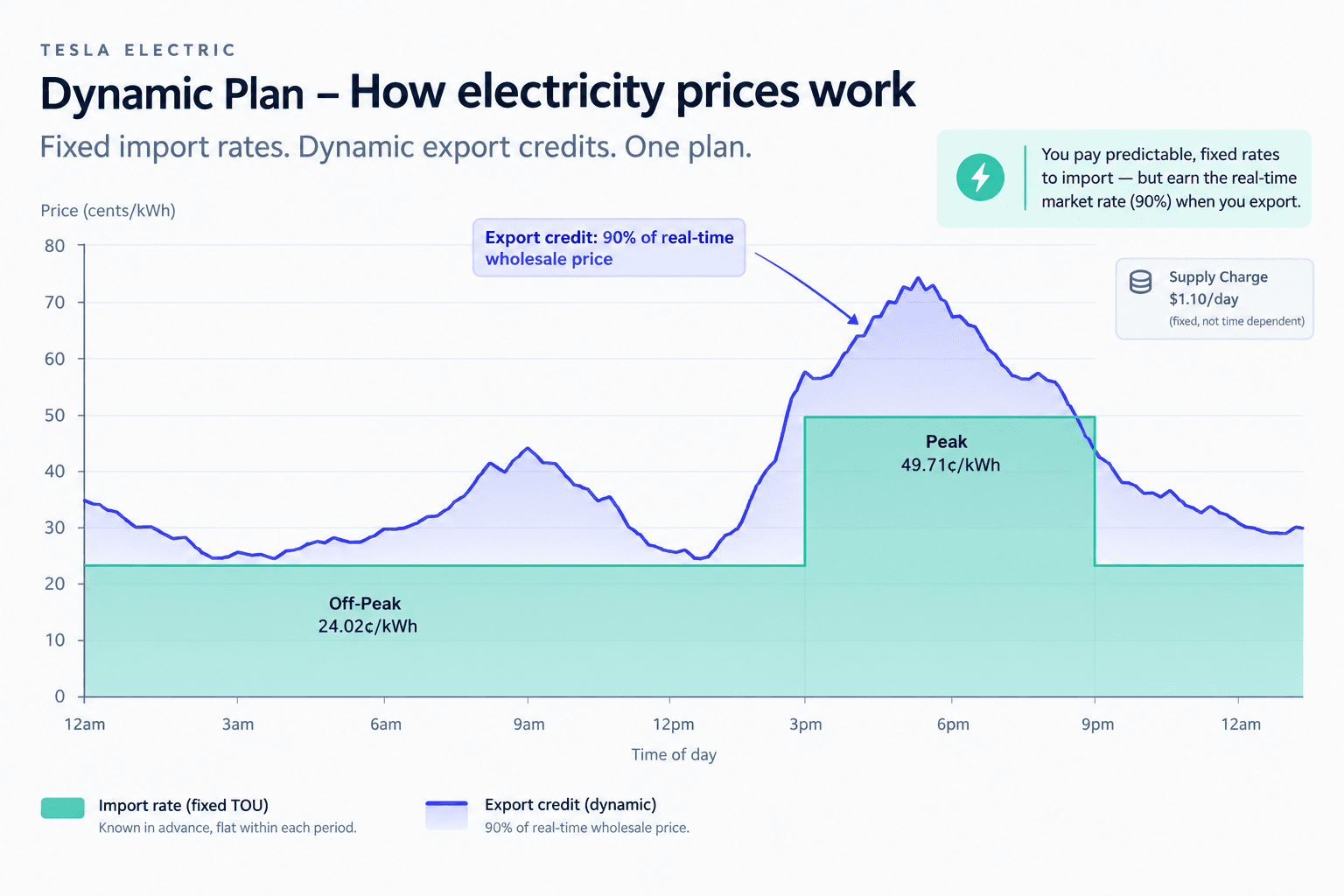
For power imported from the grid, the Dynamic Plan works like a normal retailer's time-of-use tariff. Customers are billed on fixed cents-per-kWh blocks that are set in advance and reviewed periodically, rather than moved throughout the day. Tesla's own materials describe these import rates as built for month-to-month stability.
Based on a standard address in Ausgrid’s network (NSW), rates for the Dynamic Plan's import side are a Peak block from 3pm to 9pm at 49.71c/kWh and an Off-Peak block from 9pm to 3pm at 24.02c/kWh.
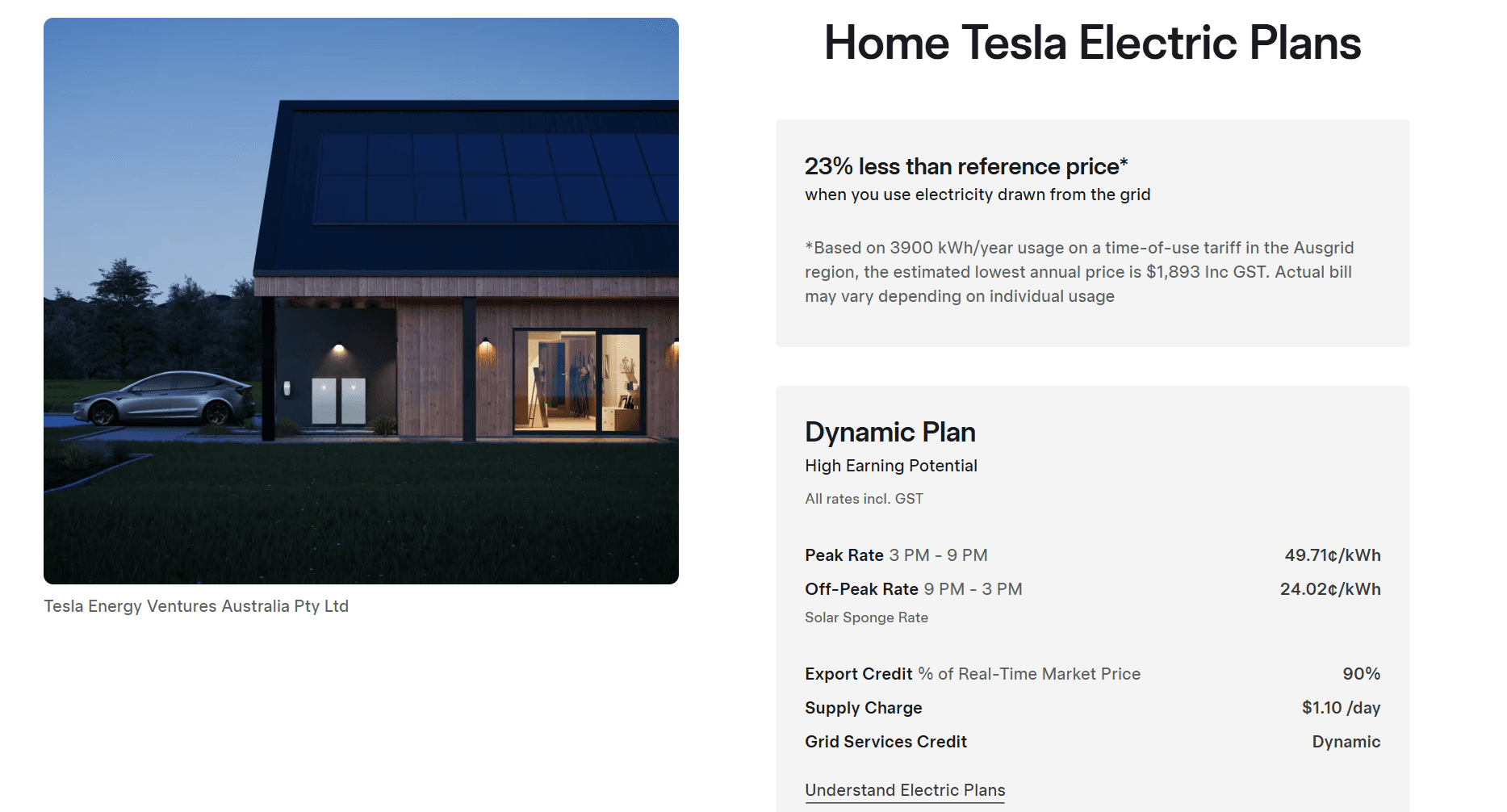
It's a different story for power exported back to the grid. Tesla's Export Credit pays 90% of the real-time wholesale market price for solar and battery exports, so what a customer earns for exporting moves with live grid conditions rather than sitting at a flat feed-in tariff. On top of that, a separate Grid Services Credit pays Powerwall owners, also on a dynamic basis, for letting their battery provide grid support services when called on, covered in more detail below.
Amber Electric is the other Australian retailer built around real-time pricing, but it applies that to both sides of the bill. Amber passes through the actual wholesale spot price for consumption, re-priced every 30 minutes, so what a customer pays to import power can spike above $1/kWh or drop near zero depending on grid conditions at the time. It charges a flat monthly subscription rather than building a margin into the rate. Tesla Electric's Dynamic Plan only behaves this way on the export side; importing power is priced more like an ordinary time-of-use retailer.

How this differs from a standard electricity plan
On the import side, Tesla Electric doesn't look radically different from a standard electricity plan. Retailers commonly sell time-of-use tariffs with peak, off-peak and sometimes a cheap solar-sponge block in the middle of the day, and the Dynamic Plan follows that same shape. Those rates are fixed once set, and reviewed periodically rather than tracking the market in real time.
The key difference shows up on exports. Most retailers pay a flat feed-in tariff for solar sent back to the grid, set well below the wholesale price and reviewed infrequently. Tesla's Export Credit instead pays 90% of the real-time wholesale price, so a customer exporting solar around the middle of the day, when wholesale prices are often low or negative, earns less, while exporting during an evening price spike earns more.
Tesla Electric's Dynamic Plan: import vs. export pricing
Side of the bill | How it's priced | Rate | How often it changes |
Import (grid draw) | Fixed time-of-use tariff, set by Tesla | Peak (3pm-9pm): 49.71c/kWh. Off-Peak (9pm-3pm): 24.02c/kWh | Set in advance, reviewed periodically |
Export (solar/battery to grid) | Export Credit, linked to the wholesale market | 90% of the real-time wholesale price | Moves with the market, in real time |
Grid Services Credit | Dynamic payment for Powerwall FCAS support | Not published by Tesla | Paid when the Powerwall is dispatched |

Extra bill credits for Powerwall owners
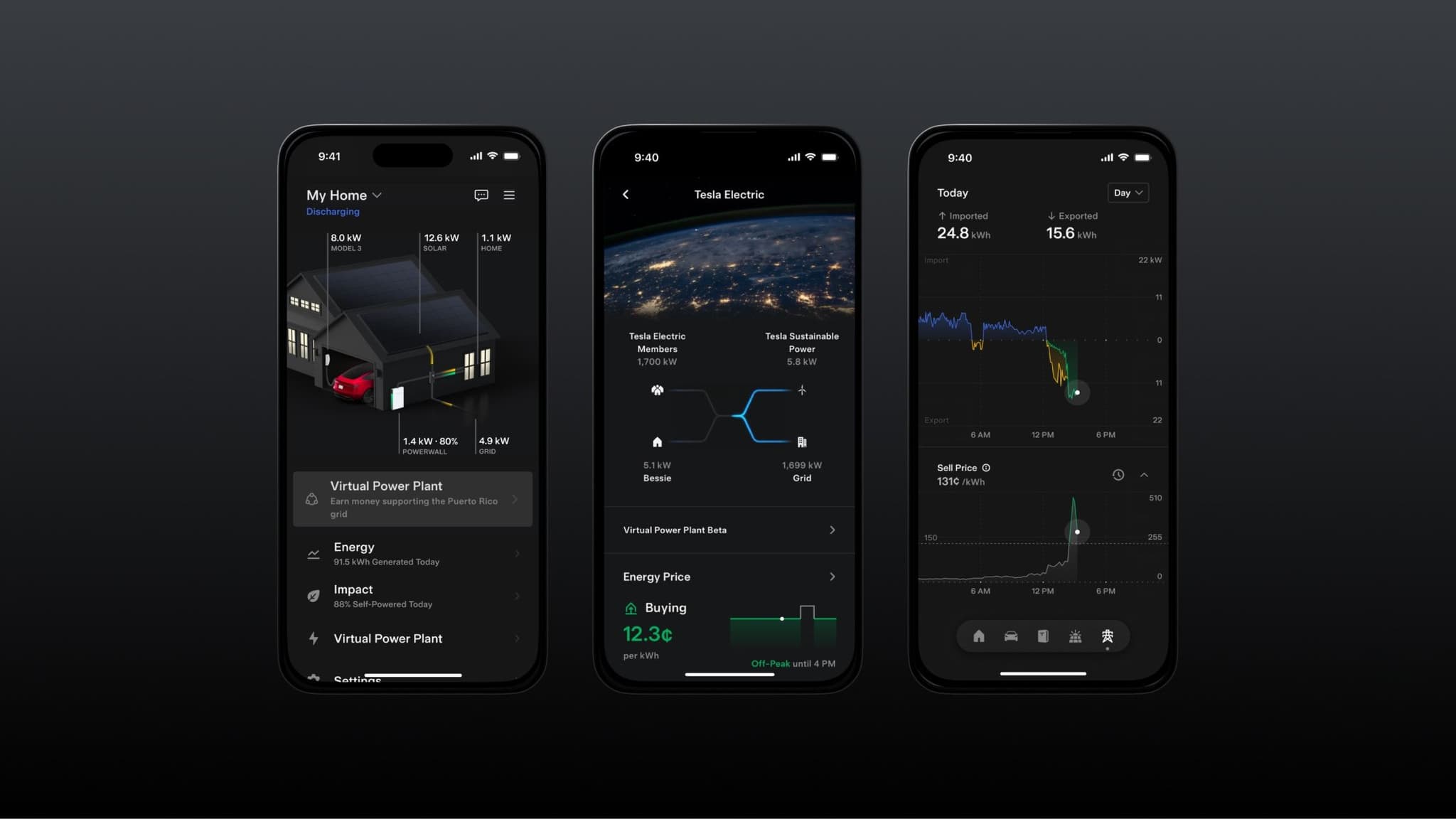
Tesla calls this the Grid Services Credit. It pays Powerwall owners, on a dynamic basis, when their battery provides grid support services, which can include frequency control ancillary services (FCAS), a set of services the electricity grid uses to keep supply and demand in balance from one second to the next. This is separate from the Export Credit, which covers ordinary solar and battery exports.
When a Powerwall is called on for FCAS, Tesla says the battery may charge, discharge or go into standby mode automatically. Tesla has not published a rate card or a typical annual figure for the Grid Services Credit, so how much a household earns will depend on how often its battery is dispatched.
Eligibility and how to sign up
To join Tesla Electric, a customer's site must be approved to export electricity to the grid, and Tesla says it needs to verify the connection agreement held with the local distributed network service provider (DNSP). Sign-up happens through the Tesla app.
Tesla's Australian page for the plan does not spell out whether owning a Powerwall or a Tesla vehicle is required to join. That is a condition of Tesla's electricity plan in Texas, which is open only to Powerwall or vehicle owners in the parts of that state where customers can choose their retailer.

What replaced the old Tesla Energy Plan
Tesla's earlier electricity offer in Australia, the Tesla Energy Plan, was run in partnership with retailer Energy Locals. It combined time-of-use rates with up to five years of extra Powerwall warranty cover and bill credits of up to $220 a year for customers whose batteries joined Tesla's virtual power plant. It operated in South Australia, Victoria, New South Wales, the Energex network area of south-east Queensland, and the ACT.
That plan closed on 30 September 2025. Customers who didn't choose a new plan were moved onto Energy Locals' Standing Offer by default. At the time, Tesla told customers it was developing "the next generation of Tesla Energy offers" and asked for feedback to help shape it. Tesla Electric, sold directly by Tesla rather than through Energy Locals, appears to be that successor.
The regulatory path to becoming a retailer
Tesla's Australian energy arm, Tesla Energy Ventures Australia (TEVA), applied to the Australian Energy Regulator (AER) in November 2023 for authorisation to sell electricity in New South Wales, the ACT, Queensland, Tasmania and South Australia. It lodged a separate licence application with Victoria's Essential Services Commission, which granted TEVA a retail electricity licence on 17 April 2024. The AER has also confirmed TEVA holds a national electricity retailer authorisation.
Neither the AER nor Tesla has published a detailed breakdown of contract terms, exit fees or a state-by-state rollout schedule for Tesla Electric. Those details, if they exist, have not been made public.


About the author

Danny is a consultant and entrepreneur working at the cutting edge of the electric vehicle and energy transition. He is passionate about educating and helping consumers make better decisions through data.
