Key Points
- A Tesla Robotaxi drove into bollards at an Austin intersection.
- Tesla recently described its Robotaxi safety record as “impeccable”.
- Australia’s current rules still require drivers to supervise assisted-driving systems.
A Tesla Robotaxi has been caught on camera driving into a row of bollards in Austin, Texas, in another real-world example of the challenges facing fully autonomous vehicles.
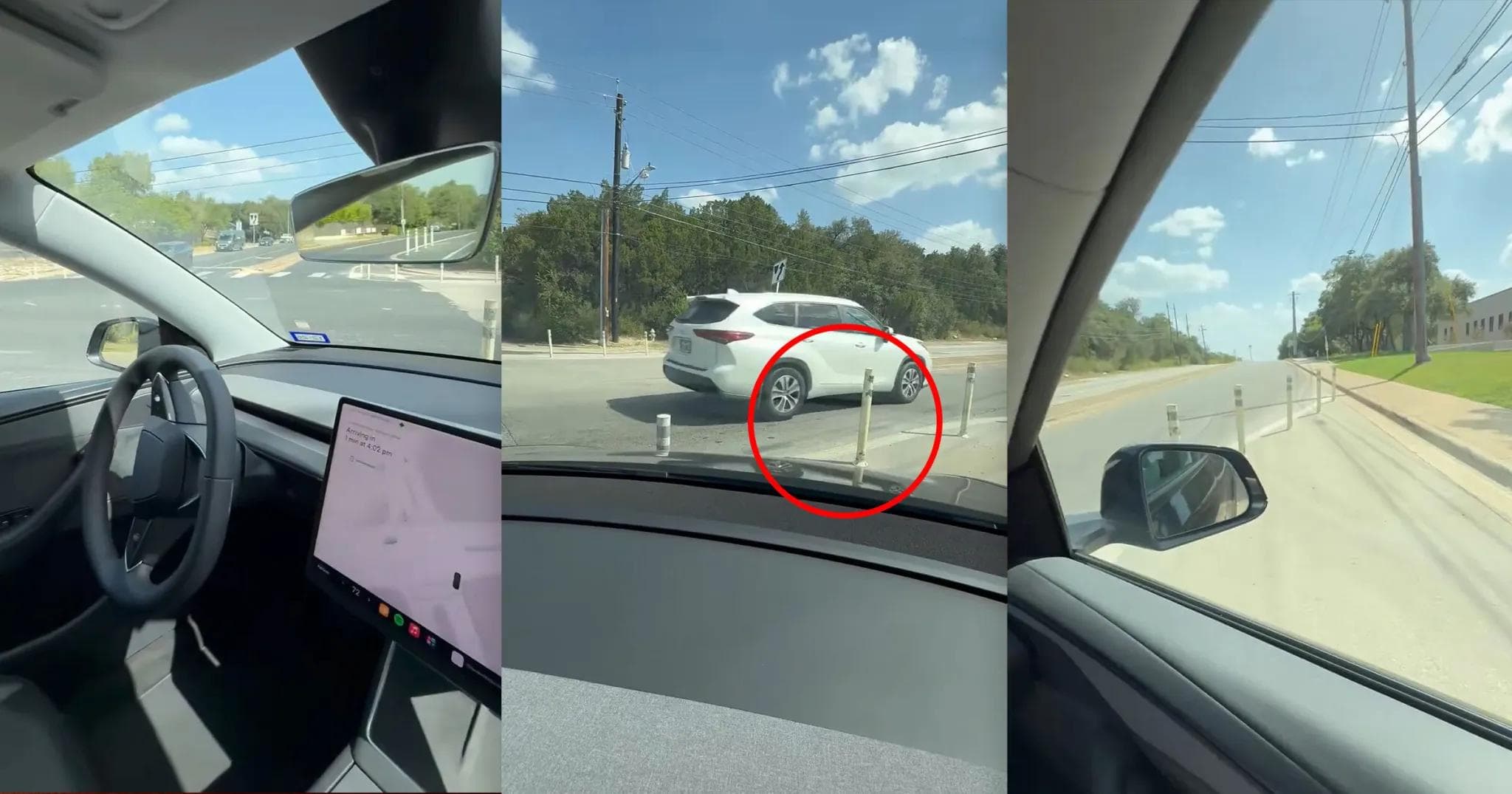
The incident was captured in a video posted to Reddit by user bladerskb and shows an unsupervised Robotaxi approaching an intersection before turning right towards a section of road blocked by several bollards.
The car appears to recognise the obstacles and stops, but what happens next is more unusual.
Rather than backing away from the obstruction, the Robotaxi remains stationary for several moments, appears to repeatedly apply its brakes, and then begins moving forward again.
▶️MORE: Tesla Model 3 Performance
It eventually squeezes between two of the bollards, striking them as it makes its way through.
The incident did not result in any reported injuries, but the footage offers a useful glimpse into one of the problems autonomous vehicles still have to solve: what should the car do when it encounters an obstacle it cannot confidently navigate around?
The Robotaxi saw the bollards but didn't know what to do next
The video does not appear to show the Tesla simply failing to detect the bollards.
Instead, the Robotaxi stops when it encounters them, suggesting its perception system was aware that something was blocking its intended path.
The problem appears to have come after that.
The vehicle did not immediately reverse or find another route around the obstruction. After stopping and seemingly “pulsing” the brakes, it eventually chose to continue forward and squeezed through the gap.
Several Reddit users identified the location of the incident and noted that the bollards have reportedly been installed there for at least three years.
That detail is significant because this was not necessarily a completely new or temporary obstacle. The road layout appears to have been established for some time.
The footage therefore raises a straightforward question for autonomous-driving technology: if a vehicle knows an obstacle is there but cannot determine a safe path around it, should it simply stop and wait for assistance?
For a human driver, the answer is relatively simple. An autonomous vehicle needs to make that decision without someone sitting behind the wheel.

Tesla's safety claims face another real-world test
The Austin incident comes shortly after Tesla executives highlighted the safety record of the company's Robotaxi program.
During Tesla's recent earnings call, vice president of AI Ashok Elluswamy described the program's safety record as “impeccable”, saying the Robotaxis had completed more than 380,000 miles of unsupervised driving across six cities in two US states without any “notable incidents”.
The bollard encounter provides another reminder that the scale of a Robotaxi program matters when those safety claims are assessed.
Tesla's reported 380,000 unsupervised miles may sound substantial, but rival Waymo has accumulated a vastly larger amount of rider-only autonomous driving.
Waymo said in June that its vehicles had completed 220.6 million rider-only miles without a human driver.

According to Waymo's analysis, its vehicles were involved in:
- 94 per cent fewer crashes resulting in serious or fatal injuries.
- 82 per cent fewer crashes involving airbag deployment.
- 82 per cent fewer crashes involving any reported injury.
Those figures do not mean Waymo's vehicles are accident-free. They instead illustrate why autonomous-driving safety is increasingly being measured against large amounts of real-world driving data.
Tesla's Robotaxi fleet is also considerably smaller. Reports earlier this year put Tesla's total active Robotaxi fleet across its markets at just 31 vehicles, with apparently only 14 operating without a safety driver.
Waymo, by comparison, operates more than 3,800 vehicles, although that figure has been linked to reports surrounding a recent recall of 3,871 vehicles over a software issue that could cause them to enter freeway construction zones.
▶️MORE: Home charging guide for Tesla Model 3 & Y
What does this mean for Australia?
Australia is still some distance from allowing Tesla's Robotaxi-style service to operate in the same way as it does in parts of the US.
Tesla's driver-assistance technology available to Australian customers continues to operate within a regulatory environment where the driver remains responsible for supervising the vehicle.
That distinction is important.
A system that can assist a human driver has a very different safety requirement from one that is expected to make every driving decision on its own.
The Austin footage is therefore less about whether Tesla's technology is capable of driving a car from A to B and more about how it handles the unexpected situations that inevitably occur on public roads.
Temporary lane closures, unusual road layouts, construction barriers, bollards and other obstacles are everyday occurrences for human drivers. For a genuinely driverless vehicle, each one becomes a test of how well the system can perceive, understand and respond to the environment.
Tesla's Robotaxi program is still expanding, and incidents like this will inevitably receive intense scrutiny as the company moves towards wider unsupervised deployment.
For Australian motorists watching the technology develop overseas, the bigger question is not simply when Tesla's Robotaxi technology could arrive here — but whether it can demonstrate the level of reliability regulators would require before taking the human driver out of the equation.

