


Key Points
- The 2027 Hyundai Staria Load Electric is on sale now from $70,990 before on-road costs, in Liftback or Twin Swing rear door form.
- It uses an 84kWh battery and 160kW front motor for up to 450km of WLTP range, with 10 to 80 per cent DC charging in 20 minutes.
- The van keeps the 4,935-litre cargo area of the diesel and Hybrid models and adds a 1,005kg payload, 2,000kg braked towing and interior V2L.
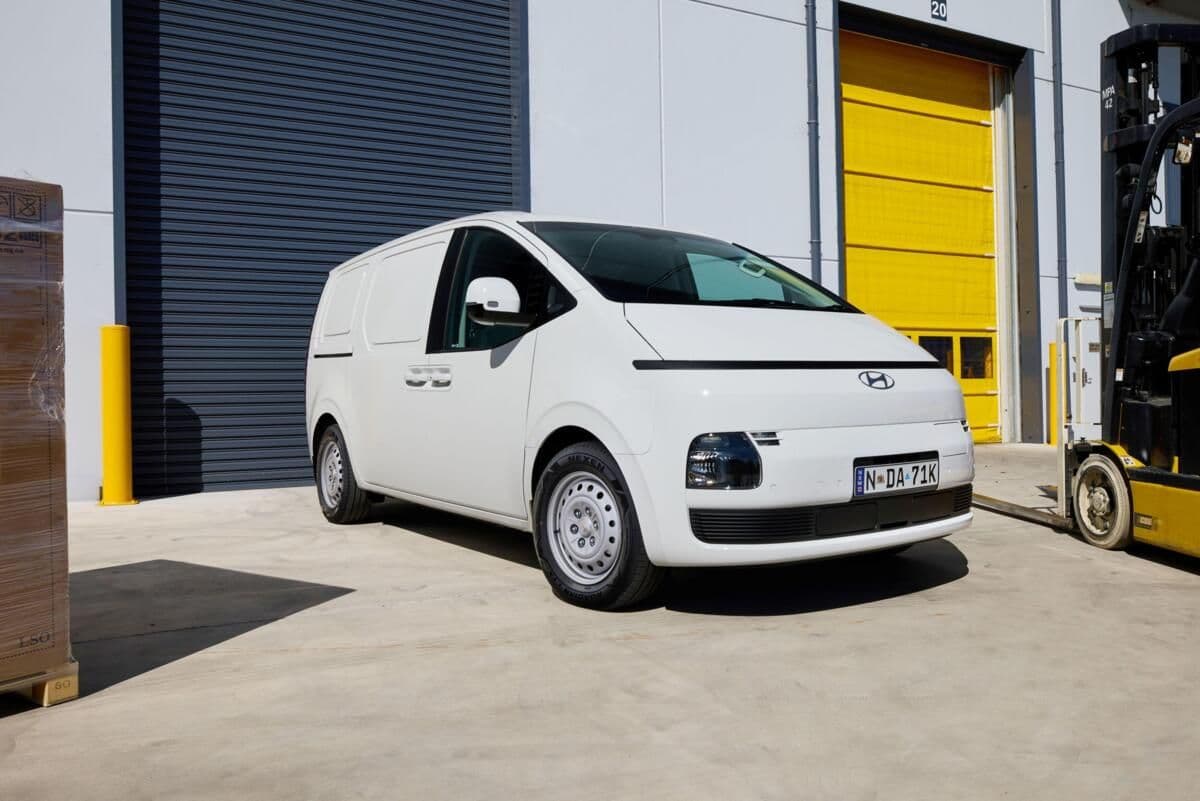
Hyundai Australia has put the 2027 Staria Load Electric on sale, priced from $70,990 before on-road costs. It is the first fully electric version of the Staria Load and joins the existing turbo-diesel and Hybrid variants.
The electric van uses Hyundai's 800V E-GMP architecture, an 84kWh battery and a 160kW front motor. It is capable of 450km of WLTP range, which is one of the longest claimed ranges of any electric van on sale in Australia. A 10 to 80 per cent DC charge takes 20 minutes. It keeps the same cargo space as the diesel and Hybrid, has a payload of over a tonne and can tow 2,000kg braked.
Price and availability
The Staria Load Electric is available now in one two-seat grade. Buyers can choose Liftback or Twin Swing rear doors, and both are priced the same. The Electric costs $21,000 more than the entry diesel Staria Load and $17,500 more than the base Hybrid.
2027 Hyundai Staria Load pricing
Variant | Powertrain | Rear doors | Price (MLP) |
Staria Load | 2.2 CRDi turbo-diesel | Liftback / Twin Swing | $49,990 |
Staria Load Hybrid | 1.6 T-GDi Hybrid | Liftback / Twin Swing | $53,490 |
Staria Load Hybrid Premium | 1.6 T-GDi Hybrid | Liftback | $61,240 |
Staria Load Electric | 160kW / 84kWh electric | Liftback / Twin Swing | $70,990 |
Prices are Manufacturer's List Price (MLP) and exclude delivery and on-road costs.
Get a novated lease quote
Electric powertrain, range and payload
A single 160kW, 350Nm electric motor drives the front wheels. It draws power from an 84kWh high-voltage battery. Hyundai rates the Staria Load Electric at up to 450km of WLTP range and 20.7kWh/100km combined energy consumption.
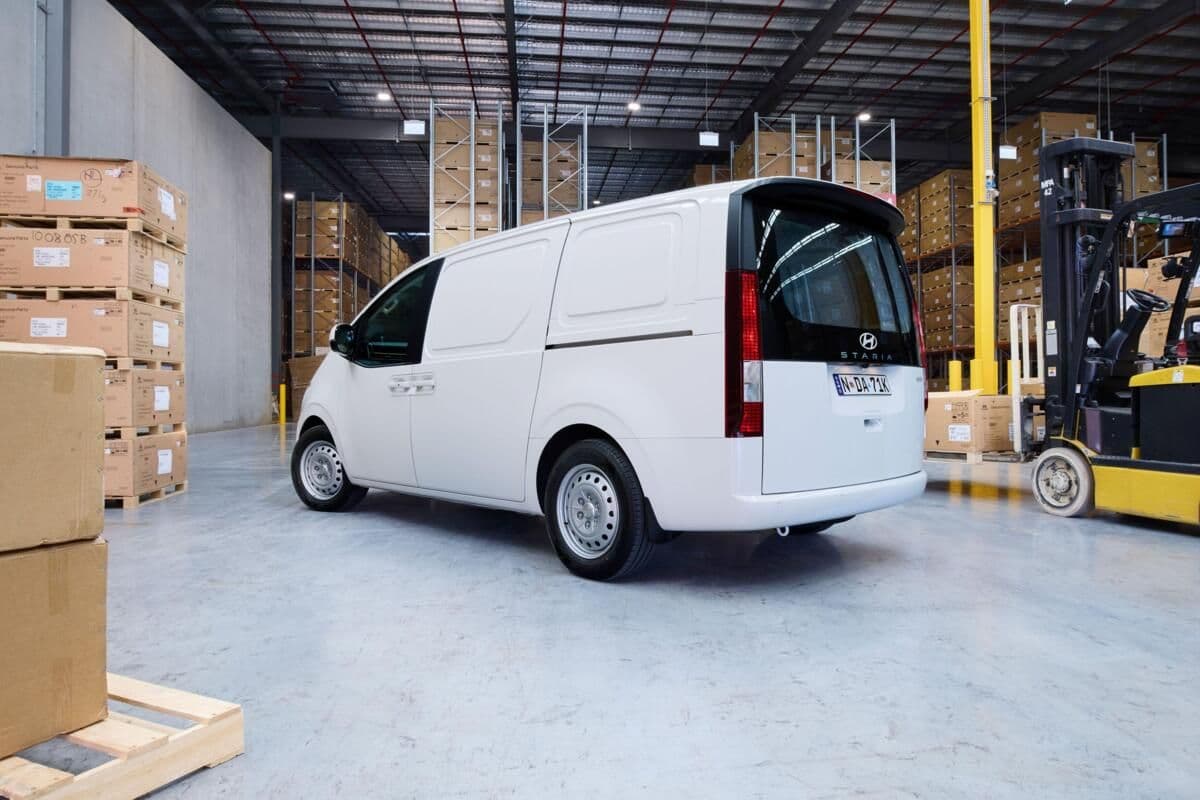
Hyundai says the battery has been packaged without reducing cargo space. The load area measures 2,607mm long, 1,640mm wide and 1,436mm high, the same as the diesel and Hybrid. Total cargo volume is 4,935 litres (VDA).
Payload is 1,005kg. That sits between the diesel (997kg) and the Hybrid (1,039kg). The Electric is rated to tow 2,000kg braked and 750kg unbraked. The diesel tows 2,500kg braked, while the Hybrid is not rated to tow at all.
Staria Load key specifications by powertrain
Specification | Diesel | Hybrid | Electric |
Power | 130kW | 180kW (130kW + 54kW) | 160kW |
Combined consumption | 7.0L/100km | 6.5L/100km | 20.7kWh/100km |
WLTP range | N/A | N/A | Up to 450km |
Braked towing | 2,500kg | 0kg | 2,000kg |
Unbraked towing | 750kg | 0kg | 750kg |
Cargo area (L x W x H) | 2,607 x 1,640 x 1,436mm | 2,607 x 1,640 x 1,436mm | 2,607 x 1,640 x 1,436mm |
Cargo volume (VDA) | 4,935L | 4,935L | 4,935L |
Payload | 997kg | 1,039kg | 1,005kg |
Charging and V2L
800V fast charging
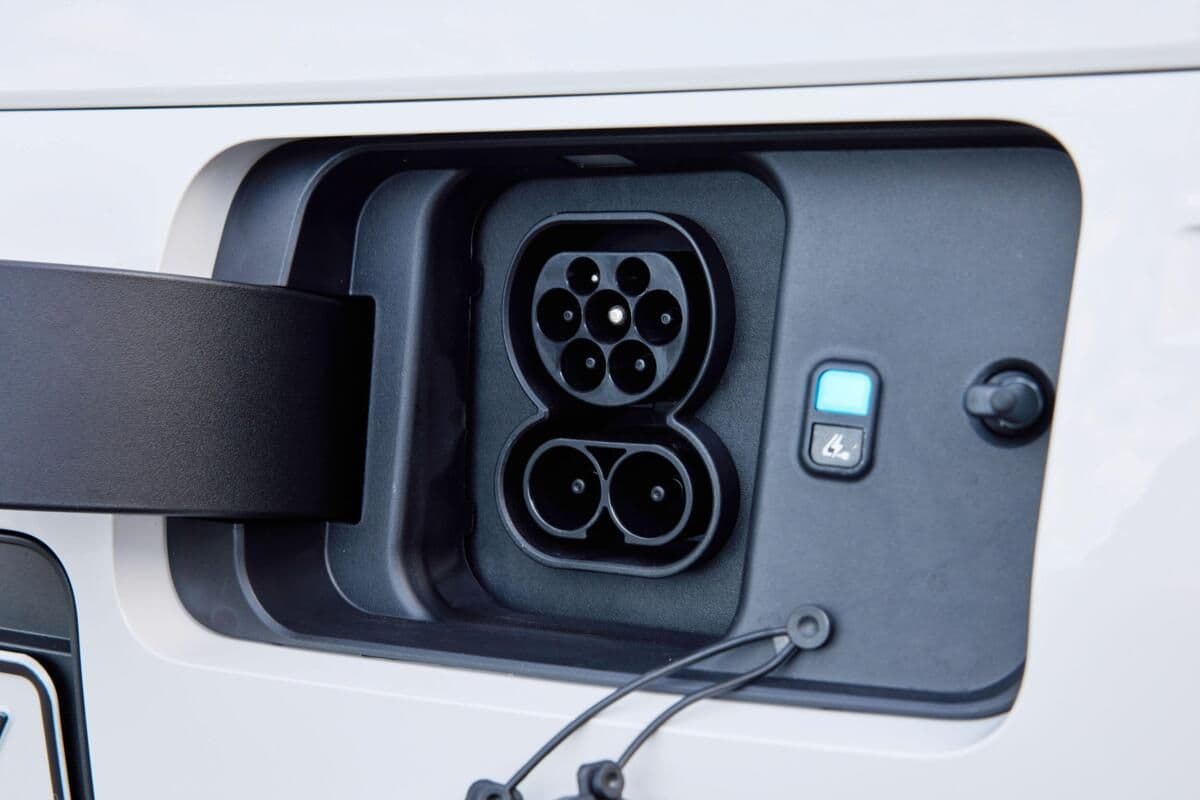
The 800V system supports DC fast charging at up to 350kW, according to Hyundai. On a suitable charger, the 84kWh battery goes from 10 to 80 per cent in 20 minutes. The charge port sits in the centre of the front panel, which Hyundai says makes it easier to reach when nosing into a charging bay.
Vehicle-to-Load
An interior Vehicle-to-Load (V2L) outlet is mounted on the right-hand side of the cargo area. It uses a standard three-pin socket, so the high-voltage battery can run tools and equipment on a job site or while on the move.

How the Staria Load Electric compares with rival electric vans
The Staria Load Electric enters a growing field of mid-size electric vans in Australia. The table below compares it with the closest rivals on price, battery, range, charging and carrying capacity.
Staria Load Electric vs mid-size electric vans
Model | Price (from) | Battery | WLTP range | DC charging | Payload | Cargo volume | Braked towing |
Hyundai Staria Load Electric | $70,990 | 84kWh | 450km | Up to 350kW; 10-80% in 20 min | 1,005kg | 4.9m³ | 2,000kg |
Kia PV5 Cargo Long Range | $55,990 | 71.2kWh | 416km | 10-80% in approx. 30 min | 690-740kg | 4.4m³ | Not stated |
Farizon V7E Extended Range | $53,990 drive-away | 66kWh | 329km | 100kW; 20-80% in 33 min | 1,208kg | 6.95m³ | 1,000kg |
LDV eDeliver 7 SWB Low Roof | $54,990 drive-away (ABN offer) | 77kWh | 318km | 20-80% in approx. 43 min | 1,350kg | 5.9m³ | Not stated |
Volkswagen ID. Buzz Cargo | $69,990 | 79kWh (usable) | 431km | 185kW; approx. 26 min to 80% | 680kg | 3.9m³ | 1,200kg |
Ford E-Transit Custom | $77,590 | 64kWh | 301-307km | 125kW; 15-80% in approx. 32 min | 1,111-1,187kg | 5.8-6.8m³ | 2,300kg |
Volkswagen e-Transporter | $83,590 | 64kWh | Approx. 330km | 125kW; 10-80% in 38 min | 760-806kg | 5.8-6.8m³ | 2,300kg |
Prices are before on-road costs unless marked drive-away.
One of the longest-range electric vans on sale
At 450km, the Staria Load Electric has one of the longest claimed WLTP ranges of any electric van on sale in Australia. It edges out the Volkswagen ID. Buzz Cargo (431km) and the Kia PV5 Cargo (416km). It also beats the claimed range of the large Mercedes-Benz eSprinter LWB, which is rated at up to 440km from a much bigger 113kWh battery and costs more than $120,000 before on-road costs.
Most other electric vans in Australia are rated between about 250km and 370km. The Ford E-Transit Custom and Volkswagen e-Transporter both use 64kWh batteries and sit around 300 to 330km. The Staria's 20.7kWh/100km combined consumption helps it go further than several rivals with similar or larger batteries, such as the 88kWh LDV eDeliver 7 LWB (up to 362km) and the 83kWh Farizon SuperVan (366km).
Claimed WLTP range: electric vans on sale in Australia
Model | Van size | Battery | Claimed range (WLTP) |
Hyundai Staria Load Electric | Mid-size | 84kWh | 450km |
Mercedes-Benz eSprinter LWB | Large | 113kWh | Up to 440km |
Volkswagen ID. Buzz Cargo | Mid-size | 79kWh (usable) | 431km |
Kia PV5 Cargo Long Range | Compact | 71.2kWh | 416km |
Farizon SuperVan | Large | 83kWh | 366km |
LDV eDeliver 7 LWB High Roof | Mid-size | 88kWh | Up to 362km |
Volkswagen e-Transporter | Mid-size | 64kWh | Approx. 330km |
Farizon V7E Extended Range | Mid-size | 66kWh | 329km |
LDV eDeliver 7 SWB Low Roof | Mid-size | 77kWh | 318km |
Ford E-Transit Custom | Mid-size | 64kWh | 301-307km |
Ford Transit City | Compact | 56kWh | 254km |
Range figures are manufacturer WLTP claims.
Charging speed
Hyundai's quoted 20-minute 10 to 80 per cent charge time is also the quickest claim here. Most rivals quote around 26 to 43 minutes, although test windows differ between brands, so the figures are not a direct like-for-like comparison.
Payload, cargo space and towing
The Staria Load Electric's 1,005kg payload is well ahead of the Kia PV5 Cargo, ID. Buzz Cargo and e-Transporter. It trails the LDV eDeliver 7, Farizon V7E and Ford E-Transit Custom, which all carry more than 1,100kg.
Cargo space is the Staria's main trade-off. At 4.9m³ it has more room than the PV5 Cargo (4.4m³) and ID. Buzz Cargo (3.9m³). The eDeliver 7, V7E, E-Transit Custom and e-Transporter all offer between 5.8m³ and 6.95m³.
Its 2,000kg braked towing capacity beats the ID. Buzz Cargo and Farizon V7E. The Ford E-Transit Custom and Volkswagen e-Transporter are rated higher at 2,300kg.
Price
At $70,990, the Staria Load Electric costs $15,000 more than the Kia PV5 Cargo. It is $1,000 more than the ID. Buzz Cargo but undercuts the Ford E-Transit Custom by $6,600 and the Volkswagen e-Transporter by $12,600. The Farizon V7E and LDV eDeliver 7 are cheaper again on a drive-away basis.
Get a novated lease quoteExterior changes
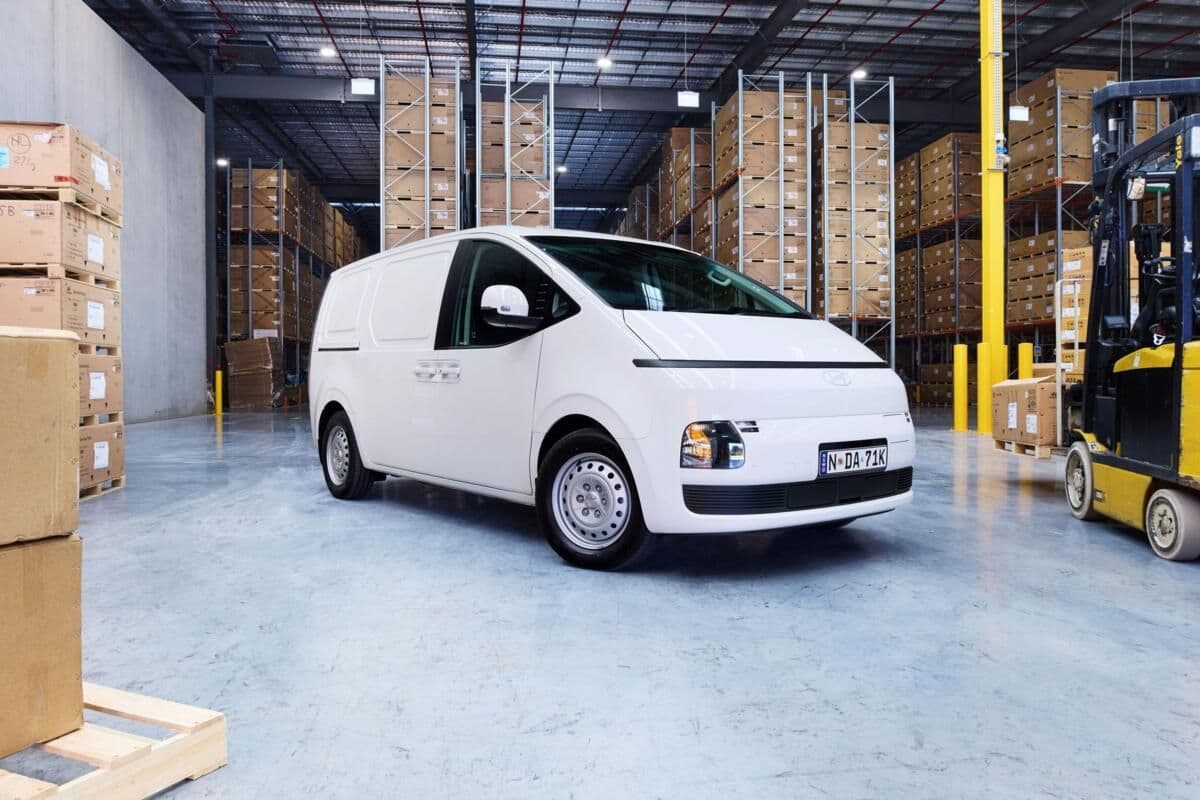
The Electric keeps the Staria Load's one-curve body shape but adds several EV-specific details. A smooth closed panel replaces the grille at the front to improve aerodynamics, and it houses the charge port. The horizon light garnish carries over from the rest of the 2027 range.
Undercovers beneath the front section and rear floor manage airflow under the van to reduce drag. Vertical tail-lights sit at the rear, and both Liftback and Twin Swing versions wear an 'Electric' badge.
The Staria Load Electric rides on 17-inch steel wheels. It is offered in Creamy White or Shimmering Silver.
Interior and ride
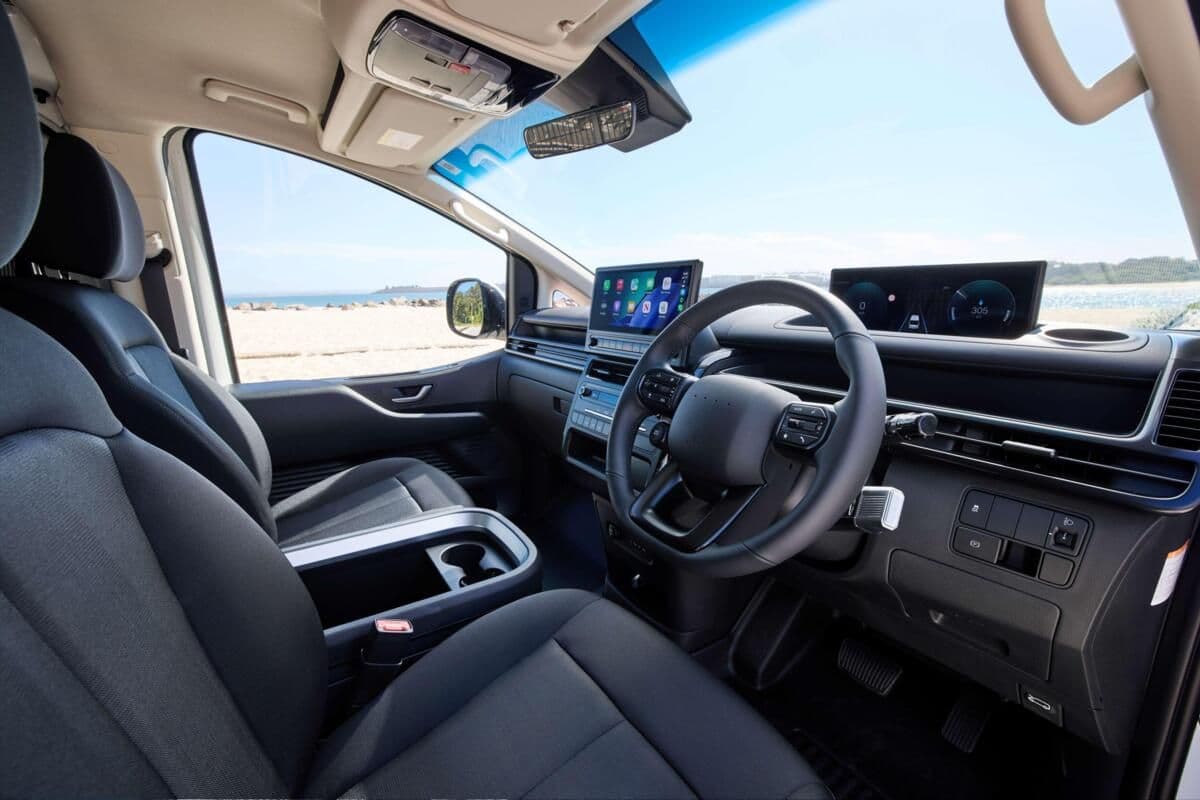
The cabin uses the updated two-seat layout and open centre console introduced on the 2027 Staria Load. Obsidian Black cloth upholstery is standard.
EV-specific changes include a column-mounted Shift-by-Wire selector, which changes drive mode with a forward or backward twist of the stalk. A 23.9-litre front boot (frunk) adds extra storage. Standard equipment also includes a battery heating system and a 12.3-inch digital instrument cluster, in place of the 4.2-inch cluster in the base diesel.
Hyundai has fitted Rack-mounted Motor Driven Power Steering (R-MDPS), which applies assistance directly to the steering rack rather than the column. Strut-mounted dynamic dampers reduce road-induced booming, and sound-absorbing tyres cut tyre noise.
Safety equipment
The Staria Load Electric has seven airbags and Hyundai SmartSense driver assistance. It adds Lane Following Assist 2, a second-generation system that gives more steering help to keep the van centred in its lane.
Key SmartSense features include:
- Forward Collision-Avoidance Assist 1.5
- Blind-Spot Collision-Avoidance Assist (Rear)
- Rear Cross-Traffic Collision-Avoidance Assist
- Lane Keeping Assist
- Lane Following Assist 2
- Intelligent Speed Limit Assist
- Manual Speed Limit Assist
- Smart Cruise Control 2 with Stop & Go
- Front and rear Parking Distance Warning
- Tyre Pressure Monitoring System
Multimedia, Bluelink and over-the-air updates
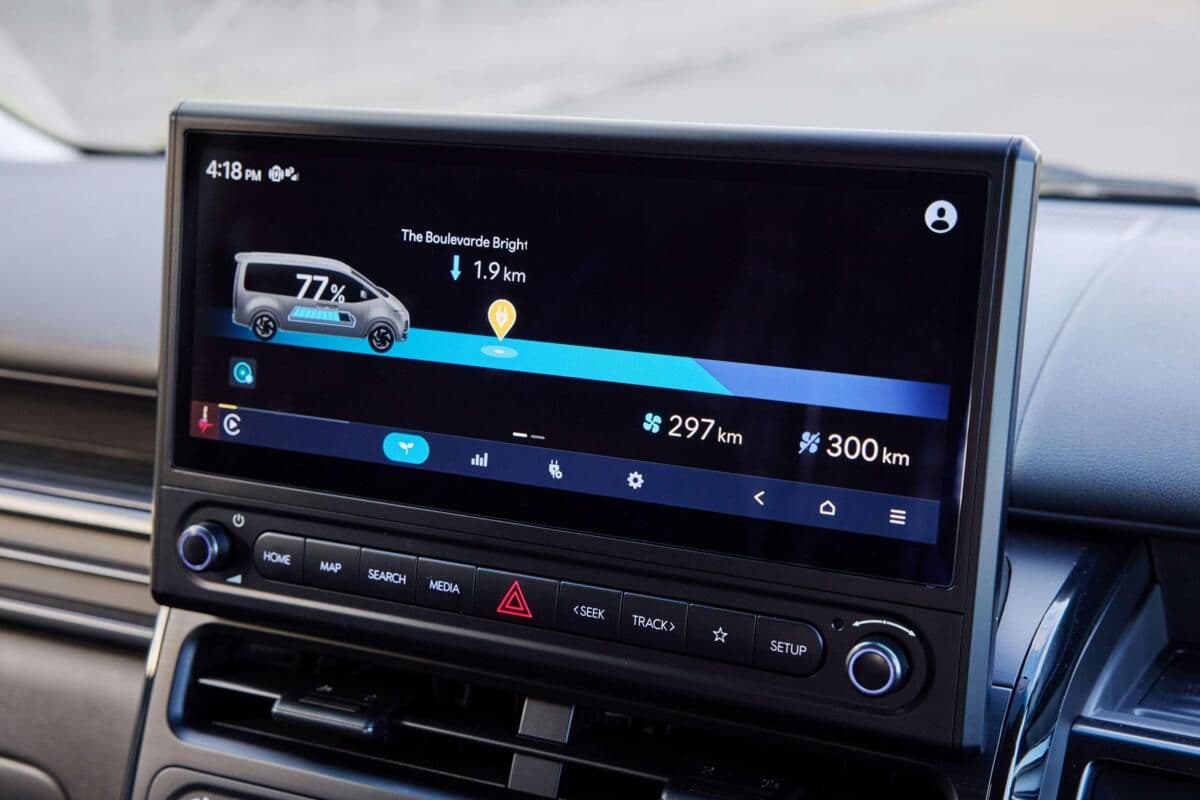
The Electric uses Hyundai's Connected Car Navigation Cockpit (ccNC). It pairs a 12.3-inch multimedia touchscreen with a 12.3-inch instrument cluster and built-in satellite navigation. The system supports over-the-air (OTA) updates for a range of vehicle systems, including safety, braking, performance and driver assistance software.
Bluelink connected car services are free for the first five years of ownership. The subscription transfers to a new owner within that five-year period. Bluelink features include:
- Navigation send-to-car
- Automatic Collision Notification
- Find my Car
- Emergency Call (SOS)
- Live weather information
- Connected Routing with live traffic
- Vehicle diagnostics and vehicle status
- Geo-fencing, valet, speed and time alerts
- Voice recognition for points of interest and vehicle controls
- Remote climate and vehicle function control
Servicing and warranty
The Staria Load Electric has a service interval of 24 months or 30,000km. Hyundai has published the following capped-price service costs.
Staria Load Electric service pricing
Service | Interval | Cost (incl. GST) |
First service | 24 months / 30,000km | $686 |
Second service | 48 months / 60,000km | $708 |
Hyundai's myHyundaiCare program includes Lifetime Premium Roadside Support and sat-nav updates when the vehicle is serviced by Hyundai. The high-voltage battery is covered for eight years or 160,000km.
Hyundai advertises a seven-year, unlimited-kilometre warranty. This is made up of a five-year standard warranty plus up to two extra years when all servicing is done at Hyundai. However, Hyundai's warranty terms exclude vehicles used for "commercial application". Buyers should confirm with Hyundai which warranty terms apply to the Staria Load Electric.

About the author

Danny is a consultant and entrepreneur working at the cutting edge of the electric vehicle and energy transition. He is passionate about educating and helping consumers make better decisions through data.
