
Key Points
- EV batteries can retain more than 90% health at 150,000km.
- Battery degradation varies significantly between models and individual cars.
- Independent testing could help Australian used EV buyers.
A major analysis of more than 500,000 independent EV battery tests has found most electric car batteries retain a surprisingly high level of capacity at 150,000km, although performance varies significantly between models and individual vehicles.
Concerns about battery degradation have long been one of the biggest questions around buying a used electric vehicle. But new data from Austrian battery diagnostics company Aviloo suggests those fears may be overstated.
The company analysed more than 500,000 independent battery health tests conducted between 2022 and 2026, covering 20 popular EV models around the world, including Australia.
The wider Aviloo database now contains more than one million battery tests across Europe, Asia, Australia, North America and South America.
The results show that EV batteries generally retain between 87% and 94% of their original usable capacity at 150,000km, depending on the model.
But there is an important catch. The average battery health for a model does not necessarily tell you how a particular used EV has aged.

EV batteries are ageing better than expected
Aviloo measures battery State of Health (SoH), which represents the percentage of a battery's original usable capacity that remains.
A battery showing 95% SoH, for example, retains roughly 95% of its original range capability.
The study measured median SoH at three mileage points: 50,000km, 100,000km and 150,000km.
The results reveal three broad trends.
Battery health generally falls as kilometres increase, the difference between individual cars becomes wider at higher mileages, and some models consistently retain more capacity than others.
Importantly, degradation does not always happen at a steady rate.
The Tesla Model 3, for example, experienced much of its decline during the first 50,000km before the rate of degradation levelled out. The Hyundai Ioniq 5 went in the other direction, recording a median SoH of 97.13% at 50,000km before being overtaken by the Mercedes EQA and BMW i4 at higher mileage.
That means simply looking at the odometer is not enough to determine how much battery capacity remains.
▶️MORE: How Long Do Electric Car Batteries Last?
The Best And Worst EV Batteries
There are significant differences between the 20 models included in Aviloo's analysis.
The Mercedes EQA was the strongest performer at 150,000km, retaining 94% battery health, followed closely by the Hyundai Ioniq 5 and BMW i4.
At the other end, the Nissan Leaf recorded 86.7%, with the Mini Cooper SE and Renault Zoe also towards the bottom of the ranking.
The Tesla Model Y performed better than the Model 3, although both sat below several of the strongest
EV battery State of Health by model
Rank | EV model | SoH at 50,000km | SoH at 150,000km |
1 | Mercedes EQA | 96.6% | 94.0% |
2 | Hyundai Ioniq 5 | 97.1% | 93.8% |
3 | BMW i4 | Not specified | 93.6% |
4 | Hyundai Kona Electric | 96.3% | Not specified |
5 | Volvo XC40 Recharge | Not specified | Not specified |
6 | Tesla Model Y | 94.5% | 90.3% |
7 | Tesla Model 3 | Not specified | 88.9% |
8 | Renault Zoe | Not specified | 87.3% |
9 | Mini Cooper SE | Not specified | 87.1% |
10 | Nissan Leaf | 91.2% | 86.7% |
(Aviloo did not provide 50,000km figures for every model in the supplied data, so those entries are marked as not specified)
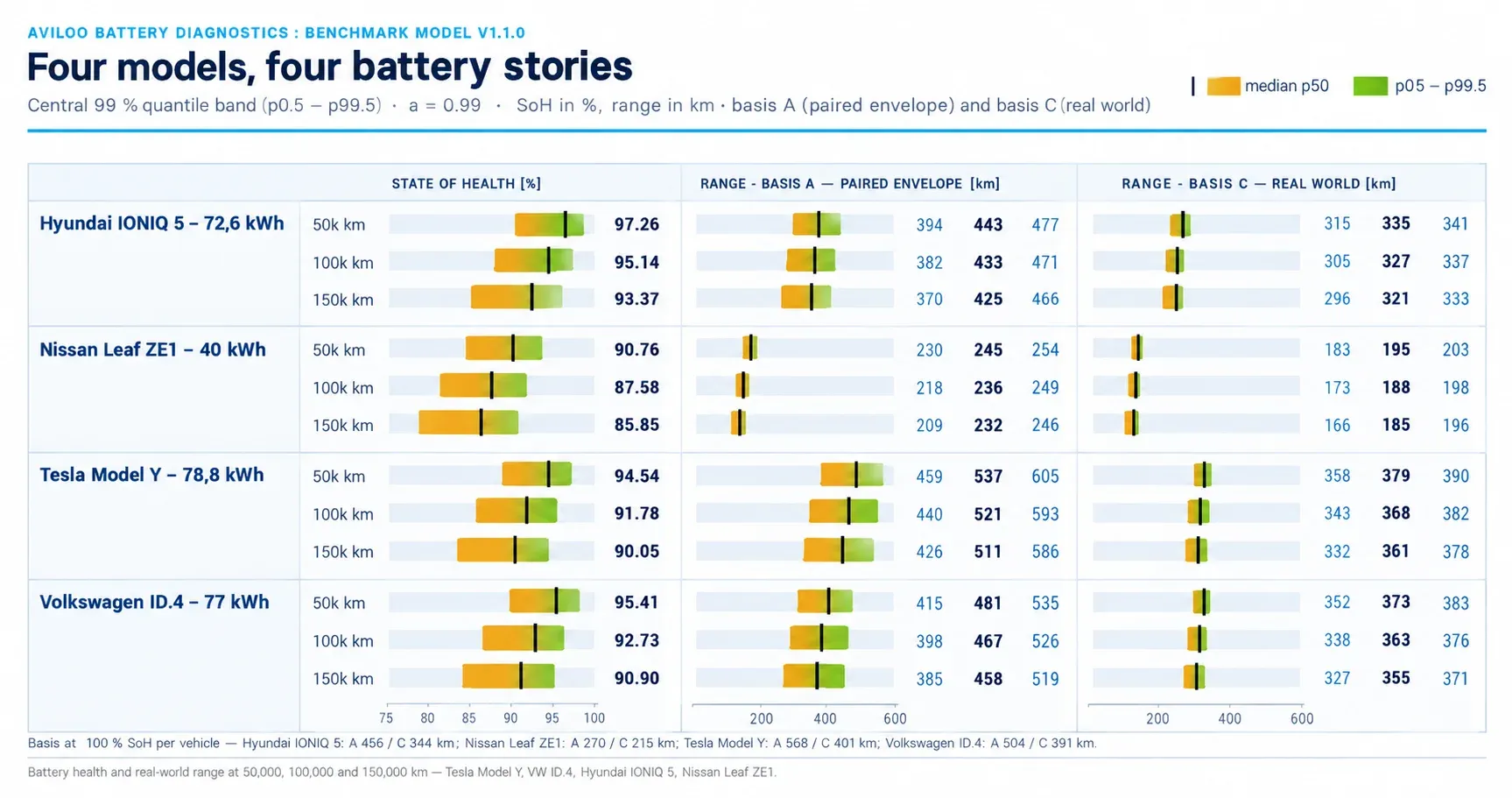
The newer Aviloo dataset also provides a useful comparison between four EVs. At 150,000km, the Model Y had a median SoH of 90.3%, compared with 90.6% for the Volkswagen ID.4, 92.8% for the Ioniq 5 and 86.3% for the Nissan Leaf.
The Leaf's result needs some context. Its 40kWh battery is significantly smaller than the packs in the other vehicles, meaning its remaining range is much lower even when the percentage of capacity retained is relatively high.
At 150,000km, Aviloo estimates the Leaf's median real world range at around 185km, compared with about 362km for the Model Y, 354km for the ID.4 and 319km for the Ioniq 5.

Same EV, very different battery health
Perhaps the most important finding for used car buyers is not which model came first.
It is how much battery health can differ between individual examples of the same model.
Aviloo found differences of roughly 10 to 15 percentage points between individual vehicles in some cases. For the Model Y, the variation across the tested mileage range was up to 11 percentage points, equivalent to around 46km of real world range.
The Leaf showed an even wider variation, reaching 13.5 percentage points at 150,000km.
That can have a meaningful impact on how useful a used EV is.
▶️MORE: What are LFP, NMC, NCA Batteries in Electric Cars?
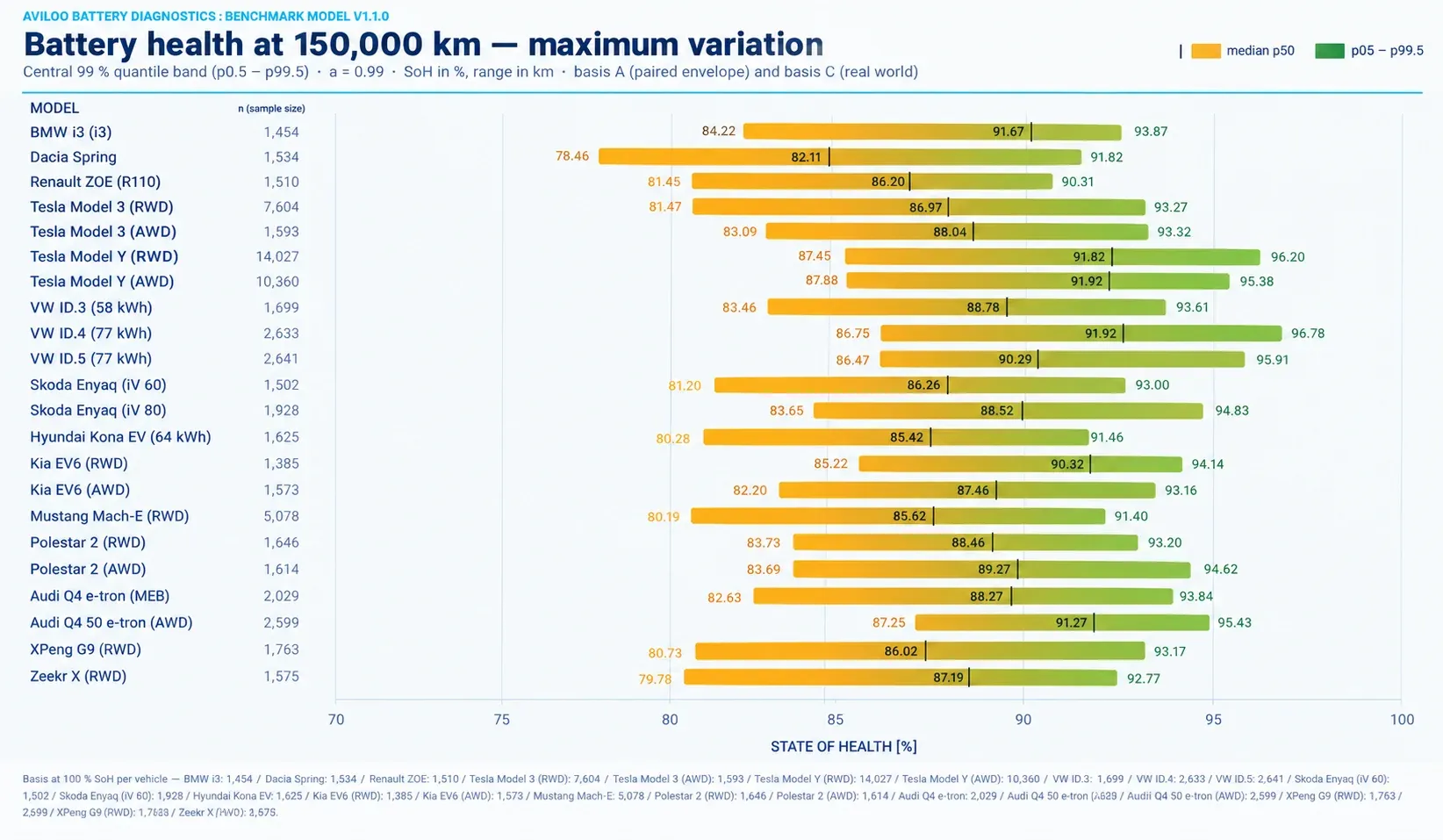
A car with significantly poorer battery health could require an additional charging stop on a longer trip compared with another example of exactly the same model and similar age.
It could also affect resale value.
The study found that charging behaviour can play a role in battery ageing, with smaller battery packs potentially requiring more frequent charging and showing comparatively poorer results.
This is why a model's average battery health should be treated as a guide rather than a guarantee.

Why battery testing matters for used EVs
For years, used car buyers have relied heavily on kilometres travelled, service history and vehicle condition when assessing a second hand petrol or diesel car.
EV buyers have another major component to consider: the traction battery.
A dashboard battery health reading can provide useful information, but an independent test can offer a different level of assessment.
Aviloo's Flash Test is performed through the vehicle's OBD port and takes around three minutes. The company says its assessment uses a statistical model trained on hundreds of thousands of used EVs, considering factors including mileage, vehicle age, charge cycles, cell voltage differences and other diagnostic information.
That matters because two cars with similar odometer readings could have very different battery conditions.
For a buyer considering a used EV, an independent battery health report could therefore become as useful as a mechanical inspection or service history.
Aviloo CEO Marcus Berger said the key lesson from the data is that averages can hide significant differences between individual vehicles.
A 10% or 15% difference in SoH is not simply a number on a report. It can translate into a meaningful difference in range and potentially the vehicle's value.
▶️MORE: EV Battery Life: New Data Challenges Long-Held Concerns
What this means for Australia
The findings are particularly relevant as Australia's used EV market continues to develop.
Aviloo's database includes vehicles tested in Australia and New Zealand, alongside cars from Europe, Asia and the Americas. That provides a broader picture than a study based on a single climate or market.
Climate is also an important consideration.
Temperature can influence battery degradation and charging behaviour, meaning battery performance cannot be judged solely by kilometres travelled. Australia's wide range of climates makes real world battery testing particularly useful when assessing an individual vehicle.
For Australian buyers, the study delivers two messages.
First, there is encouraging news: modern EV batteries appear to be ageing considerably better than the worst battery degradation fears suggest.
Second, buyers should not assume every used EV will perform the same way.
As more early generation EVs enter Australia's second hand market, an independent battery health check could help buyers distinguish between a well preserved battery and one that has experienced significantly greater degradation.
That could give consumers more confidence to buy used EVs while also creating a clearer way for dealers, fleets, lenders and private sellers to establish the value of the battery itself.

