Key Points
- The UK’s largest EV battery study analysed over 8,000 vehicles across 36 brands.
- Average battery health sits at 95.15% across all ages.
- 8–9-year-old EVs still retain a median 85% capacity.
- High mileage alone is not a reliable predictor of battery degradation.
- Greater battery transparency could strengthen used EV confidence in Australia.
For years, one question has hovered over the used electric vehicle market: what happens to the battery?
A major new study suggests the concern may be overstated.
The 2025 Battery Performance Index from UK-based diagnostics specialist Generational analysed more than 8,000 battery health assessments conducted in 2025, spanning 36 manufacturers and vehicles aged between zero and 12 years.
Its conclusion is clear: battery degradation is not the systemic risk it was once assumed to be.
Instead, uncertainty around battery condition — not underlying durability — is emerging as the key factor shaping used EV values.
▶️MORE:How Long Do Electric Car Batteries Last?
Battery degradation is not the systemic risk
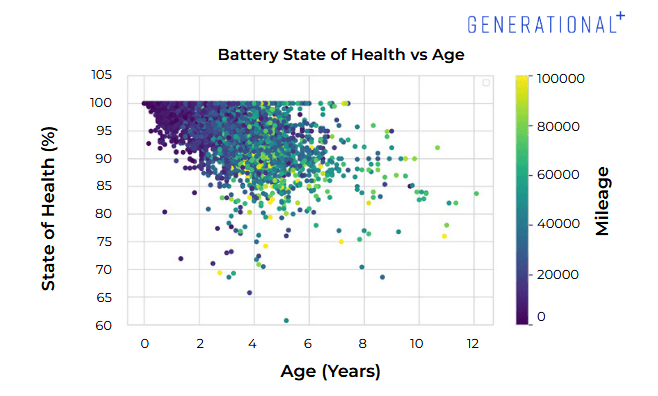
Across the full dataset, the average battery State of Health (SoH) sat at 95.15 per cent compared to new.
Even vehicles between eight and nine years old retained a median 85 per cent of original capacity. That is comfortably above the 70 per cent minimum threshold typically guaranteed by manufacturers for eight years or 100,000 miles (around 160,000km).
High-mileage vehicles also performed strongly. EVs with more than 100,000 miles frequently returned battery health readings between 88 and 95 per cent.
In practical terms, that suggests most EV batteries are likely to outlast the usable life of the vehicle itself — a finding that directly challenges lingering consumer scepticism.
Generational’s data indicates that while a small proportion of vehicles do fall outside warranty parameters, the vast majority exceed them with margin to spare.
▶️MORE: What are LFP, NMC, NCA Batteries in Electric Cars?

How healthy are used EV batteries really?
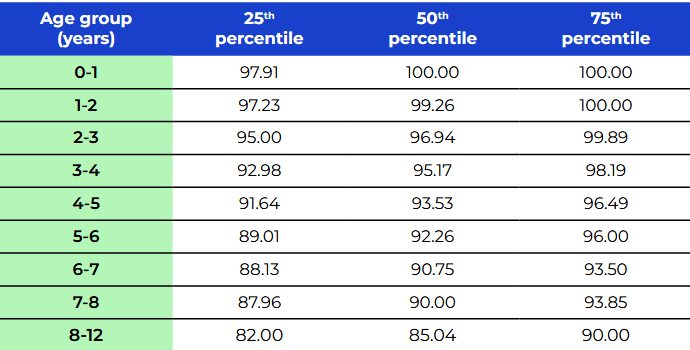
The study’s percentile benchmarking offers a clearer picture of what buyers can expect.
Among four- to five-year-old EVs:
- The median battery health is 93.53 per cent.
- Even the lower 25th percentile sits at 91.64 per cent.
- The top-performing quarter reach 96.49 per cent.
For older vehicles aged eight to 12 years:
- The 25th percentile averages 82 per cent.
- The median sits at 85.04 per cent.
- The 75th percentile retains 90 per cent capacity.
The key shift is not collapsing averages — it is widening variance.
As vehicles age, the performance gap between the best and worst examples increases. Well-maintained cars continue to perform strongly, while underperformers drift further from the median.
This growing dispersion is reshaping how risk should be assessed in the used EV market.
▶️MORE: EV Battery Life: New Data Challenges Long-Held Concerns
Age and mileage are no longer reliable shortcuts
One of the most significant findings is that age and odometer readings alone are becoming poor proxies for battery condition.
In some cases, a three-year-old fleet vehicle with 90,000 miles can present a stronger battery proposition than a six-year-old car with 30,000 miles, depending on usage patterns and charging behaviour.
That undermines traditional valuation models inherited from the internal combustion era, where mileage was a primary indicator of mechanical wear.
For EVs, battery condition — verified through testing — is emerging as the defining determinant of long-term value, performance and risk.
In other words, what matters is not how far the vehicle has travelled, but how the battery has been treated.
📏 Electric Car Range: Everything You Need to Know
▶️ Best EV Charging Networks in Australia
What does this mean for used EV buyers?
For consumers, the message is broadly reassuring.
Most used EVs are retaining significantly more capacity than many buyers might expect. Even cars approaching the end of their factory battery warranty periods are, on average, well above minimum coverage thresholds.
However, the study underscores that transparency is critical.
Where battery condition is opaque, worst-case assumptions can dominate pricing decisions. Without verified data, buyers and dealers may undervalue strong-performing vehicles or overestimate risk.
Battery health reporting is therefore moving from a “nice-to-have” to an expected part of the buying process — similar to service history or mileage verification.
As Vehicle Remarketing Association chair Philip Nothard notes, buyer confidence hinges on trust that the most expensive component in an EV will not deliver unpleasant surprises.
What could this mean for Australia’s EV market?
Although the study focuses on UK vehicles, the implications for Australia are clear.
Australia’s used EV sector is still developing, and concerns about long-term battery degradation continue to influence resale values and buyer confidence. If similar durability trends hold locally, it could materially strengthen residual values — a key factor in lease pricing, novated finance and fleet total cost of ownership.
As more off-lease EVs enter the Australian market over the next few years, verified battery condition reporting could become essential infrastructure rather than a premium add-on.
Greater transparency would likely:
- Reduce uncertainty-driven price discounts
- Support stronger finance residuals
- Improve fleet remarketing outcomes
- Accelerate mainstream EV adoption
The larger shift is psychological.
If battery degradation is no longer the central risk, the conversation moves to data transparency and condition verification. And that evolution could play a pivotal role in normalising EV ownership in Australia’s second-hand market.
