
Key Points
- The Tesla Model Y RWD starts at $58,900 before on-road costs, $3,910 more than the BYD Sealion 7 Premium at $54,990
- The Sealion 7 Premium offers more range at 482km WLTP versus the Model Y RWD's 466km, helped by a larger battery.
- Year to date in 2026, the Model Y leads the segment with 12,324 sales against the Sealion 7's 7,786.
The Tesla Model Y RWD and BYD Sealion 7 Premium are the two best-selling electric cars in Australia in 2026, and the two biggest sellers in the medium SUV segment. Both are mid-size electric SUVs aimed squarely at the same buyer: a single-motor base variant under $60,000 with enough range and space for family use.
The Model Y has held the sales lead in the segment for three years running. The Sealion 7 has closed in fast since its February 2025 launch, and YTD sales data through May 2026 shows the gap narrowing further.
Model | Jan | Feb | Mar | Apr | May | YTD 2026 |
Tesla Model Y | 288 | 2,791 | 2,818 | 822 | 5,605 | 12,324 |
BYD Sealion 7 Premium | 1,171 | 1,327 | 1,970 | 1,780 | 1,538 | 7,786 |
Editor's note: pricing, specifications and offers for both models are subject to change. Figures below reflect Zecar's EV database and manufacturer-published specs as of June 2026.
Pricing
Both cars are sold in a single base variant locally. The Sealion 7 Premium undercuts the Model Y RWD by $3,910 before on-road costs.
Variant | Price (before on-road costs) | Drive type |
Tesla Model Y RWD | $58,900 | Rear |
BYD Sealion 7 Premium | $54,990 | Rear |
Stepping up the range, Tesla's Performance AWD jumps to $89,400, a $30,500 premium over the RWD. BYD's Sealion 7 Performance AWD is a smaller step up at $63,990, just $9,000 more than the Premium. Both cars qualify for the federal fringe benefits tax exemption on novated leases.
Get a novated lease quote
Dimensions and Size
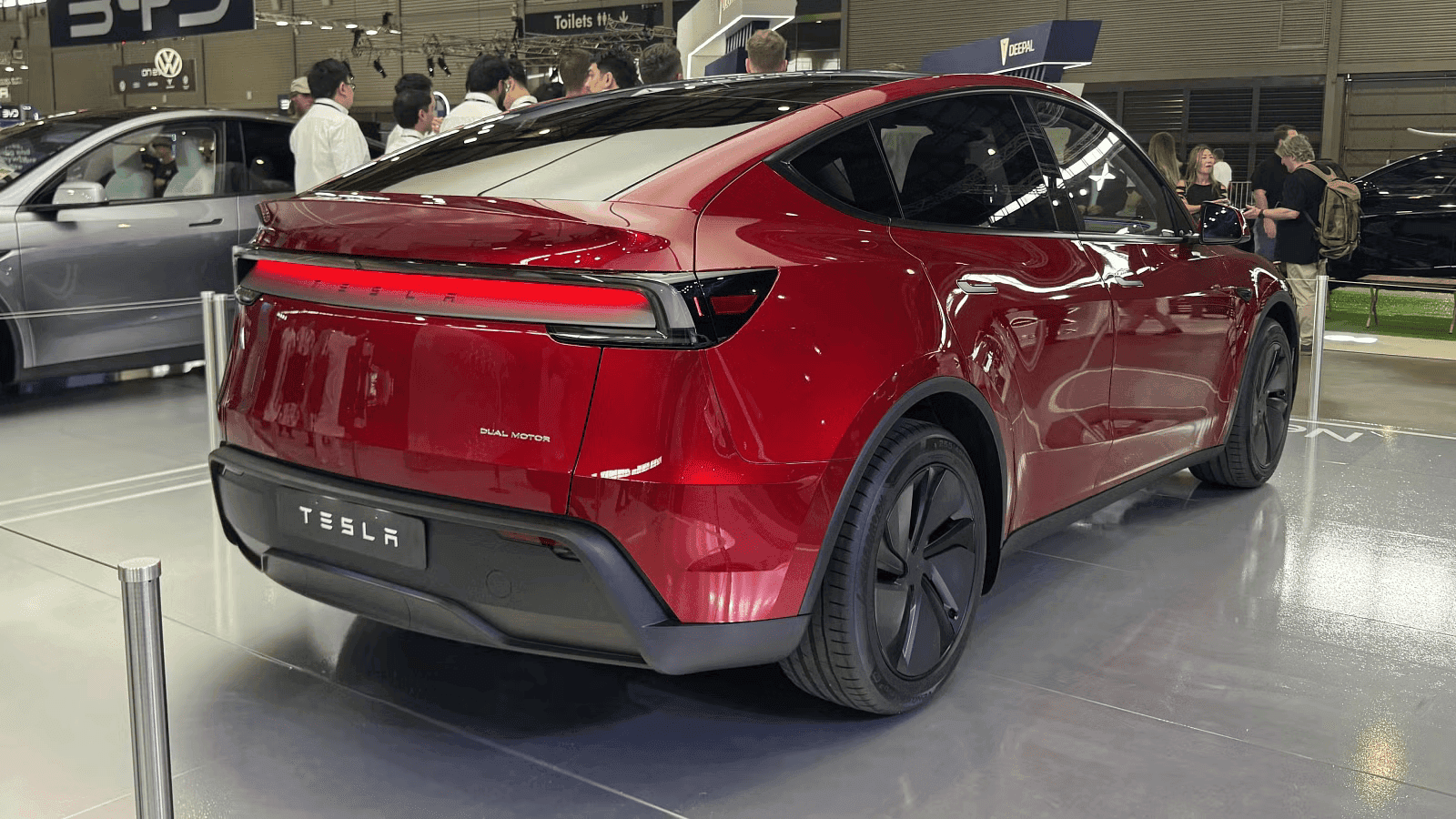
The Sealion 7 is longer and wider than the Model Y, while the Model Y rides on a longer wheelbase and offers more ground clearance. Kerb weight favours the Model Y by a wide margin.
Dimension | Tesla Model Y RWD | BYD Sealion 7 Premium | Difference |
Length | 4,790mm | 4,830mm | Sealion 7 +40mm longer |
Width | 1,982mm | 1,925mm | Model Y +57mm wider |
Height | 1,624mm | 1,620mm | Model Y +4mm taller |
Wheelbase | 2,890mm | 2,930mm | Sealion 7 +40mm longer |
Ground clearance | 167mm | 165mm | Model Y +2mm |
Turning circle | 12.0m | 12.4m | Model Y 0.4m tighter |
Kerb weight | 2,003kg | 2,225kg | Model Y 222kg lighter |
Boot capacity (std/max) | 854L / 2,138L | 500L / 1,358L | Model Y +354L standard |
Frunk capacity | 117L | 58L | Model Y +59L |
The Sealion 7's body is classified as a SUV Coupe with a sloping roofline, which costs it boot space against the Model Y's more conventional SUV shape. The Model Y's 222kg weight advantage is notable given the Sealion 7 carries a larger battery, and it likely reflects Tesla's dedicated EV platform versus the heavier overall packaging of BYD's e-platform 3.0 in this application.
Range and Performance
The Sealion 7 Premium claims more range than the Model Y RWD, helped by a substantially larger battery. The Model Y is quicker off the line despite less power, partly thanks to its lighter weight.
Spec | Tesla Model Y RWD | BYD Sealion 7 Premium |
WLTP range | 466km | 482km |
Usable battery | 60kWh | 82.5kWh |
Efficiency (WLTP) | 129Wh/km | 171Wh/km |
0-100km/h | 5.9 seconds | 6.7 seconds |
Top speed | 201km/h | 180km/h |
Power | 220kW | 230kW |
Torque | 420Nm | 380Nm |
Towing capacity (unbraked/braked) | 750kg / 1,600kg | 750kg / 1,400kg |
The Sealion 7's 16km range advantageis due to carrying a 22.5kWh larger battery. The Model Y is the significantly more efficient car of the two at 129Wh/km against the Sealion 7's 171Wh/km.
Acceleration favours the Model Y by 0.8 seconds to 100km/h, helped by its 222kg weight advantage despite near-identical power outputs. The Model Y also tows 200kg more on its braked rating.

Battery and Charging
Both cars use LFP battery chemistry. The Sealion 7 charges faster on AC, but the Model Y has the faster maximum DC rate on paper, though real-world charging on Australia's public network typically falls well short of either car's peak figure.
Spec | Tesla Model Y RWD | BYD Sealion 7 Premium |
Usable battery capacity | 60kWh | 82.5kWh |
Chemistry | LFP | LFP (Blade Battery) |
Max AC charging power | 11kW | 11kW |
AC charge time (0-100%) | 7 hours | 8 hours 18 minutes |
Max DC charging power | 175kW | 150kW |
DC charge time (10-80%, approx) | ~27 minutes | ~31 minutes |
Bidirectional charging | Not offered | V2L only |
Bidirectional power output | - | 6.6kW |
Despite the Model Y's higher peak DC figure, the Sealion 7 charges its much larger battery in a similar window thanks to a favourable charging curve. Neither car supports vehicle-to-home or vehicle-to-grid in Australia. The Sealion 7 offers vehicle-to-load as standard at 6.6kW, enough to run power tools, camping gear or appliances during an outage. The Model Y RWD does not offer V2L, a notable gap against BYD's standard feature, though the larger Model Y L variant does support it.

Driver Technology and Infotainment
Both cars carry a five-star ANCAP safety rating and come standard with a comparable suite of Level 2 driver assistance features.
Standard on both:
- Autonomous emergency braking (AEB)
- Adaptive cruise control
- Lane keep assist and lane departure warning
- Blind spot monitoring and rear cross-traffic alert
- 360-degree camera system
The Model Y relies entirely on camera-based Autopilot and does not support Apple CarPlay or Android Auto in any variant. The Sealion 7 uses a more conventional radar and camera array and supports wireless Apple CarPlay and Android Auto, a point of difference buyers used to smartphone integration will notice immediately.
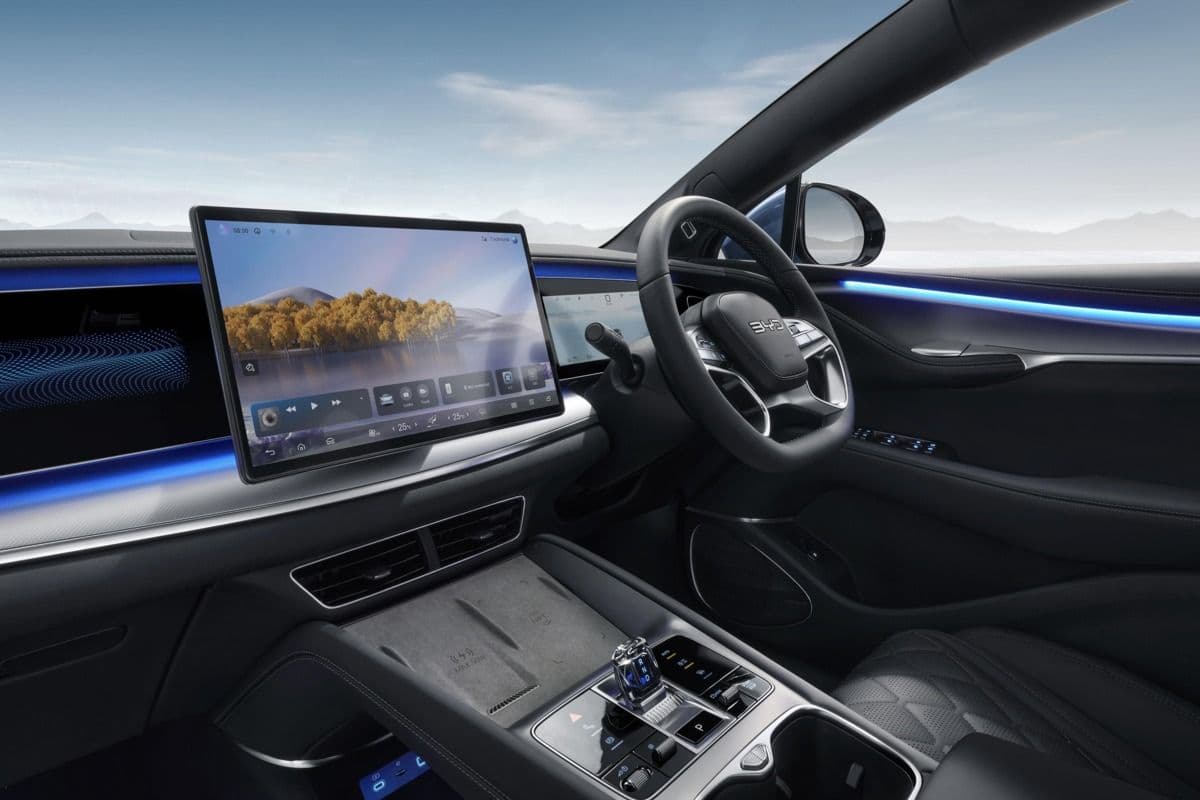
On infotainment, the Model Y centres its cabin entirely around a single 15.4-inch central touchscreen with no separate instrument display, reflecting Tesla's minimalist design philosophy. The Sealion 7 Premium pairs a 15.6-inch rotating central touchscreen with a separate 10.25-inch digital instrument cluster and a head-up display, giving the driver more conventional sightlines.
Both include wireless phone charging and a companion smartphone app for remote lock, climate control and charge monitoring. Tesla's software update cadence is more frequent, and its built-in app ecosystem (streaming, games, navigation with live Supercharger occupancy) is more developed than BYD's offering. The Sealion 7's advantage is CarPlay and Android Auto support, which the Model Y lacks entirely.
![BYD Sealion 7 Premium rotating touchscreen and digital instrument cluster"]](/_next/image?url=https%3A%2F%2Fcdn.sanity.io%2Fimages%2Fo5m1ex7g%2Fproduction%2Fb5aeaa33f716d336788f6ebbf08f1c71ffa8834d-1200x800.jpg&w=2048&q=75 "BYD Sealion 7 Premium rotating touchscreen and digital instrument cluster\"]")
Other Features
Outside the core spec sheet, each car has features the other does not offer.
Exclusive to the Tesla Model Y RWD:
- 117L frunk in addition to a 854L rear boot
- Access to the Tesla Supercharger network across Australia
- Lighter kerb weight (2,003kg vs 2,225kg), which benefits efficiency and handling
- Higher peak DC charging rate on paper (175kW vs 150kW)
Exclusive to the BYD Sealion 7 Premium:
- Standard Apple CarPlay and Android Auto
- Vehicle-to-load (V2L) as standard, rated to 6.6kW
- Longer claimed WLTP range (482km vs 466km)
- Lower entry price by $3,910 before on-road costs
Warranty and Servicing
Tesla and BYD take different approaches to coverage. BYD offers a longer term on the core vehicle warranty, while both back their batteries for the same eight years.
Spec | Tesla Model Y RWD | BYD Sealion 7 Premium |
Vehicle warranty | 5 years / Unlimited km | 6 years / 150,000km |
Battery warranty | 8 years / 160,000km | 8 years / 160,000km |
Service interval | Condition-based, no fixed schedule | 12 months / 20,000km |
BYD's 150,000km cap is less than Tesla's unlimited limit which only applies for private use. Commercial use is limited to 150,000km.
Tesla's condition-based servicing means will automatically flag issues like brake fluid checks or cabin filter replacement as needed, rather than booking in at fixed intervals, and Zecar's own servicing data shows this keeps typical annual costs low at around $225 a year. BYD's Sealion 7 Premium carries capped-price servicing across 10 years, totalling $4,157 over that period, giving buyers a clearer upfront picture of long-term running costs.
Verdict
Both cars are closely matched on paper. The Sealion 7 Premium offers more range, a cheaper entry price, standard CarPlay and Android Auto, and standard V2L. The Model Y RWD counters with a lighter kerb weight, a larger frunk, a higher peak DC charging rate and access to the Tesla Supercharger network.
Buyers prioritising outright specs and smartphone integration will find a stronger case in the Sealion 7 Premium. Buyers who want Tesla's charging network and software ecosystem will likely stick with the Model Y despite the higher price and shorter range.
Sales data suggests Australian buyers are still leaning toward the Model Y overall, though the Sealion 7's growth rate is the more interesting trend to watch through the rest of 2026.
Get a novated lease quote
About the author

Danny is a consultant and entrepreneur working at the cutting edge of the electric vehicle and energy transition. He is passionate about educating and helping consumers make better decisions through data.
