


Key Points
- Ford has revealed the all-electric Transit City van for Australia and New Zealand, priced from a recommended $50,000 driveaway.
- The single-spec van uses a 56kWh LFP battery for up to 254km of WLTP combined range or up to 380km of WLTP city range, with 87kW DC fast charging.
- Transit City carries up to 1,085kg payload and 6.4 cubic metres of cargo space, with first deliveries expected from November 2026.
Ford Australia and New Zealand has revealed the Transit City, a fully electric van built specifically for inner-city delivery and trade work. It goes on sale as a single, well-equipped specification, with Ford saying that approach cuts ordering complexity and keeps the total cost of ownership down for fleet buyers.
The Transit City is priced from a recommended $50,000 driveaway, with first customer deliveries expected to start in November 2026. It joins a growing field of electric vans built for Australian cities, including the LDV eDeliver 5 and the Farizon V7E.
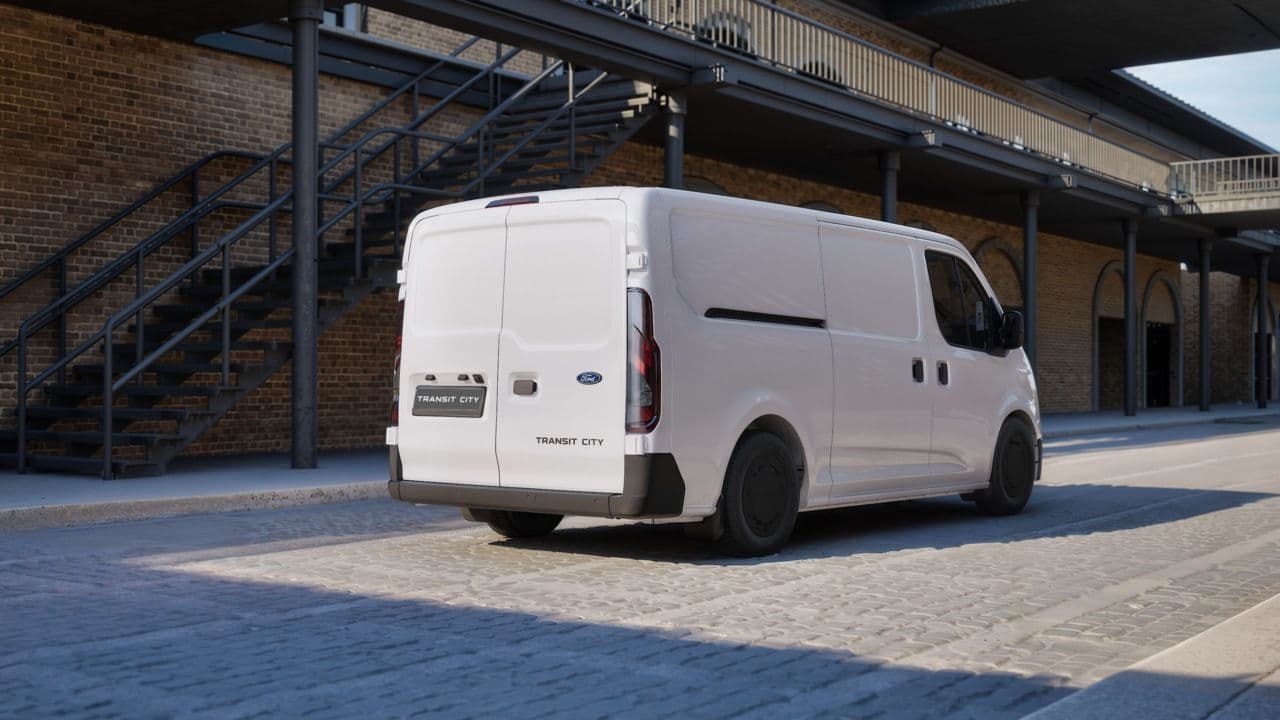
Built for narrow streets and heavy daily use
Ford designed the Transit City around dense metropolitan driving: narrow city streets, laneways and tight loading bays. Despite its compact footprint, the van has a 6.4 cubic metre load compartment that Ford says fits three Euro pallets, and a maximum payload of up to 1,085kg.
Every Transit City comes standard with commercial-grade protection, including a full-surface load liner, half-height protective side trim and tie-down lashing points. Ford says the van has been through its global durability testing regime, simulating 10 years of commercial use and more than 200,000 door-slam cycles in extreme climate chambers.
To settle on the battery size, Ford engineers analysed telematics data from more than 2,312 Transit Custom vans operating in Australia between November 2024 and July 2026. That data showed typical urban daily trips average 76km, with 90 per cent of daily routes covering 200km or less.
Battery, range and charging
The Transit City runs a 56kWh Lithium Iron Phosphate (LFP) battery paired with a single 110kW front-wheel-drive electric motor. Ford chose LFP chemistry for its thermal durability, long cycle life and resistance to degradation under frequent DC fast charging.
Ford rates the van at up to 254km of WLTP combined range, or up to 380km of WLTP city range, which is calculated using only the low and medium speed phases of the WLTP test cycle. Both figures are lab-tested and real-world range will vary with load, driving style and conditions.
DC fast charging peaks at 87kW, taking the battery from 10 to 80 per cent in about 33 minutes, or adding roughly 68km of range in 10 minutes. An 11kW AC charger takes the van from 10 to 100 per cent in around 5.5 hours, suited to overnight depot or home charging.
In addition to lower fuel savings, Ford says scheduled maintenance costs should come in lower than an equivalent diesel van, helped by 1-year/30,000km service intervals and the absence of a turbo, fuel injection system or multi-speed gearbox.
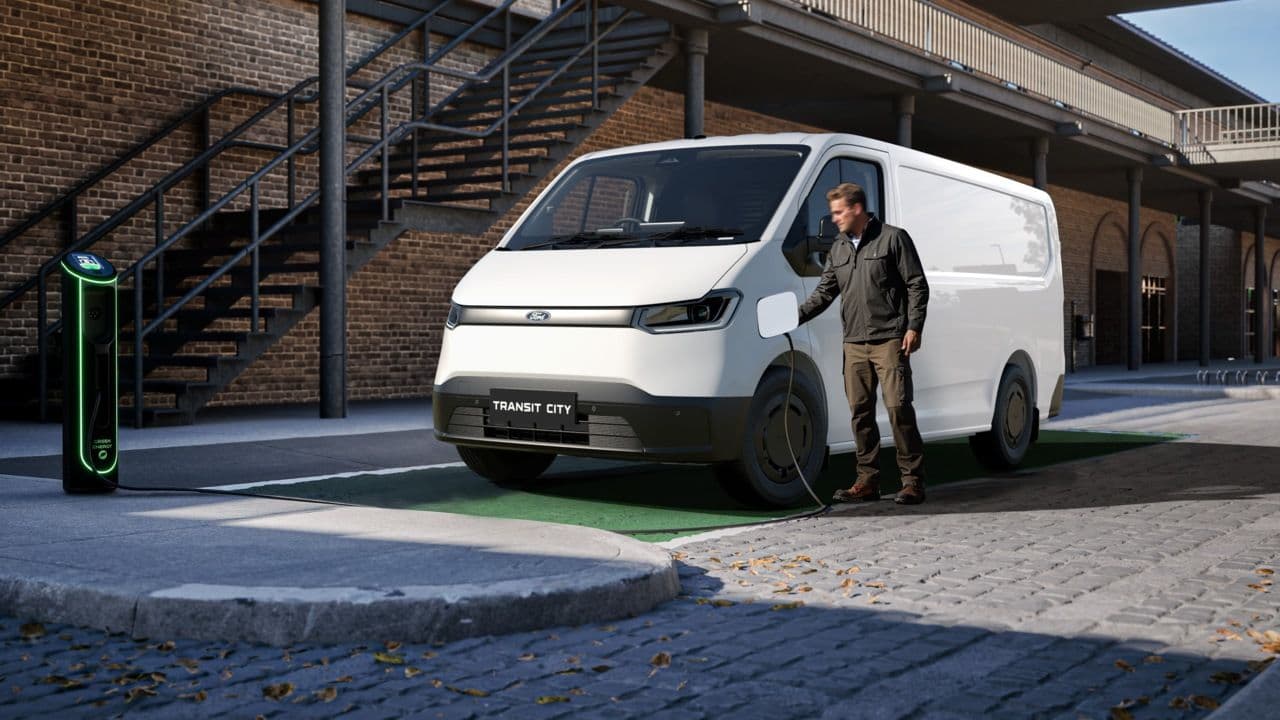
Ford Transit City specifications
Spec | Detail |
Powertrain | Single front-wheel-drive e-motor, 110kW |
Battery | 56kWh Lithium Iron Phosphate (LFP) |
WLTP range | Up to 254km combined / up to 380km city |
Max payload | Up to 1,085kg |
Cargo volume | 6.4 cubic metres (fits 3 Euro pallets) |
DC charging (10-80%) | Approx. 33 minutes at up to 87kW |
AC charging (10-100%) | Approx. 5.5 hours at 11kW |
Service interval | 1 year / 30,000km |
Vehicle warranty | Up to 7 years / unlimited km |
Battery warranty | 8 years / 160,000km |
Price | From $50,000 recommended driveaway |
Availability | Deliveries expected from November 2026 |
Cabin technology and safety
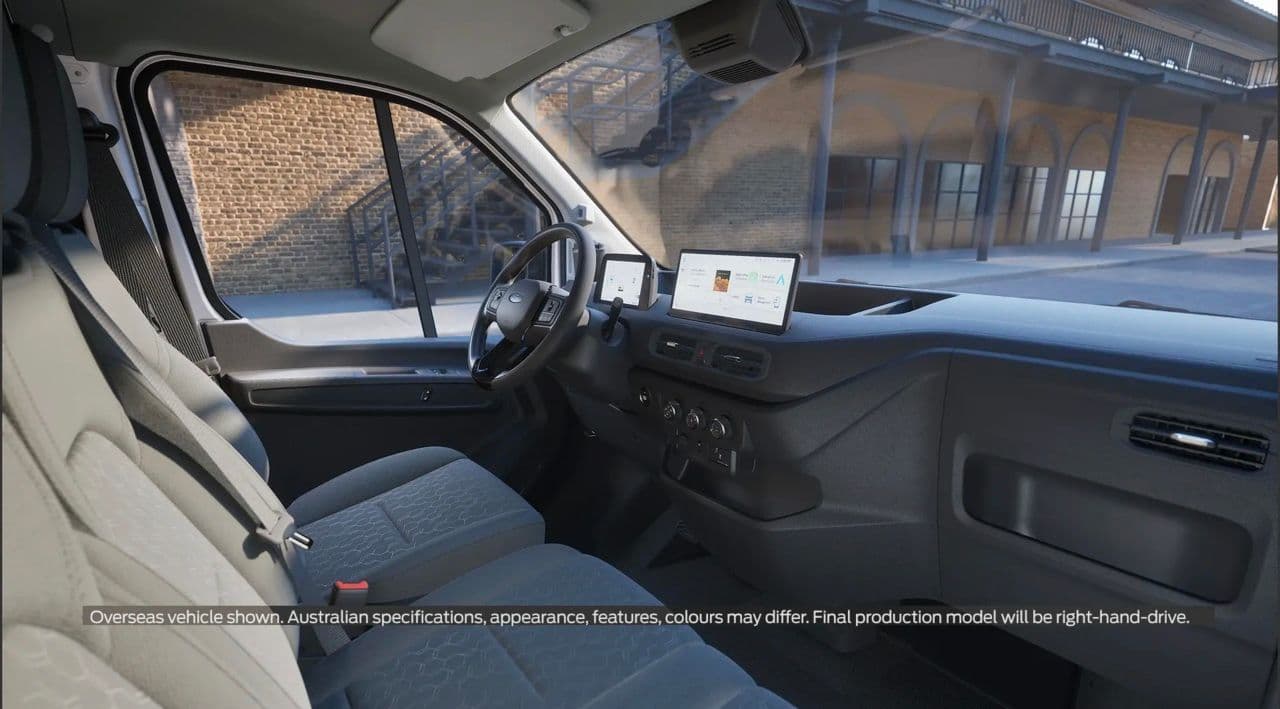
Inside, the Transit City is built around drivers who Ford says can get in and out of the van more than 200 times a shift.
A 12.3-inch touchscreen runs wireless Apple CarPlay and Android Auto. Standard driver assistance includes autonomous emergency braking, front and rear parking sensors, a rear-view camera with dynamic guidelines, adaptive cruise control with stop-and-go, and lane departure warning.
Price and availability
Transit City is priced from a recommended $50,000 driveaway in Australia. Ford has not yet detailed state-by-state variations or fleet pricing. First customer deliveries are expected to begin in November 2026.
The van carries Ford's 7-year, unlimited-kilometre conditional vehicle warranty for new and demonstrator vehicles delivered from 1 September 2026, plus an 8-year, 160,000km warranty on the high-voltage battery.
Get a novated lease quote
How it compares to other electric vans
The Transit City lands in a fast-growing field of sub-$55,000 electric vans built for Australian cities and fleets. The LDV eDeliver 5 and Farizon V7E are its closest rivals on price and size, though each takes a different approach to battery size, payload and cargo volume.
Electric van comparison
Van | Battery | WLTP range | Payload | Cargo volume | Price (driveaway) |
Ford Transit City | 56kWh LFP | 254km combined / 380km city | Up to 1,085kg | 6.4m³ | From $50,000 |
LDV eDeliver 5 (SWB low-roof) | 64kWh LFP | 335km | 1,200kg | 6.6m³ | From $47,990 (ABN) / $52,621 (private) |
Farizon V7E (Standard Range) | 50kWh LFP | 240km | 1,338kg | 6.95m³ | From $49,990 |
Farizon V7E (Extended Range) | 66kWh LFP | 329km | 1,208kg | 6.95m³ | From $53,990 |
On paper, the eDeliver 5 and V7E both undercut the Transit City on payload and cargo volume, and the eDeliver 5's SWB variant can be had slightly cheaper for ABN holders. The Transit City's advantage is its bigger 380km WLTP city range figure and Ford's dealer and service network, which matters for fleets that need support close to home.


Electric vs diesel: how the price stacks up
Australia's one-tonne van segment is dominated by diesel, not petrol, so there is no direct petrol equivalent to compare the Transit City against. Its closest combustion rivals are the diesel Ford Transit Custom and Toyota HiAce.
The comparison below uses list prices before on-road costs for the diesel vans, since drive-away pricing was not published for every variant. On-road costs would add several thousand dollars to each diesel price, which narrows the gap to the Transit City's drive-away figure further.
Electric vs diesel van pricing
Van | Powertrain | Price | Payload | Cargo volume |
Ford Transit City | Electric | From $50,000 driveaway | Up to 1,085kg | 6.4m³ |
Ford Transit Custom Trend SWB | 2.0L diesel | From $56,590 (excl. on-road costs) | 1,023kg | 5.8m³ |
Toyota HiAce LWB | 2.8L diesel | From $51,880 (excl. on-road costs) | 995-1,135kg | 6.2m³ |
Even before on-road costs are added to the diesel prices, the Transit City's driveaway price already undercuts the Transit Custom and lands close to the HiAce. Ford is also projecting lower scheduled maintenance costs for the Transit City compared with an equivalent diesel van, though it has not published exact running-cost figures.
Get a novated lease quote

About the author

Danny is a consultant and entrepreneur working at the cutting edge of the electric vehicle and energy transition. He is passionate about educating and helping consumers make better decisions through data.
