


Key Points
- Ford has confirmed the Bronco Basecamp, its first electrified Bronco, for Australia and New Zealand, arriving in the second half of 2027.
- It uses a range-extender super-hybrid powertrain: dual electric motors and a usable 49kWh battery, backed by a 1.5-litre turbo petrol engine that only ever acts as an onboard generator, for a combined WLTP range of 800-900km.
- Ford has not confirmed a separate electric-only range for Australia, but overseas data suggests Bronco Basecamp should cover more than 190km on electric power alone before the petrol generator kicks in.
Ford has confirmed the Bronco Basecamp, the first electrified Bronco and a new model line for the brand in Australia and New Zealand. Local arrivals are slated for the second half of 2027.
Bronco Basecamp is built around a range-extender powertrain Ford calls "super-hybrid": dual electric motors driven by a usable 49kWh battery, paired with a 1.5-litre turbocharged petrol engine that acts solely as an onboard generator and never drives the wheels directly. Ford quotes a combined driving range of 800-900km on the WLTP test cycle.
The Bronco Name: How Basecamp Differs From the US Bronco
Bronco first appeared in 1966 as a compact off-roader built to rival the Jeep CJ-5. It grew into a full-size SUV in 1978, then Ford dropped the name in 1996. Bronco returned in 2021, built like a traditional off-road truck (with a separate chassis underneath, closely related to the Ranger ute) and designed to go head-to-head with the Jeep Wrangler.
The Basecamp is a mechanically unrelated branch of the Bronco family. It uses unibody construction like the electric Mustang Mach-E, is built in China through Ford's joint venture with Jiangling Motors Corporation (JMC) rather than at Ford's Michigan plant, and swaps removable panels, a solid axle and petrol-only power for independent suspension, differential locks and the range-extender super-hybrid powertrain detailed below.
Built as a Basecamp for Camping and the Outdoors
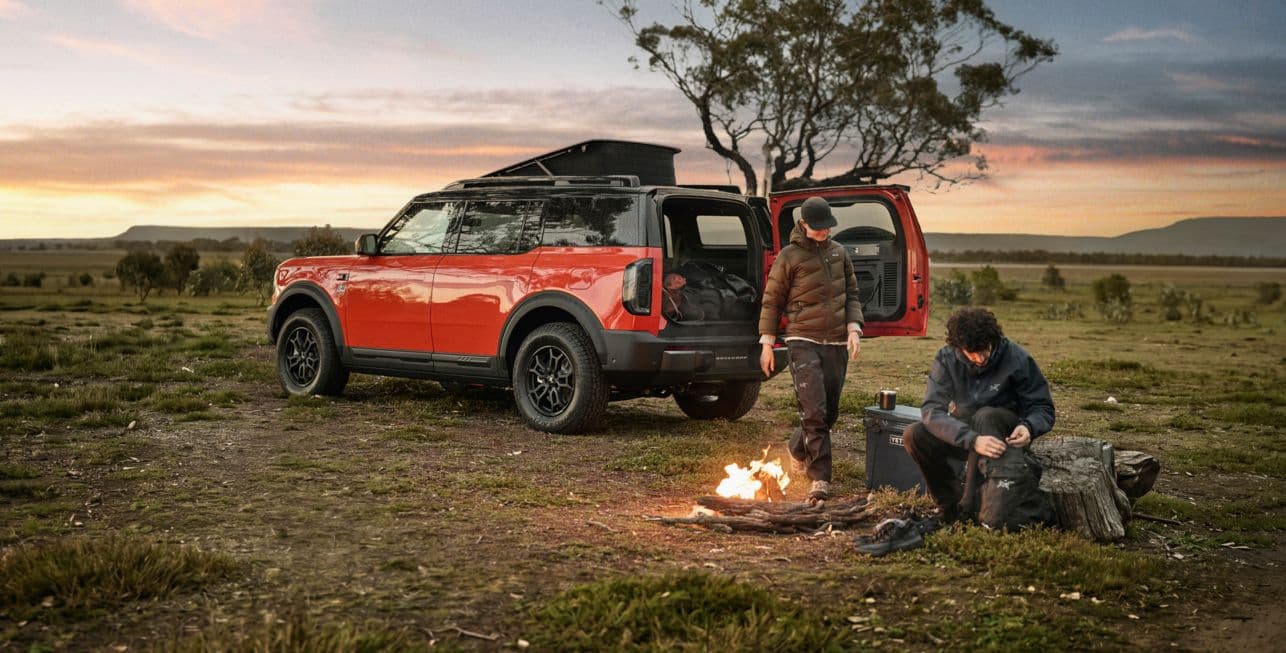
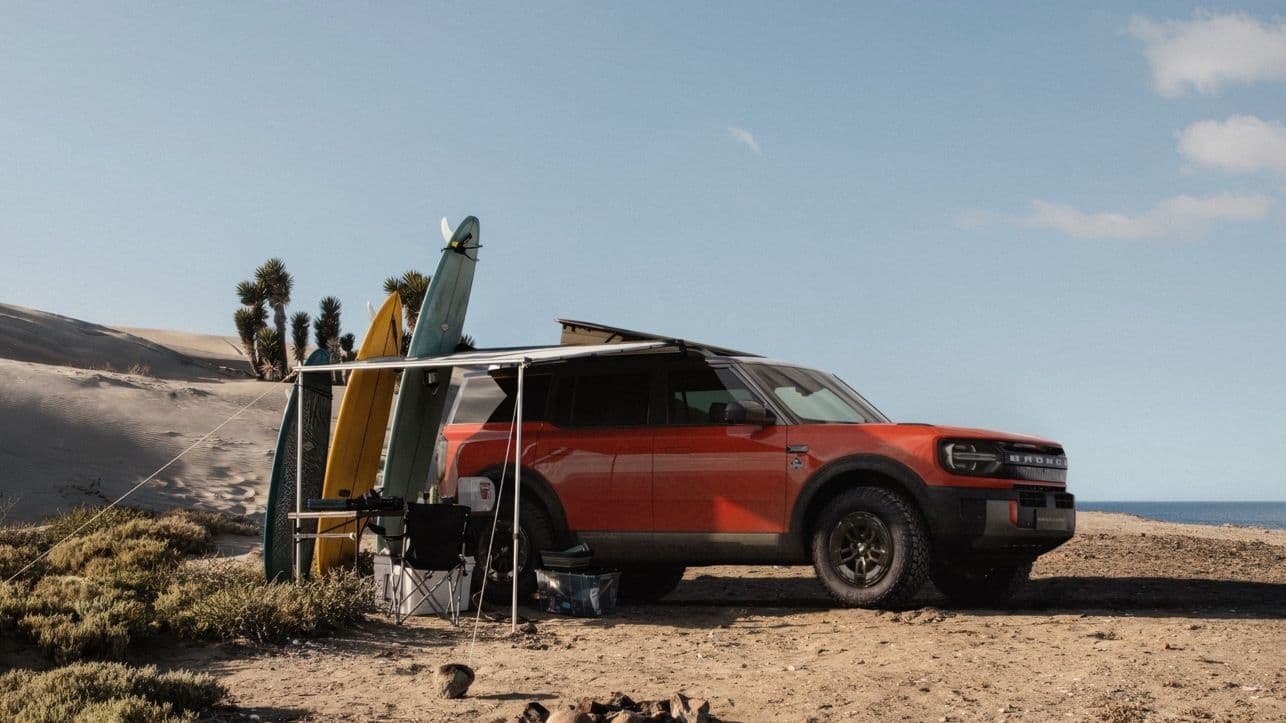
Ford has designed Bronco Basecamp as a versatile vehicle to suit day-to-day driving as well as for outdoor usage. On Outer Banks models, an electric Pop-Up Lift Roof raises at the touch of a button to add interior headroom and airflow. The interior converts into a sleeping space, and when paired with an optional custom-fit inflatable mattress, it creates an overnight shelter without unpacking cargo.
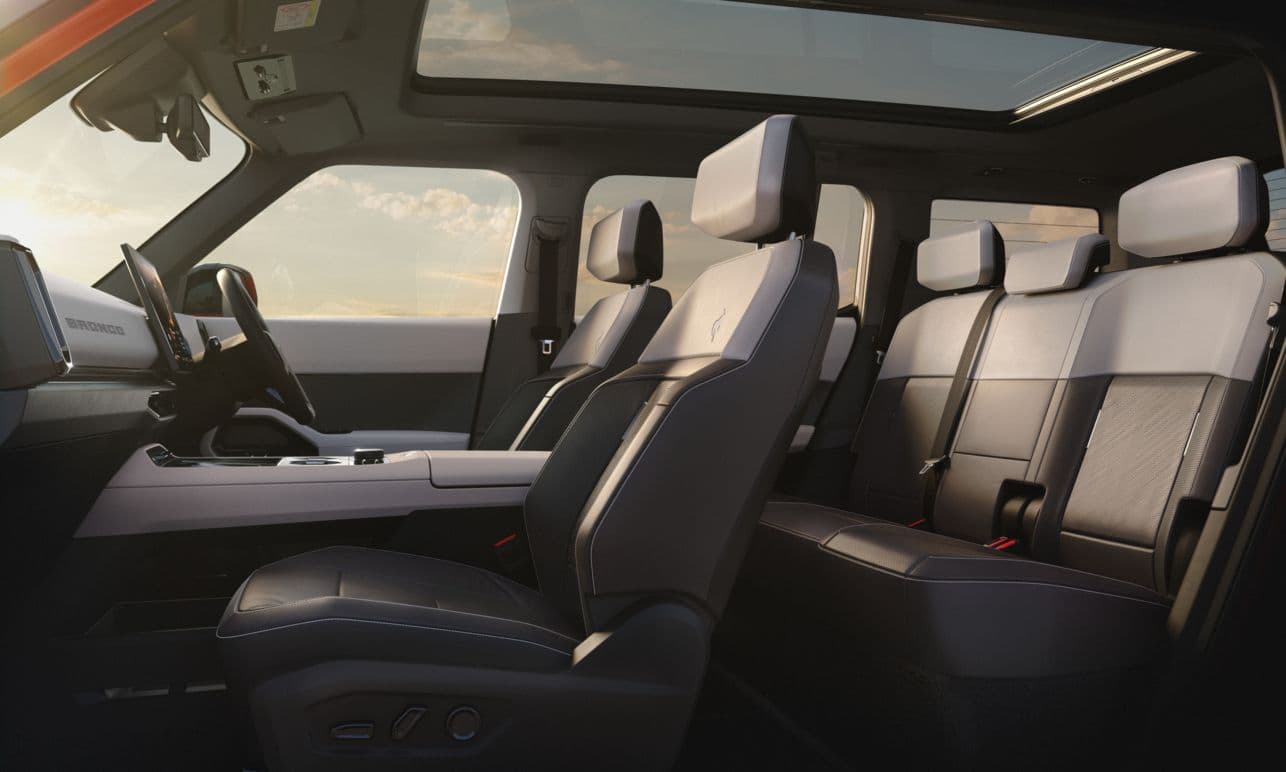
A 7.5-litre warm/cool fridge is built into the centre console, standard on Outer Banks and optional elsewhere, though it only operates while the vehicle is running. The rear swing gate houses what Ford calls the Wild Kitchen: a fold-down table built in for cooking gear, powered by the vehicle's Pro Power Onboard system.
It features vehicle-to load (V2L) which can supply up to 6.6kW when the vehicle is parked, enough to run induction cooktops, coffee machines, camera gear or laptops directly from the battery. Ford splits this across two outlets, an interior port limited to 2.3kW and an exterior port capable of up to 6.6kW when the interior port is not in use (4.3kW when it is), with the exterior port requiring an optional adaptor.
How the Super-Hybrid Powertrain Works
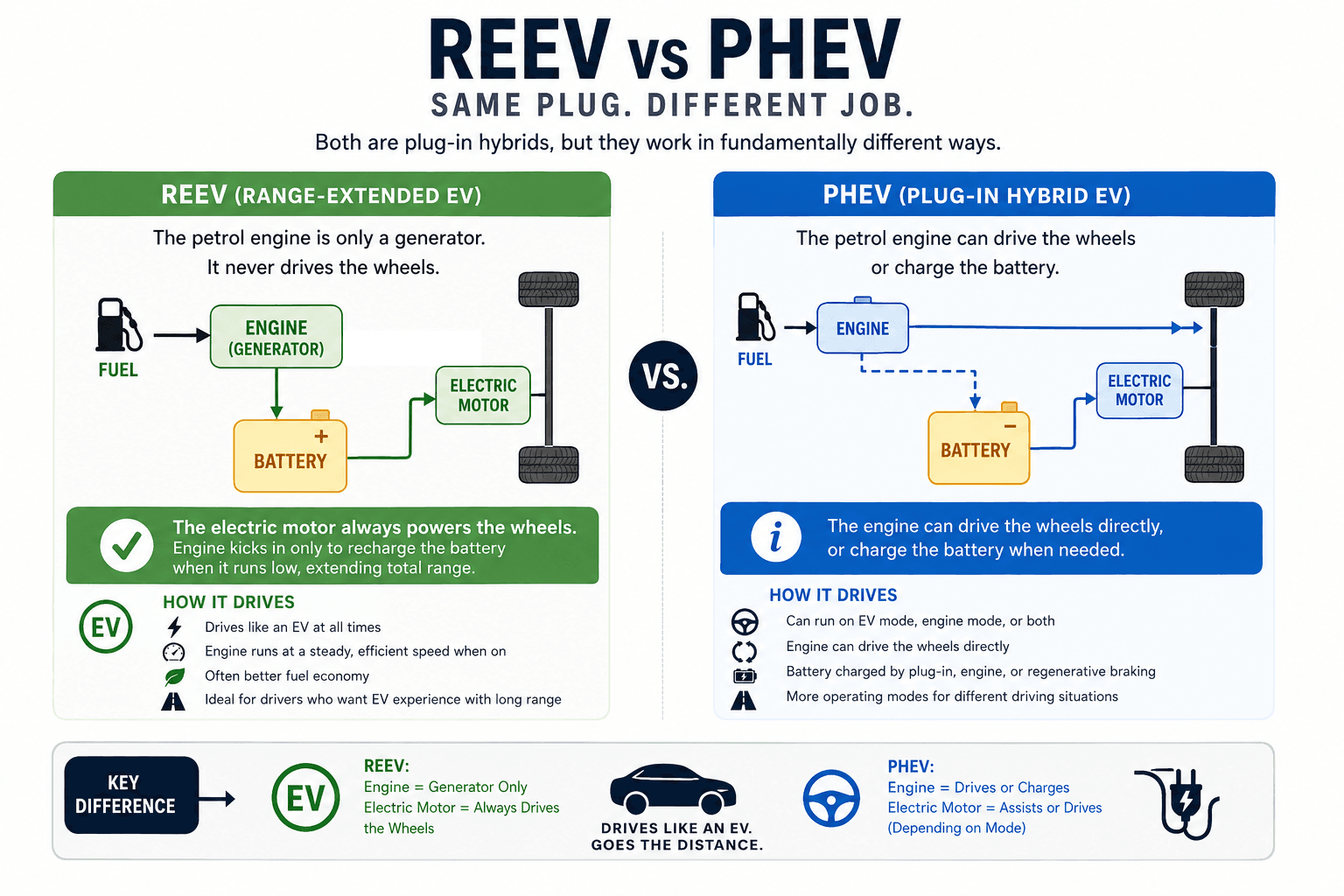
Bronco Basecamp is what's usually called a range-extender EV, or EREV. The vehicle always drives on electric power, through dual motors fed by the 49kWh battery. The 1.5-litre turbo petrol engine never connects to the wheels. Instead, it runs as needed to generate electricity and top up the battery, extending the vehicle's range well beyond what the battery alone could deliver.
This is a different approach to a conventional plug-in hybrid (PHEV), where the petrol engine can drive the wheels directly as well as charge the battery. In an EREV, driving character stays closer to a pure EV: smooth and immediate, with the engine working purely in the background as a generator.
Ford's official figure for Australia and New Zealand is a combined range of 800-900km on the WLTP cycle, on a full charge and full tank. These numbers are still subject to change ahead of final testing.
While not officially confirmed by Ford, electric range is expected to be 150km to 180km on the WLTP standard based on the battery size and the CLTC electric range of the 220km for the China market Bronco which features a 43.7kWh battery.
China also gets a fully electric version of the Bronco New Energy, with a 650km CLTC range and no petrol engine at all. Ford has not confirmed whether this BEV variant will be offered in Australia; although its availability will likely hinge on the success of the EREV variant.

Why a Range Extender Suits Australian Family Road Trips
For a lot of Australian families, Bronco Basecamp's combination of a usable battery and a petrol backup solves a problem consumers often struggle with when going electric. Day to day, most driving, the school run, the commute, weekend errands, will happen entirely on electric power, with the smoothness, quiet and lower running costs that come with it.
The petrol generator exists for the trip that battery-only EVs can sometimes struggle with: a long weekend away, a drive up the coast, or a proper camping trip into the national parks and coastal trails Ford says it designed this vehicle around. Rather than planning a route around charging stops, or worrying about charger availability, drivers can lean on the 1.5-litre engine to keep the battery topped up and simply keep driving.
That backup is parricularly relevant in places where camping trips tend to be: regional and remote areas where DC fast chargers may still be limited , and where the chargers that do exist can be queued out or offline during peak holiday periods like Christmas, Easter and long weekends, when everyone is towing a trailer or a boat down the same stretch of highway at once.
Bronco Basecamp vs Petrol and PHEV Rivals in Australia
Bronco Basecamp will land in a segment currently split between traditional petrol and diesel off-roaders, and a newer wave of plug-in hybrid utes and SUVs. Local Bronco Basecamp pricing has not been confirmed, though Australian media have speculated on a range of roughly $58,000 to $60,000 before on-road costs, based on the China-market car's specification and positioning.
Bronco Basecamp vs Key Petrol and PHEV Rivals (Australia)
Model | Powertrain | Price (AU) | Electric-only range |
Ford Bronco Basecamp | Range-extender EV: 49kWh battery, dual motor, 1.5L turbo petrol generator | Unconfirmed, speculated $48,000-$60,000 | ~190-210km WLTP-equivalent (Zecar estimate) |
GWM Tank 500 Hi4-T | Plug-in hybrid: 37.1kWh battery, 2.0L turbo petrol | $77,990-$79,990 drive-away | 120km (NEDC) |
BYD Shark 6 | Plug-in hybrid ute: 29.6kWh battery, 1.5L/2.0L turbo petrol | $55,900-$62,900 before on-road costs | 80km (WLTP, Performance) to 100km (NEDC, Dynamic/Premium) |
Toyota LandCruiser Prado | 2.8L turbo-diesel, no electrification | $78,978-$108,094 drive-away | N/A |
Jeep Wrangler | 2.0L turbo-petrol, no electrification | $81,990-$88,490 before on-road costs | N/A |
Ford Everest | 2.0L or 3.0L turbo-diesel, no electrification | $58,990-$83,490 before on-road costs | N/A |
On the numbers Ford and its rivals have published so far, Bronco Basecamp's speculated price range would undercut the Wrangler, Prado and Tank 500, while offering roughly double the electric-only range of the Tank 500 and Shark 6, the two closest plug-in hybrid rivals on sale today. Prado and Everest remain conventional diesels with no electric-only driving at all, and Wrangler has no hybrid or PHEV variant in Australia.

Part of Ford's Growing Electrified Lineup
Bronco Basecamp will join a fast-growing electrified range for Ford in Australia. That lineup already includes the Mustang Mach-E, a mid-size electric SUV, the E-Transit, a fully electric van, the Ranger PHEV, a plug-in hybrid version of Ford's top-selling ute, and the Transit Custom, sold locally in both plug-in hybrid and fully electric form. Bronco Basecamp adds a fourth electrified powertrain type to that range: a range-extender EV, sitting alongside Ford's existing BEV and PHEV models.
Availability and Pricing
Ford says further details on local specifications, pricing, variants and exact arrival timing for Australia and New Zealand will be shared closer to launch in the second half of 2027. Bronco Basecamp is expected to be offered in Big Bend, Outer Banks and Badlands-style trim levels based on the China-market range, though Ford has not confirmed local variant names.
Customers can register interest in Bronco Basecamp on Ford's website.



About the author

Danny is a consultant and entrepreneur working at the cutting edge of the electric vehicle and energy transition. He is passionate about educating and helping consumers make better decisions through data.
