
Key Points
- About 40% of novated lease holders were 'middle-income' earners, nearly one in three were in the top tax bracket (earn over $190,000 a year) according to new ATO data.
- The EV fringe benefits tax exemption has blown out from an initial $90 million estimate to $1.4 billion in 2025-26, with costs projected to reach $3 billion by 2028-29.
- The government is now likely to 'tweak' rather than overhaul the scheme, as record EV sales driven by the Iran fuel crisis make it reluctant to dampen demand.
Originally reported by the Australian Financial Review, new data from the Australian Taxation Office (ATO) has revealed that Australia's electric vehicle fringe benefits tax (FBT) exemption is disproportionately benefiting high-income earners. The data, released in response to a freedom of information request, challenges the government's claim that the policy primarily helps middle-income Australians.
Who Is Using the EV Tax Break?
ATO figures show that the largest beneficiaries of the tax break were those earning between $45,001 to $135,000 with 40% share, followed by 30.6% who wearned above the top tax threshold of $190,000. A further 24% were by those earning between $135,000 and $190,000.
For context, only 4.4% of Australians earn above $190,000, according to the Grattan Institute.
More than three-quarters of Australians earn less than $104,765. The average taxable income in 2025 was $73,381.
The data shows that while many middle income earners benefited from the FBT exemption, it disproportionately benefited high income earners.
"This policy is giving a bigger subsidy to higher-income people for the same car, but it's the same emissions reduction. That doesn't make sense," said Lachlan Vass, research manager at the e61 Institute.
How the FBT Exemption Works
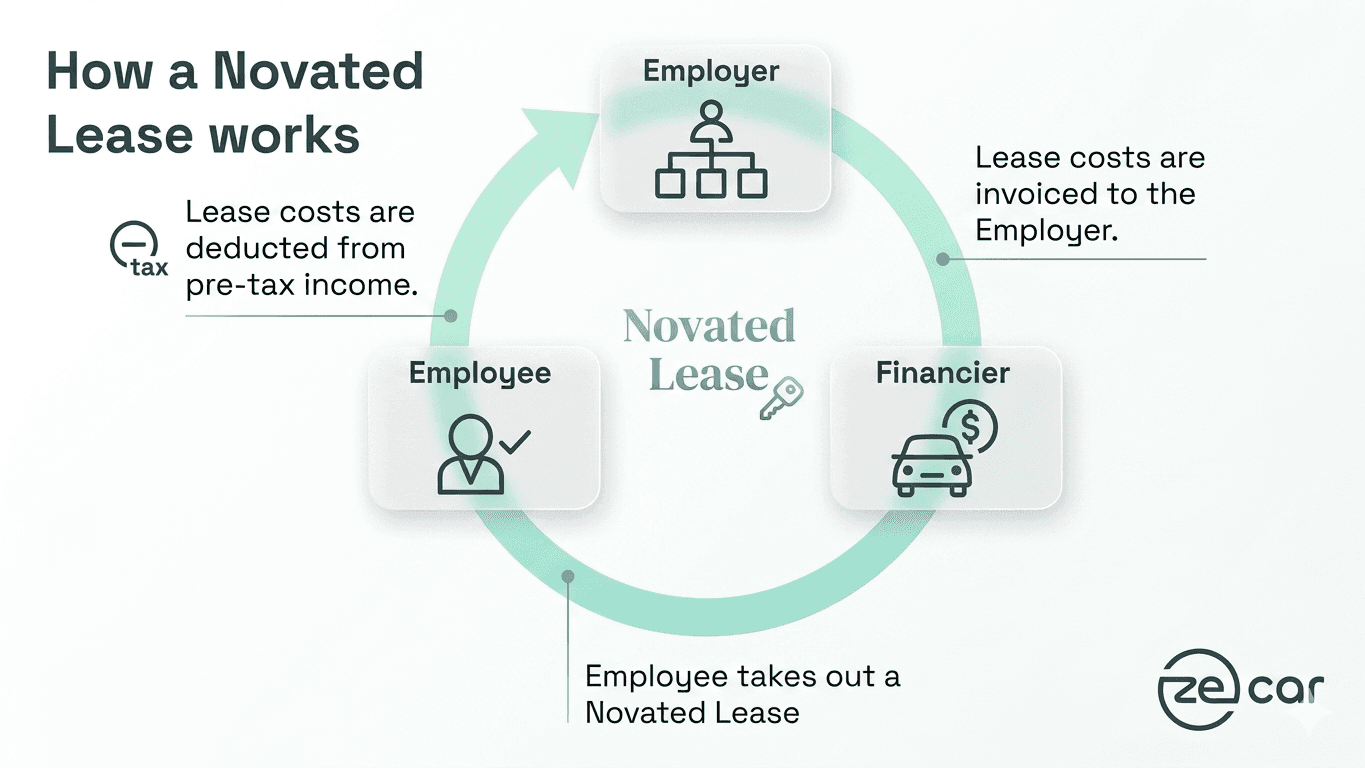
The FBT exemption lets employers avoid paying fringe benefits tax on EVs priced under the Luxury Car Tax threshold of $91,387, when provided through a novated lease. Employees pay for the car and its running costs from pre-tax income.
For a $60,000 EV, the savings can be up to $5,000 a year, according to the e61 Institute. But because the benefit is tied to income tax rates, higher earners get a larger subsidy for the same car.

The Cost Blowout
When the scheme launched, the government estimated it would cost $90 million a year. That figure has since blown out to $1.4 billion in 2025-26. By 2028-29, the cost is projected to reach $3 billion annually.
More than 68,700 people used the incentive during the ATO's tracked FBT period (April to March). That number is expected to be significantly higher now, given the surge in EV sales driven by rising fuel prices linked to the conflict in Iran.
Monthly EV sales hit 14.8% of new car sales in March 2026, a record high. The FBT exemption is credited as a key driver of that growth.
Reform or Keep the EV FBT Exemption?
The government had been considering scaling back the scheme before the May budget, either by means-testing it or lowering the eligible vehicle price cap. But with EV sales booming due to the oil shock, zecar has been advised by sources that the exemption would likely be 'tweaked' rather than overhauled or abolished.
Researchers argue the most efficient fix would be to move the subsidy out of the income tax system entirely. "If we could provide it at the point of sale or in another way, where we could provide it in a flat way, that would be much more efficient," said Vass.
Other countries further ahead in the EV transition, including several in Europe, have used direct measures such as cuts to stamp duty or GST. This is the approach many of the state government tooks with their incentives programs that ran from 2021 to 2024. Besides the ACT, state government EV incentives are now largely absent.
The government also introduced the New Vehicle Efficiency Standard last year, which penalises companies for importing carbon-intensive vehicles and rewards those importing more fuel-efficient models.

What the Government Says
A spokeswoman for Energy Minister Chris Bowen's office said the policy has benefited middle-income Australians more than any other group for consecutive years. She also pointed to the growing used EV market as evidence the scheme is broadening access.
"We're now seeing early adopters of EVs put their cars on the used car market, meaning more Australians than ever are able to access a greater variety of cheaper-to-run cars," the spokeswoman said.
Rohan Martin, chief executive of the National Automotive Leasing and Salary Packaging Association, said the exemption has delivered real cost-of-living support. "New polling shows the Electric Car Discount is being used by the very people bureaucrats too often overlook: outer-suburban families, blue-collar workers, culturally diverse communities and financially stretched households," he said.
NALSPA previously shared data that shows outer-suburban postcodes across Australia led battery electric vehicle (BEV) purchases via novated leasing in 2025
Green Shoots: The Used EV Market Is Growing
One indirect benefit of the FBT scheme is the growing supply of used EVs. As early adopters who used novated leases finish their lease terms, more second-hand EVs are entering the market at lower prices. Used EV sales more than doubled in March 2026 as fuel prices spiked, according to separate data.
The government also repealed the FBT exemption for plug-in hybrid vehicles (PHEVs) on 1 April 2025. PHEVs accounted for less than 5% of total new car sales last year.


About the author

Danny is a consultant and entrepreneur working at the cutting edge of the electric vehicle and energy transition. He is passionate about educating and helping consumers make better decisions through data.
