Key Points
- Renault concept drives over 1000 km without recharging at highway speeds
- Filante Record 2025 used standard 87 kWh battery, not oversized pack
- Average energy consumption measured just 7.8 kWh per 100 km
- Extensive aerodynamic and weight optimisation enabled record-breaking efficiency
- Demonstration highlights future potential for long-range, efficient electric vehicles
Renault has quietly delivered one of the most impressive EV efficiency demonstrations seen to date, proving that long-distance electric driving does not need oversized batteries or extreme hypermiling tactics.
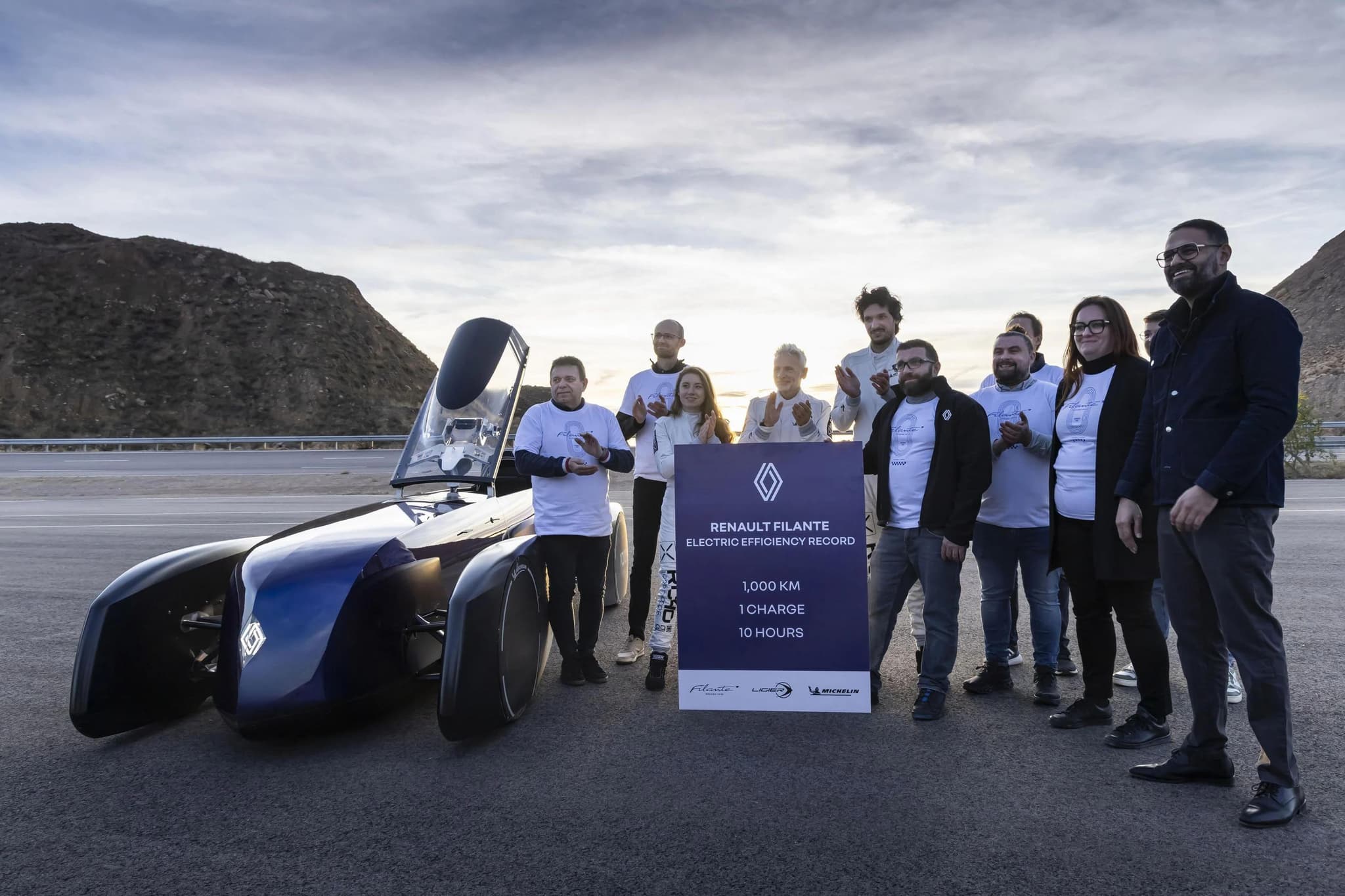
In December, the French carmaker’s Filante Record 2025 concept completed a 1008 km run in just under 10 hours on the UTAC test circuit in Morocco, maintaining real-world highway speeds throughout the attempt.
This was not a slow, carefully staged endurance crawl. The car averaged more than 110 km/h overall, including technical stops and driver changes, while cruising at over 100 km/h for the majority of the run.
The challenge was set internally at the start of 2025, with Renault tasking its engineers to build an EV capable of covering 1000 km on a single charge without sacrificing realistic driving conditions. Crucially, the team imposed a strict limit on battery size, ruling out the simplest solution of just adding more capacity.
▶️MORE:Why Aussies Aren't Saying 'Oui' to French Electric Cars from Renault


Engineering efficiency over brute force
Rather than fitting a massive battery, Renault deliberately capped the Filante Record 2025 at an 87 kWh pack, the same capacity used in the long-range Scenic E-Tech sold to customers, forcing engineers to extract efficiency through design rather than brute force.
Key engineering choices made the difference:
- Battery strategy: Standard 87 kWh lithium-ion pack, identical in capacity to Scenic E-Tech Long Range
- Energy efficiency: Just 7.8 kWh per 100 km while cruising at real highway speeds
- Remaining charge: 11 percent left after 1008 km, equating to roughly 120 km extra range
- Aerodynamics: Wheels partially separated from the body after extensive wind tunnel testing
- Weight reduction: Carbon fibre, aluminium alloys and 3D-printed Scalmalloy components
- Advanced systems: Steer-by-wire and brake-by-wire to reduce mass and improve packaging
The result is a single-seat EV weighing around 1000 kg, proving that intelligent engineering and aerodynamic discipline can deliver long-distance electric driving without oversized batteries or unrealistic driving conditions.
▶️MORE: 2026 Renault Scenic E Tech opens for orders in Australia


