


Key Points
- JAC has priced the Hunter PHEV ute from $49,988 plus on-road costs, making it Australia's cheapest plug-in hybrid ute.
- The Hunter produces a claimed 360kW of combined power and 1010Nm of combined driveline torque, with up to 3,500kg of braked towing across both grades.
- Two variants are available, Hunter Pro from $49,988 and Hunter X from $54,844, with first deliveries expected at Australian showrooms from August 2026.
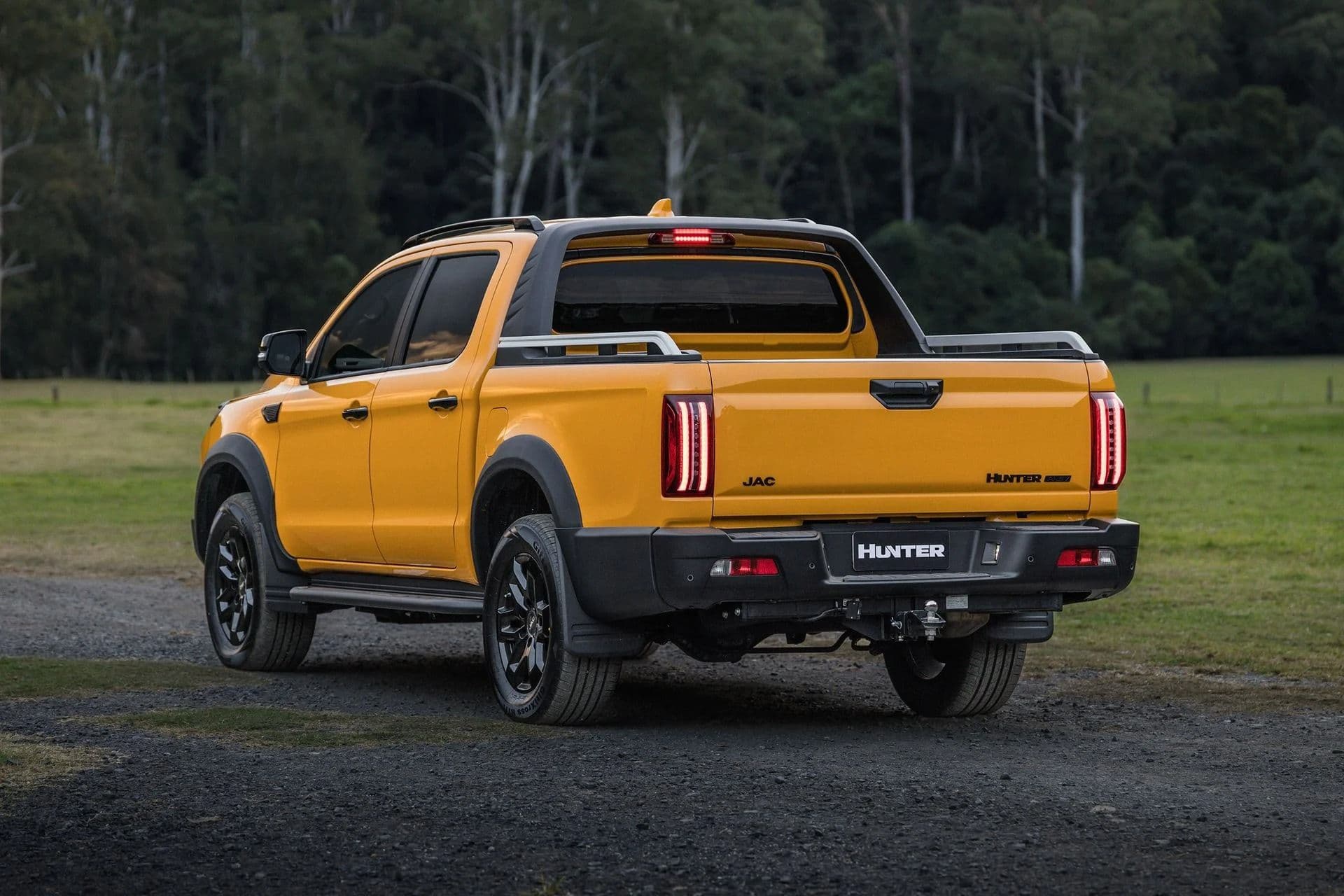
JAC Motors Australia has confirmed pricing for the Hunter, its new plug-in hybrid dual-cab ute, starting at $49,988 plus on-road costs. That price tag makes the Hunter the cheapest PHEV / electrified ute on sale in Australia, undercutting the BYD Shark 6 and the GWM Cannon Alpha PHEV.
The Hunter arrives in local showrooms from August 2026, following more than 100,000km of testing on Australian roads. JAC says vehicle dynamics were overseen from the start of the program by Australian chassis engineer Michael Barber, whose past work includes some of the country's most demanding local vehicle development programs.
Pricing and Variants
Two Hunter grades are available at launch. The entry level Pro 4x4 starts at $49,988 plus on-road costs, while the better equipped Hunter X 4x4 starts at $54,844 plus on-road costs.
Both grades share the same drivetrain, so the price difference comes down to equipment rather than performance.
| Grade | Price (plus on-road costs) |
| Hunter Pro 4x4 | $49,988 |
| Hunter X 4x4 | $54,844 |
A small number of options are available on top of these prices. Front and rear differential locks, which are standard on Hunter X, can be added to the Hunter Pro for $1,888. A power sunroof is available on the Hunter X for $1,500.
Get a novated lease quote
Power, Efficiency and Towing
The Hunter combines a 2.0 litre turbocharged petrol engine with a front electric motor and rear electric motor for a claimed combined output of 360kW and 1010Nm of driveline torque. JAC lists the individual contributions as 370Nm from the petrol engine, 300Nm from the front motor and 340Nm from the rear motor, which the brand adds together to reach the 1010Nm combined figure.
JAC quotes combined fuel consumption of 1.6L/100km and a total driving range of 1005km, including up to 100km on electric power alone. Those figures are based on the NEDC test cycle, which tends to produce more generous results than the newer WLTP standard used by some rivals, so real world figures are likely to be lower. Expected WLTP range will likely be about 80km.
2026 JAC Hunter PHEV Specifications
Engine | 2.0L turbo petrol + P2.5 front motor + P4 rear motor |
Combined power | 360kW |
Combined driveline torque | 1010Nm |
Fuel consumption (combined) | 1.6L/100km (NEDC) |
EV-only range | Up to 100km |
Combined range | 1005km (NEDC) |
Braked towing capacity | Up to 3,500kg |
Payload | 915kg |
0-100km/h | Not stated |
[IMAGE: JAC Hunter PHEV towing a trailer on an Australian road — alt: "JAC Hunter PHEV towing capacity test"]

Hunter Pro vs Hunter X: What You Get
Both grades share the Hunter's core mechanical package: 360kW of power, 1010Nm of combined torque, 1.6L/100km combined fuel efficiency, 1005km of combined range and 915kg of payload. The difference between grades comes down to comfort and presentation features.
Hunter X adds the following equipment as standard, over and above the Hunter Pro:
| Feature | Hunter Pro | Hunter X |
| Front and rear differential locks | Optional ($1,888) | Standard |
| Black styling package | No | Yes |
| Heated front seats | No | Yes |
| Passenger 4-way power seat | No | Yes |
| 360 degree panoramic camera | No | Yes |
| Front parking sensors | No | Yes |
| Power folding exterior mirrors | No | Yes |
| Black roof rails | No | Yes |
| Rear privacy glass | No | Yes |
| Welcome puddle lamps | No | Yes |
| Rear 220V accessory socket | No | Yes |
Rear parking sensors are standard on both grades.
Local Testing and Development
JAC says the Hunter has completed more than 100,000km of testing on Australian roads ahead of launch, covering durability runs, towing, load carrying, hot weather evaluation and on and off road development.
The local vehicle dynamics program was overseen from day one by Michael Barber, an Australian vehicle dynamics tuning engineer whose past work includes some of the country's most demanding local vehicle programs. JAC says all of Barber's recommendations from the program have been implemented in production vehicles headed to customers.
“In Australia, respect isn't given to a ute. It's earned. Hunter has been built, tested and proven, to earn that respect,” said Ahmed Mahmoud, Managing Director of JAC Motors Australia.
“This isn't a trade-off between price and capability. It's proof that premium performance, advanced hybrid technology and genuine capability don't have to come with a premium price tag. We didn't build Hunter to undercut the market. We built it to disrupt it and reset what Australians should expect from a PHEV ute.”

How the Hunter Compares to Its PHEV Ute Rivals
JAC is positioning the Hunter directly against the BYD Shark 6 Performance and the GWM Cannon Alpha PHEV, the two other PHEV utes in Australia rated to tow 3,500kg braked. All three now sit in the same towing bracket as diesel benchmarks like the Ford Ranger and Toyota HiLux.
PHEV Ute Comparison: 3,500kg Towing Class
Model | JAC Hunter (Pro / X) | BYD Shark 6 Performance | GWM Cannon Alpha PHEV |
Price (plus on-road costs) | $49,988 / $54,844 | $62,900 | $59,990 |
Combined power | 360kW | 350kW | 300kW |
Combined torque | 1010Nm | 700Nm | 750Nm |
0-100km/h | N/A | 5.5 sec | N/A |
EV-only range | Up to 100km (NEDC) | 80km (WLTP) | Up to 115km (NEDC) |
Combined range | 1005km (NEDC) | 640km (WLTP) | 880km (NEDC) |
Fuel consumption (combined) | 1.6L/100km (NEDC) | 1.3L/100km (SOC above 25%) | 1.7L/100km (NEDC) |
Braked towing capacity | 3,500kg | 3,500kg | 3,500kg |
Payload | 915kg | 725 kg | 685kg |
Availability | August 2026 | On sale now | On sale now |
On paper, the Hunter undercuts both rivals on price while claiming the most power, the most torque and the highest payload of the three. It is worth noting the test standards are not consistent across the segment. JAC's range and fuel consumption figures are based on the older, more lenient NEDC cycle, while BYD now tests the Shark 6 Performance under the stricter WLTP standard, so the Hunter's on-paper range advantage may narrow in real world driving.
JAC's 1010Nm combined torque figure is also a manufacturer-calculated sum of the petrol engine and both electric motors' individual torque outputs, rather than a directly measured wheel torque figure, a method common across the PHEV ute segment.
Get a novated lease quote
Reserving a Hunter
The Hunter is available to reserve now ahead of test drives opening in the coming weeks. The first 1,000 buyers can reserve their Hunter for a fully refundable $1,000 deposit.
JAC says the first 1,000 customers to reserve and take delivery will also receive their choice of a free home EV charger, excluding installation, or a $500 JAC Genuine Accessories voucher. JAC has confirmed this offer applies to vehicles pre-ordered online or through participating dealers and delivered by 31 December 2026, and is limited to the first 1,000 reservations.

About the author

Danny is a consultant and entrepreneur working at the cutting edge of the electric vehicle and energy transition. He is passionate about educating and helping consumers make better decisions through data.
