Key Points
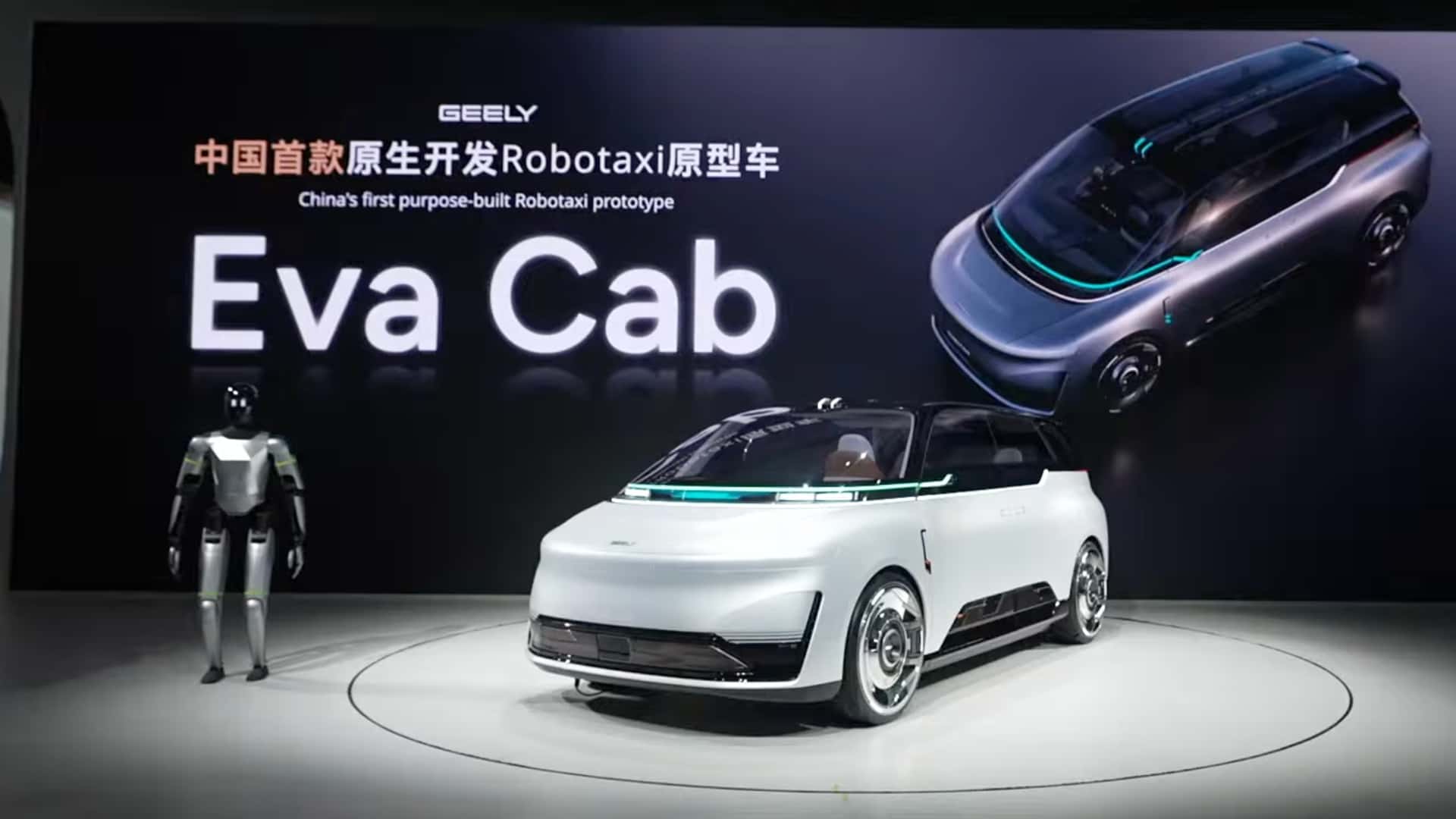
- Geely has unveiled the EVA Cab, a purpose-built electric robotaxi concept
- Features over 3000 TOPS of AI computing power and 2160-line LiDAR
- Designed around Level 4 autonomous driving and shared mobility services
- Uses Geely’s new Full-Domain AI 2.0 software ecosystem
- Technologies previewed could eventually flow into future Australian EVs
Chinese auto giant Geely has unveiled a futuristic purpose-built electric robotaxi at Auto China 2026 in Beijing, signalling just how aggressively Chinese car makers are pushing into AI-powered mobility and autonomous driving technology.
Called the Geely EVA Cab, the concept was revealed alongside AFARI Technology and CaoCao Mobility, Geely’s ride-hailing division. Unlike many futuristic concepts designed mainly for show stands, Geely says the EVA Cab is intended as a genuine preview of future autonomous mobility services.
The reveal also underlines a much bigger shift happening inside China’s EV industry. Carmakers are no longer competing only on battery range and charging speeds. Increasingly, the race is centred around AI computing power, autonomous driving software, cybersecurity and intelligent vehicle ecosystems.
▶️MORE: Tesla Cybercab Spotted Driving on Public Streets for the First Time
What exactly is the Geely EVA Cab?
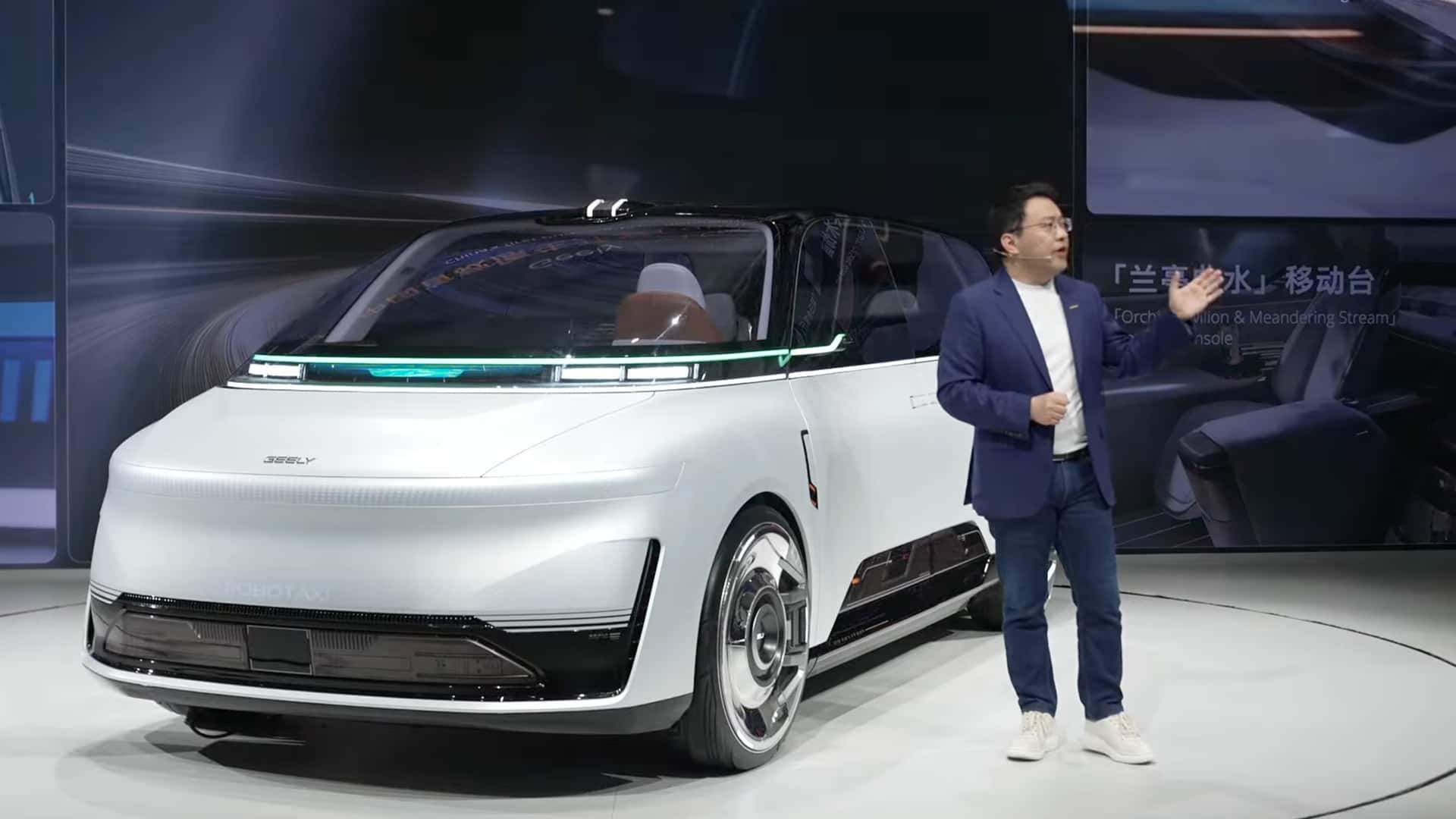
The EVA Cab has been designed specifically as a robotaxi from day one rather than adapting an existing passenger vehicle.
That changes almost every aspect of the layout.
The vehicle features wide electric sliding doors and a lounge-like cabin layout with face-to-face seating intended to maximise passenger space. Geely says the interior is designed to feel more like a mobile living room than a traditional car.
Inside, the company has leaned heavily into futuristic styling themes, including:
• “Galaxy Skyroof” panoramic ceiling
• “Drifting Galaxy” illuminated door trims
• “Orchid Pavilion and Meandering Streams” armrests
• Open cabin architecture designed for ride-sharing services
The company says the EVA Cab sits at the centre of its new “Full-Domain AI 2.0” platform, which combines:
• Autonomous driving systems
• AI-managed vehicle software
• Cloud-connected diagnostics
• Vehicle cybersecurity
• Intelligent cockpit technologies
Rather than functioning as separate systems, Geely says future vehicles will operate through a unified software architecture where chassis, powertrain, cabin and assisted-driving systems all communicate together in real time.
▶️MORE: Geely EX5 Inspire (2026 - 2026) EV Specifications


How advanced is the robotaxi technology?
Geely is making some very ambitious technology claims with the EVA Cab.
The company says the vehicle uses the world’s first “Quantum-Level AI Electronic and Electrical Architecture” alongside an EEA 4.0 platform featuring quantum encryption for vehicle-to-cloud security.
That system is designed to protect features such as:
• Bluetooth digital keys
• Remote vehicle controls
• Over-the-air software updates
• Vehicle data privacy
The robotaxi is also equipped with what Geely claims is the world’s first 2160-line digital LiDAR system, capable of processing 25.92 million points per second with a detection range of up to 600 metres.

Powering all of this is a high-performance computing setup built around three flagship chips:
| Category | Specification | Details |
| Vehicle | EVA Cab | Purpose-built robotaxi |
| Developer | Geely + AFARI + CaoCao | Mobility collaboration |
| Vehicle type | Electric robotaxi | Autonomous mobility platform |
| AI platform | Full-Domain AI 2.0 | Integrated vehicle AI framework |
| E/E Architecture | EEA 4.0 | Quantum-encrypted architecture |
| Assisted driving | L4 autonomous capability | AFARI G-ASD software |
| LiDAR system | 2160-line digital LiDAR | 25.92 million points/sec |
| AI computing power | 3000+ TOPS | Combined processing capability |
| Main processors | NVIDIA SuperChip | AI computing hardware |
| Secondary processors | NVIDIA Thor U | Advanced driving compute |
| Cockpit processor | Qualcomm Snapdragon 8397 | Intelligent cabin systems |
| Charging architecture | 900V platform | Ultra-fast EV capability |
| Fast charging | 12C charging tech | Ultra-rapid charging |
| Battery technology | Solid-state batteries | Future battery development |
| Security systems | Quantum encryption | Vehicle-cloud protection |
| Diagnostics | SOVD system | Cloud-integrated monitoring |
| Mobility deployment | CaoCao Mobility | Robotaxi fleet integration |
| Launch timing | 2027 target | Commercial deployment goal |
TOPS, or trillions of operations per second, measures AI processing power. In practical terms, it reflects how much data the vehicle can process for autonomous driving, sensor fusion and advanced driver assistance systems.
Geely says the EVA Cab’s AFARI G-ASD software is capable of enabling fully unmanned shuttle operations on open public roads.
Of course, autonomous driving promises should always be viewed carefully. The global robotaxi industry has repeatedly shown that real-world traffic conditions are far more difficult than controlled demonstrations.
Still, Geely says it already has more than a year of robotaxi pilot operations running through CaoCao Mobility in cities including Hangzhou and Suzhou.
▶️MORE: Bidirectional (V2H and V2G) EV Chargers Guide (2025)


Why is Geely suddenly focusing so heavily on AI?
The EVA Cab is part of a much broader transformation happening within Geely.
The company increasingly wants to position itself not just as a car manufacturer, but as an intelligent mobility technology company.
Geely says it has been developing foundational AI systems since 2021 under its “Smart Geely 2025” strategy. Its Xingrui Intelligent Computing Center reportedly now delivers 23.5 EFLOPS of computing power, which the company claims is the highest among Chinese automakers.
At CES 2026, Geely also introduced its WAM, or World Behaviour Model, which acts as a central AI “brain” capable of coordinating:
• Intelligent cockpit systems
• Driver assistance functions
• Chassis control
• Powertrain management
• Body and safety systems
The broader direction is becoming clear across the industry.
Future EVs are increasingly being designed as software-defined platforms where charging, energy management, safety systems, traction control and cabin technologies are all managed through centralised AI systems.
For manufacturers, this could improve efficiency, safety and user experience. For buyers, it could dramatically change how vehicles behave and evolve over time through software updates.

What could this mean for Australian EV buyers?
Australian buyers are unlikely to see autonomous EVA Cab robotaxis roaming suburban streets anytime soon.
But many of the technologies shown in Beijing are highly relevant to future vehicles that could eventually arrive here through Geely and its related brands such as Zeekr.
That includes:
• 900V ultra-fast charging systems
• Advanced intelligent cockpits
• AI-managed energy systems
• Improved assisted-driving technologies
• Vehicle-cloud integration
• Higher-level cybersecurity systems
As Chinese brands continue expanding in Australia, the competition is rapidly shifting beyond simple EV affordability.
The next battleground will likely revolve around software, AI integration, charging ecosystems and intelligent driving systems.
▶️MORE: Best selling electric vehicles in Australia in 2026
For Australian consumers, that could mean future EVs becoming more connected, more efficient and more feature-rich much faster than many traditional manufacturers anticipated.
The EVA Cab may still be a glimpse of the future, but it also highlights how quickly China’s biggest carmakers are trying to redefine what an electric vehicle actually is.

