
Key Points
- The BYD Sealion 7 Premium starts at $54,990 before on-road costs, $6,180 cheaper than the Kia EV5 Air Long Range at $61,170
- The EV5 Air Long Range claims more WLTP range at 555km against the Sealion 7's 482km, helped by a larger 81kWh usable battery
- Both cars sit in the mid-size SUV segment dominated by the Tesla Model Y, and represent two different value propositions: BYD's lower price versus Kia's longer range and warranty
The BYD Sealion 7 Premium and Kia EV5 Air Long Range are both mid-size electric SUVs that undercut the segment-leading Tesla Model Y on price while offering a larger battery than the Model Y RWD. Both are consistently mid-volume sellers in a segment that Tesla and BYD's own Sealion 7 have come to dominate.
BYD's advantage is price. Kia's advantage is range. The two cars sit $6,180 apart before on-road costs, which is enough of a gap to matter for budget-conscious buyers but small enough that range, warranty and brand reputation become the deciding factors.
Editor's note: Kia does not offer an 'Earth 2WD Long Range' variant of the EV5 in Australia. The Earth trim is all-wheel-drive only. The closest match to a front-wheel-drive, long-range EV5 is the Air Long Range, which is used throughout this comparison.
Pricing
BYD offers the Sealion 7 in two trims. Kia offers the EV5 in four. The variants compared here sit $6,180 apart before on-road costs.
Variant | Price (before on-road costs) | Drive type |
BYD Sealion 7 Premium | $54,990 | Rear |
BYD Sealion 7 Performance | $63,990 | AWD |
Kia EV5 Air Standard Range | $56,770 | Front |
Kia EV5 Air Long Range | $61,170 | Front |
Kia EV5 Earth AWD | $64,770 | AWD |
Kia EV5 GT-Line AWD | $71,770 | AWD |
Both cars qualify for the federal fringe benefits tax exemption on novated leases. BYD has also run a 5 percent novated lease discount on its full EV range, including the Sealion 7, for vehicles ordered between April and June 2026.
Get a novated lease quote
Dimensions and Size
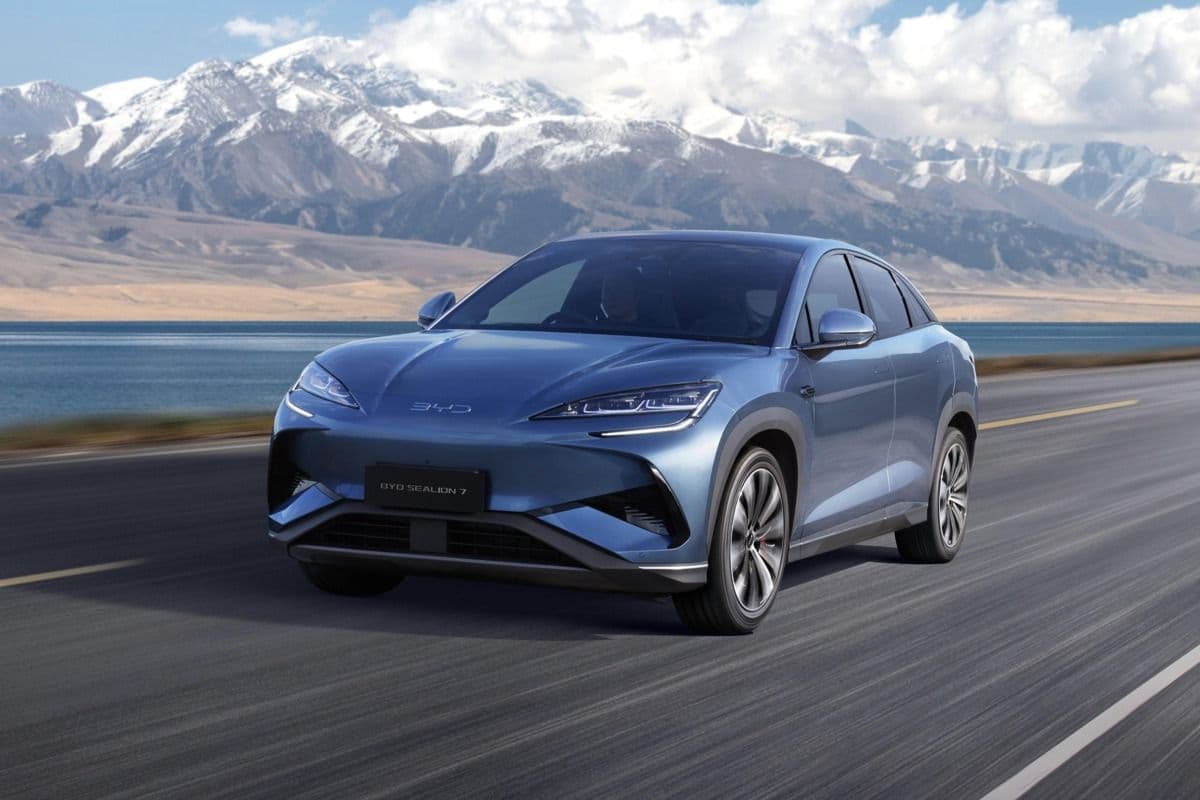
The Sealion 7 is longer and wider than the EV5, while the EV5 is taller and rides on a shorter wheelbase.
Dimension | BYD Sealion 7 Premium | Kia EV5 Air LR | Difference |
Length | 4,830mm | 4,615mm | Sealion 7 +215mm longer |
Width | 1,925mm | 1,875mm | Sealion 7 +50mm wider |
Height | 1,620mm | 1,715mm | EV5 +95mm taller |
Wheelbase | 2,930mm | 2,750mm | Sealion 7 +180mm longer |
Ground clearance | 165mm | 161mm | Sealion 7 +4mm |
Turning circle | 12.4m | 11.7m | EV5 0.7m tighter |
Kerb weight | 2,225kg | 2,054kg | EV5 171kg lighter |
Boot capacity (std/max) | 500L / 1,358L | 513L / 1,714L | EV5 +13L standard |
Frunk capacity | 58L | 67L | EV5 +9L |
The Sealion 7's SUV Coupe body trades some boot space for its sloping roofline, while the EV5's more conventional SUV shape and 95mm height advantage give it a roomier-feeling cabin despite the shorter overall length. The EV5's 171kg lighter kerb weight is a notable advantage for a car carrying a similarly sized battery, likely reflecting Hyundai-Kia's E-GMP platform efficiency.
Range and Performance
Despite a near-identical usable battery size, the EV5 covers 73km more on the WLTP cycle, a clear efficiency win at 146Wh/km against the Sealion 7's 171Wh/km. That 15 percent efficiency advantage is meaningful for buyers prioritising range over outright pace.
Spec | BYD Sealion 7 Premium | Kia EV5 Air LR |
WLTP range | 482km | 555km |
Usable battery | 82.5kWh | 81kWh |
Efficiency (WLTP) | 171Wh/km | 146Wh/km |
0-100km/h | 6.7 seconds | 8.9 seconds |
Top speed | 180km/h | 185km/h |
Power | 230kW | 160kW |
Torque | 380Nm | 310Nm |
Towing capacity (unbraked/braked) | 750kg / 1,400kg | 750kg / 1,250kg |
Outright acceleration favours the Sealion 7 by a wide margin, with a 2.2-second advantage to 100km/h thanks to 70kW more power despite carrying 171kg more weight. The two cars are closely matched on towing, with the Sealion 7 rated 150kg higher on its braked figure.

Battery and Charging
Both cars use LFP battery chemistry. The Sealion 7 charges at the same AC rate but the EV5 has a notably faster maximum DC peak on paper, despite a comparable real-world charge time.
Spec | BYD Sealion 7 Premium | Kia EV5 Air LR |
Usable battery capacity | 82.5kWh | 81kWh |
Chemistry | LFP (Blade Battery) | LFP |
Max AC charging power | 11kW | 11kW |
AC charge time (0-100%) | 8 hours 18 minutes | 8 hours 30 minutes |
Max DC charging power | 150kW | 140kW |
DC charge time (10-80%, approx) | ~31 minutes | ~36 minutes |
Bidirectional charging | V2L only | V2L only |
Bidirectional power output | 3.3kW | 3.6kW |
The two cars are closely matched on AC charging, both rated at 11kW. On DC, the Sealion 7's slightly higher peak rate translates into a faster real-world 10-80% top-up despite the similarly sized batteries. Both models feature V2L but neither car currently supports vehicle-to-home or vehicle-to-grid in Australia.
Driver Technology and Infotainment
Both cars carry a five-star ANCAP safety rating and come standard with a comparable suite of Level 2 driver assistance features.
Standard on both:
- Autonomous emergency braking (AEB)
- Adaptive cruise control
- Lane keep assist and lane departure warning
- Blind spot monitoring and rear cross-traffic alert
- 360-degree camera system
- Safe exit assist
Both brands offer a similarly comprehensive Level 2 suite at this price point, reflecting how competitive the mid-size SUV segment has become on safety equipment. Neither car stands out with a meaningfully more advanced system than the other.
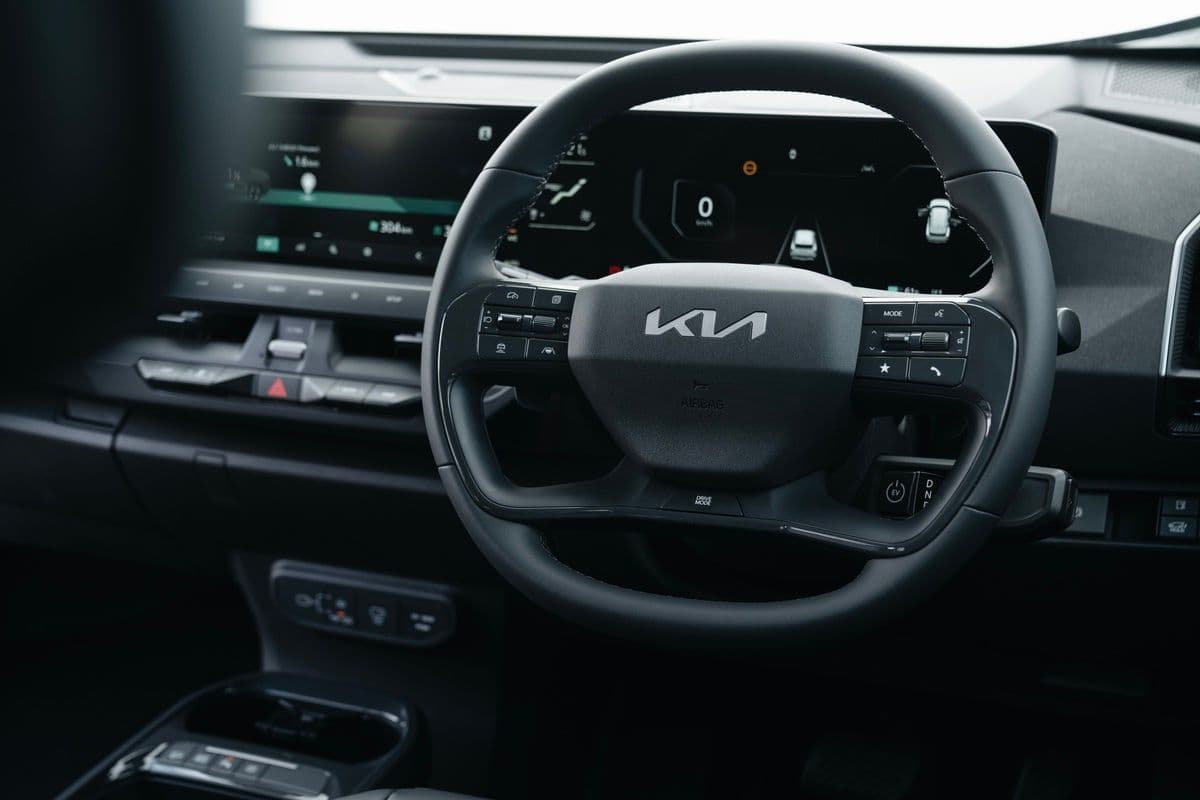
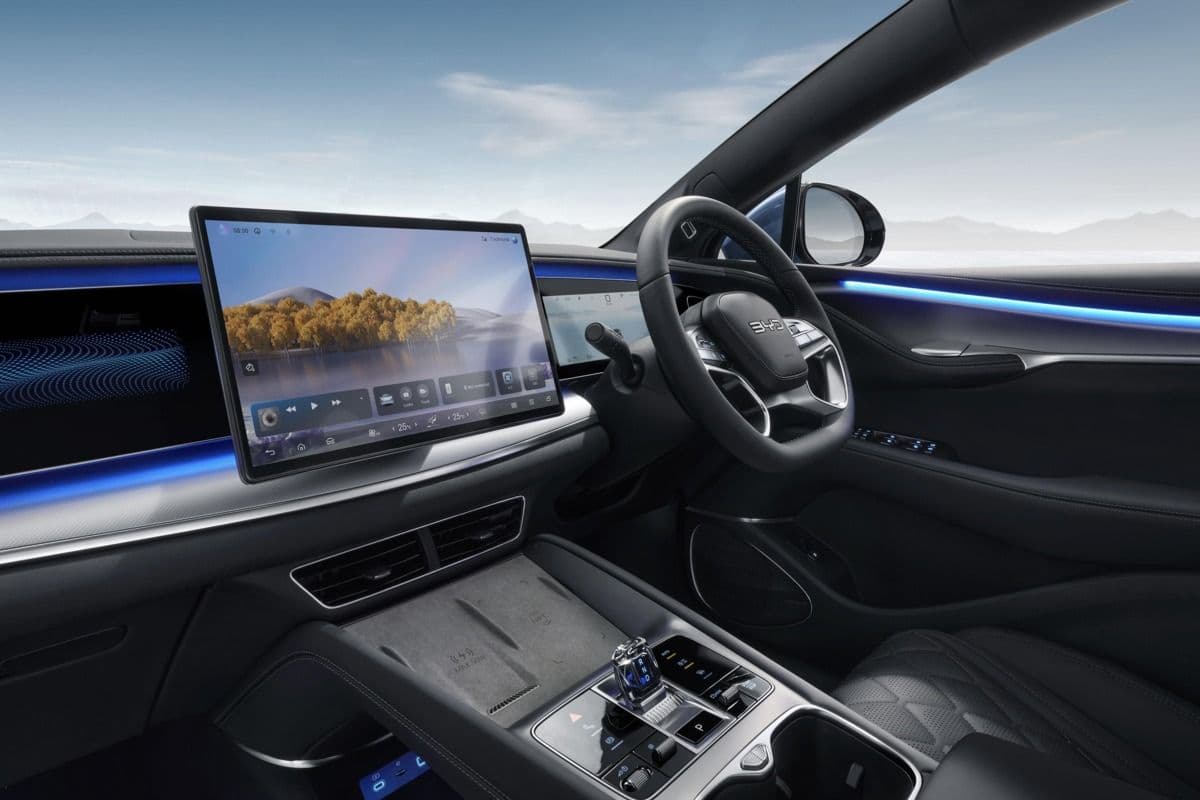
On infotainment, the Sealion 7 Premium pairs a 15.6-inch rotating central touchscreen with a separate 10.25-inch digital instrument cluster and a head-up display. The EV5 runs Kia's Integrated Panoramic Display arrangement on higher trims, giving it a similarly tech-forward cabin, though exact screen sizes vary by grade within the EV5 range.
Both include wireless phone charging, wireless Apple CarPlay and Android Auto, and a companion smartphone app for remote lock, climate control and charge monitoring. Neither car has a clear edge here; the choice comes down to interface preference rather than missing features on either side.
Other Features
Outside the core spec sheet, each car has a handful of features the other does not offer.
Exclusive to the BYD Sealion 7 Premium:
- Lower entry price by $6,180 before on-road costs
- Substantially quicker acceleration (6.7 seconds vs 8.9 seconds to 100km/h)
- Higher V2L output (6.6kW vs 3.6kW)
Exclusive to the Kia EV5 Air Long Range:
- Longer claimed WLTP range (555km vs 482km)
- Lighter kerb weight (2,054kg vs 2,225kg) despite a similar battery size
- Larger boot capacity (513L vs 500L standard, 1,714L vs 1,358L maximum)
- Longer vehicle warranty (7 years vs 6 years)
Warranty and Servicing
Kia's vehicle warranty term is longer, while BYD's capped-price servicing gives buyers more cost certainty over the medium term.
Spec | BYD Sealion 7 Premium | Kia EV5 Air LR |
Vehicle warranty | 6 years / 150,000km | 7 years / unlimited km |
Battery warranty | 8 years / 160,000km | 7 years / 150,000km |
Service interval | 12 months / 20,000km | 12 months / 15,000km |
Kia's seven-year, unlimited-kilometre vehicle warranty is longer than BYD's six-year, 150,000km term, though BYD counters with a marginally longer battery warranty at eight years against Kia's seven.
BYD's Sealion 7 also carries capped-price servicing across 10 years, totalling $4,157, giving buyers a clear upfront figure for long-term running costs. Kia's shorter 15,000km service interval against BYD's 20,000km means EV5 owners visiting the dealer somewhat more often over the same distance travelled.
Verdict
These two cars trade off in opposite directions. The Sealion 7 Premium is cheaper, quicker and has more features. The EV5 Air Long Range has more range, is more efficient and carries a longer vehicle warranty.
Buyers who prioritise outright value and performance per dollar will find the Sealion 7 Premium hard to beat at $6,180 less before on-road costs. Buyers who drive longer distances regularly, or who put more weight on warranty length and Kia's established Australian service network, will find the EV5 Air Long Range the more reassuring choice despite the higher price.
Both have proven themselves as legitimate mid-size SUV contenders against the Tesla Model Y, just with strengths on their spec sheets.
Get a novated lease quote
About the author

Danny is a consultant and entrepreneur working at the cutting edge of the electric vehicle and energy transition. He is passionate about educating and helping consumers make better decisions through data.
