Key Points
- V2G technology is ready, but standards, regulation and market signals are not yet aligned
- Automakers need clear safety frameworks and predictable rules before enabling bidirectional charging at scale
- Consumer trust depends on upstream technical decisions, not just education
Vehicle-to-grid (V2G) technology lets electric vehicles power their home and send power back to the grid. It can help balance energy supply, support renewables, and give EV owners a way to earn from their battery. But in Australia, scaling V2G is not moving as fast as the technology allows.
In February 2026, the Vehicle-Grid Network (VGN) held its first industry roundtable. It brought together 51 stakeholders from 31 organisations, including car and charger makers, energy companies, regulators, state governments, and research bodies. The goal was to identify what needs to happen before V2G can scale responsibly in Australia.
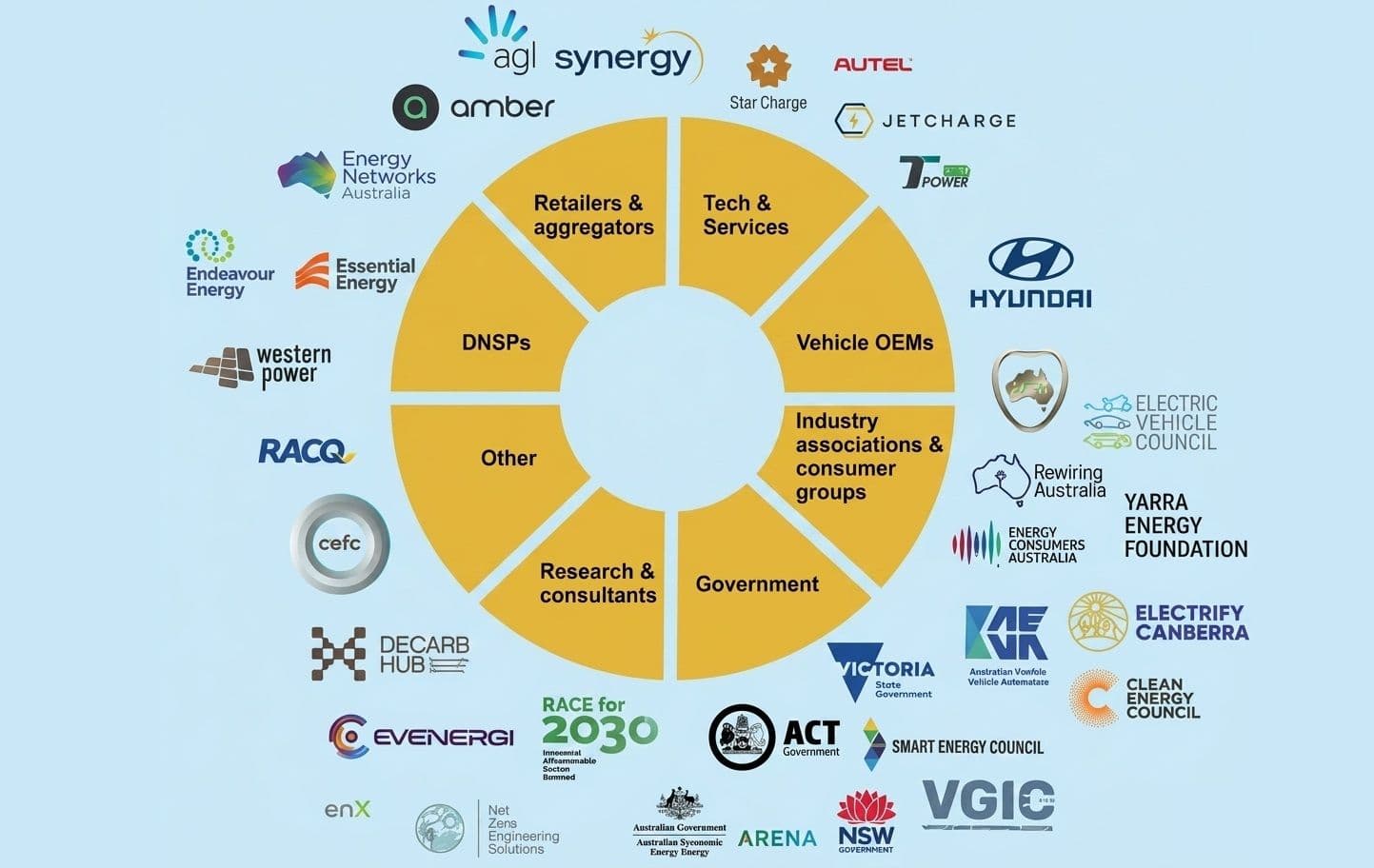
In summary the report found: the barriers are not mainly technical. They are about coordination.
What Is the VGN?
The Vehicle-Grid Network is Australia's cross-sector collaboration network for EV-to-grid integration. It is led by Climate-KIC Australia and the UTS Institute for Sustainable Futures, and funded by ARENA and the RACE for 2030 CRC.
No single organisation can coordinate V2G alone. VGN brings together vehicle and charger manufacturers, energy networks, retailers, regulators, and consumers to align efforts and address gaps.
The Core Problem: Coordination, Not Technology
Roundtable participants agreed that V2G technology works. The problem is that standards, safety frameworks, certification pathways, market rules, and consumer protections are not yet aligned. Progress on one front can stall without progress on others.
The roundtable identified six key themes that need to be addressed together.
1. Automakers Need Safety and Regulatory Clarity
Automakers see V2G as a safety, warranty, and reputational issue. Before they enable bidirectional charging at scale, they need clear safety frameworks, predictable standards, and mature consumer-facing processes.
Security and communications protocols, including PKI implementation and OCPP-CSIP-AUS translation, are still unsettled. Distribution network service providers (DNSPs) also need confidence that connected equipment can safely disconnect when required.
Battery health and liability were also raised. Participants called for independent evidence on battery degradation, aligned warranty approaches, and real-world operational data.
2. Australia Lacks a Clear Technical Direction
There is broad agreement that Australia should align with international standards such as ISO 15118-20 and OCPP 2.x. But this has not been formalised. The lack of a clear, endorsed technical direction is creating uncertainty for every part of the supply chain.
Australia has a small domestic manufacturing base. Aligning with global standards is seen as critical to attract international automakers and reduce localisation costs. DNSPs also need clearer direction to set consistent integration requirements across networks.
Key V2G Standards Referenced in the Report
Standard | What It Covers | Relevance to Australia |
ISO 15118-20 | Bidirectional EV charging communication between vehicle and charger | Broad alignment exists but not yet formalised |
OCPP 2.0.1 / 2.1 | Open Charge Point Protocol for charger-to-network communication | Protocol translation with CSIP-AUS remains unresolved |
CSIP-AUS (IEEE 2030.5) | Australian standard for DER communication with distribution networks | Required by DNSPs; translation from OCPP is a key gap |
3. Certification and Connection Pathways Are Too Slow
Getting a bidirectional charger certified (e.g. AS/NZS 4777.2) and connected in Australia takes too long. Approval processes vary across DNSPs, testing infrastructure is limited, and guidance is unclear.
Participants said this is discouraging manufacturers from entering the Australian market. Fewer products means less consumer choice and slower adoption.

4. The Value Case Is Still Unclear
Australia is seen as a strong candidate for early V2G adoption. But the value proposition is hard to assess. Limited real-world data, evolving business models, and regulatory uncertainty make it difficult for consumers, fleets, financiers, and insurers to evaluate costs and benefits.
There is also no shared view on sequencing. Should automaker activation come first? Or standards formalisation? Or DNSP rule harmonisation? Participants agreed that clarity on sequencing is essential to avoid wasted effort and unintended consequences.
VGN Roundtable: Key Barriers at a Glance
Theme | Key Barrier | What Is Needed |
Automaker activation | Safety, warranty and reputational risk | Clear safety frameworks and regulatory certainty |
Technical standards | No endorsed national direction | Formalise alignment with ISO 15118-20 and OCPP 2.x |
Certification pathways | Slow, variable DNSP approval processes | Streamlined, nationally consistent certification |
Market signals | No shared view on sequencing or value stack | Validated use cases, shared data, pilot projects |
Consumer trust | Uncertainty on battery warranties, safety and value | Clear standards, transparent compatibility info, trained installers |
Regulation | Complex, fragmented rules across energy, tax, building and consumer law | Modernised, harmonised national regulatory approach |
5. Consumer Trust Starts with Technical Decisions
Consumer trust is not just about education. It is shaped by the technical decisions made upstream. Weak or inconsistent standards can create real consumer risks, such as unclear EV-charger compatibility or unexpected restrictions on V2G operation.
Installers were identified as a critical link. They need the knowledge and capability to explain the risks, benefits, and trade-offs of V2G to customers. Participants also stressed that V2G is not suitable for every household, and this needs to be communicated clearly.
Equity was also raised. Overly technical or complex messaging may exclude less-engaged consumers. Early adopters and mainstream consumers have different needs and risk tolerances.
6. Regulation Is Fragmented
V2G sits across energy market rules, taxation, building codes, fire regulations, and consumer protections. The regulatory environment is complex and fragmented. Participants called for modernised, harmonised national approaches to attract international manufacturers and create a coherent domestic market.
What Happens Next
VGN will establish three Working Groups in May 2026 to take these findings forward:
1. Standards and Interoperability
2. Regulation and Market Strategy
3. Consumer Journey and Deployment
These groups will develop detailed work plans and practical outputs to help move V2G from pilots to early commercial deployment.
The full report is available via the UTS Institute for Sustainable Futures and the Vehicle-Grid Network.
Zecar’s Take
While the lack of progress with V2G in Australia is frustrating for some, the report reinforces that the barriers to mass adoption are surmountable with coordinated industry effort. The Vehicle-Grid Network was established for this very purpose.
The hype around V2G has eased, largely driven by strong consumer uptake of battery rebates and the clear benefits they provide. This may actually be a blessing in disguise, easing the pressure on industry and allowing time to develop a compelling, affordable consumer offering that works as seamlessly as other home energy solutions like home batteries and solar.

About the author

Danny is a consultant and entrepreneur working at the cutting edge of the electric vehicle and energy transition. He is passionate about educating and helping consumers make better decisions through data.
