
Key Points
- NSW has released its 2026 Electric Vehicle Strategy, backed by $100 million in funding.
- The strategy targets five areas: fast chargers, kerbside charging, electric trucks, workforce training and better information.
- Switching to an EV can cut fuel costs by up to $3,000 a year and reduce maintenance costs by around 40 per cent.
The NSW government has released its 2026 Electric Vehicle Strategy. Backed by $100 million, the plan focuses on closing charging gaps, expanding electric truck support and training the workforce needed to service EVs.
EVs now make up 15.6 per cent of new car sales in NSW. More than 117,000 EVs are registered in the state, saving an estimated 141 million litres of petrol each year.
Five Priority Areas
The strategy focuses on five areas:
2026 NSW EV Strategy: Five Priority Areas
Priority | What It Means |
Fast chargers in blackspots | Expanding the fast charging network in regional, remote and suburban areas with gaps |
More kerbside chargers | Rolling out kerbside charging for EV drivers who cannot charge at home, including apartment residents |
Electric trucks | Expanding the EV Fleets Incentive Program to include small and medium-size trucks |
Workforce training | Training around 2,000 mechanics in regional NSW to safely service EVs and charging infrastructure |
Better information | Strengthening central sources of information for drivers, businesses, councils and owners corporations |
To date, the NSW government has funded more than 3,300 EV chargers across more than 1,200 sites in metropolitan, regional and remote NSW.
Cost Savings for Drivers
Switching to an EV can cut fuel costs by up to $3,000 a year. When paired with home solar, fuel costs can be eliminated entirely. Maintenance costs are also around 40 per cent lower than a petrol or diesel vehicle.
With global fuel prices under pressure, the government says accelerating EV uptake has never been more important.
Expanding to Electric Trucks
The strategy marks a shift from light vehicles to heavier transport. Trucks and buses make up only 3 per cent of road vehicles but account for 26 per cent of NSW road transport emissions.
The EV Fleets Incentive Program has been expanded beyond 4.5 tonnes Gross Vehicle Mass to include small and medium-size trucks. This targets back-to-base and last-mile delivery operations.
Climate and Health Benefits: Electric Rigid Truck vs Diesel
Benefit | Electric Rigid Truck | Diesel Truck |
Climate benefit (lifetime) | $82,000 | $11,500 |
Health benefit from reduced air pollution | $9,000 | $300 |
Fleet and truck operators can currently apply for grants to electrify vehicles and install charging infrastructure.
Charging in Regional and Remote NSW
Regional and remote communities face persistent charging gaps. The updated strategy aims for charging stations at least every 100 km across all major NSW highways.
The government will deliver an optimal mix of charger types, from fast DC chargers to lower wattage AC chargers, to serve residents, tourists and businesses.
Applications are now open for eligible councils to build capability and plan for further public charging rollout under a $3 million program.
Kerbside Charging for Apartment Residents
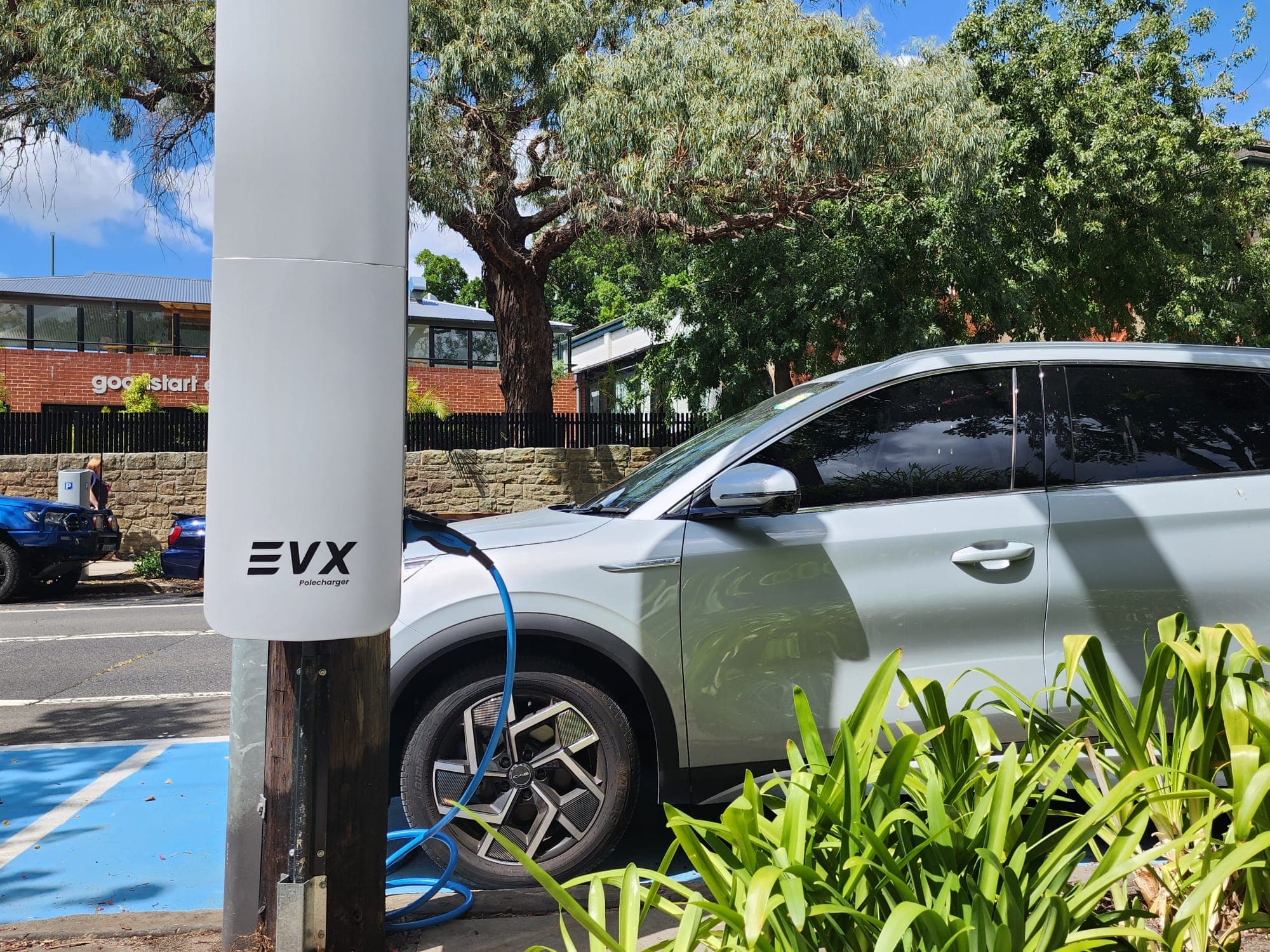
Not all residents have access to off-street parking. NSW has installed or contracted 1,065 kerbside charging plugs across Greater Sydney, Newcastle and Wollongong through two competitive grant rounds.
At least one more round of kerbside charging co-investment is planned. The government is also supporting amendments to the Strata Schemes Management Act 2015 that give owners a right to install EV chargers that owners corporations cannot unreasonably refuse.

Training the EV Workforce
The strategy invests in training around 2,000 mechanics in regional NSW. Access to training courses is limited in regional areas and travel distances are longer.
TAFE NSW is delivering EV skills training across 13 micro-skills courses. Emergency service workers are also being trained to respond to EV incidents.
Emissions, Health and Safety
Transport is on track to become NSW's largest source of emissions by 2029-30. In 2021-22, transport made up 22 per cent of NSW annual carbon emissions, with 87 per cent from road transport.
Air pollution from cars and trucks causes more than 11,000 premature deaths each year in Australia, contributing to asthma, respiratory illness and cardiovascular disease.
NSW has legislated targets to cut emissions from 2005 levels by 50 per cent by 2030, 70 per cent by 2035, and reach net zero by 2050.
On EV fire safety, the strategy notes that EV battery fires are less frequent than fires in petrol and diesel vehicles. Between January 2010 and January 2026, there were only 12 EV battery fires in Australia, with just 2 involving vehicles connected to chargers.
Public Transport and the Grid
The government is also electrifying public transport:
NSW Public Transport Electrification Targets
Initiative | Target / Status |
Greater Sydney buses | All zero-emission by 2035 |
Outer Metropolitan buses | All zero-emission by 2040 |
Regional NSW buses | All zero-emission by 2047 |
Rail, light rail and metro | 100% renewable electricity since 2025 |
Heavy vehicle trial | Two-year trial for zero-emission heavy vehicles on state roads |
Total public transport buses | More than 8,000 transitioning to zero-emission technology |
The government is also exploring smart, bidirectional charging technology. This would allow EV owners to power their homes using spare battery energy and discharge back to the grid during peak demand.

What the Numbers Show
NSW EV Strategy 2026: Key Numbers
Metric | Figure |
EVs registered in NSW | More than 117,000 |
EV share of new car sales in NSW | 15.6% |
Petrol saved per year | 141 million litres |
Chargers funded to date | More than 3,300 across 1,200+ sites |
Fleet EVs supported | More than 5,600 by late 2025 |
Strategy funding | $100 million |
Mechanics to be trained | Around 2,000 in regional NSW |
EV models available in Australia | Over 110 from 43 manufacturers (end of 2025) |
Cheapest EV available in Australia | Under $30,000 (first model in 2025) |

About the author

Danny is a consultant and entrepreneur working at the cutting edge of the electric vehicle and energy transition. He is passionate about educating and helping consumers make better decisions through data.
