
Key Points
- Hyundai Motor Company Australia completed the country's first V2G discharge using the ISO 15118-20 standard with an IONIQ 9 and StarCharge Halo 7.4 kW bidirectional DC charger.
- The StarCharge Halo received Clean Energy Council listing in March 2026 and is AS/NZS 4777.2 compliant.
- Hyundai models under evaluation for V2G in Australia include the IONIQ 9, IONIQ 5, IONIQ 6 and future IONIQ platforms.
Hyundai Motor Company Australia (HMCA) has completed Australia's first Vehicle-to-Grid (V2G) discharge using the ISO 15118-20 communication protocol. The milestone paired a Hyundai IONIQ 9 with the StarCharge Halo 7.4 kW bidirectional DC charger.
ISO 15118-20 is the second-generation international standard for bidirectional power transfer between electric vehicles and charging equipment. It provides the secure, interoperable framework required for V2G, Vehicle-to-Home (V2H) and Vehicle-to-Everything (V2X) applications. This standard is expected to be adopted in Australia for optimal operation of V2G systems, ensuring vehicles and chargers from different manufacturers can communicate reliably.
The StarCharge Halo received Clean Energy Council (CEC) listing in March 2026 and is AS/NZS 4777.2 compliant.
V2G roadmap and Hyundai's leadership
The IONIQ 9 is built on Hyundai's Electric-Global Modular Platform (E-GMP) with 800-volt architecture designed for high-power DC charging and bidirectional energy flows. This milestone confirms that local V2G software enablement and certification is progressing in 2026.
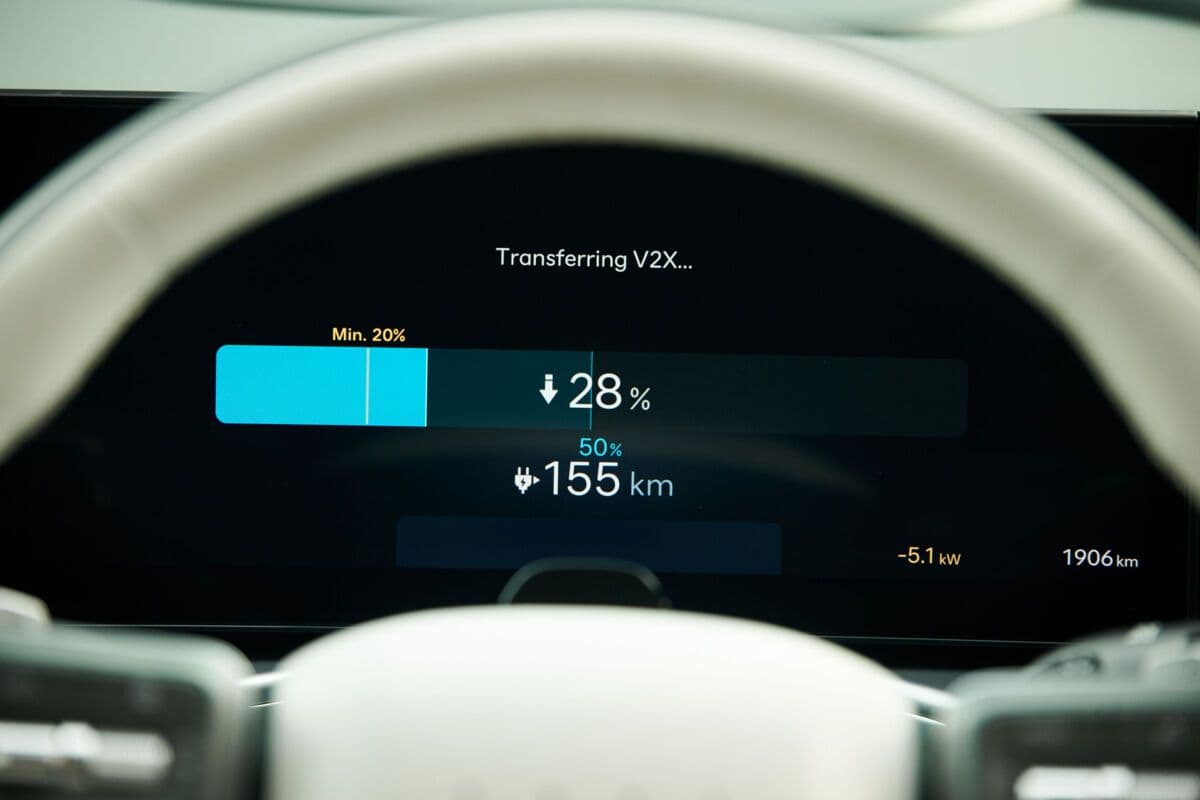
This milestone highlights Hyundai's leadership in bringing an ISO 15118-20-enabled vehicle platform to Australia. With the IONIQ 9, Hyundai is helping establish a standards-based pathway for scalable, manufacturer-supported V2G and V2X deployment across homes, buildings, energy networks and virtual power plants.
Don Romano, Chief Executive Officer of HMCA, said:
"This is the result of sustained technical work by Hyundai's R&D teams in Korea and Australia. ISO 15118-20 includes all the messages and sequence requirements for bidirectional power transfer. Getting this right is essential because V2G will only scale in Australia if consumers, energy providers and governments can trust the technology.
"Electric cars can do far more than just drive. They can power homes and support the grid. This first V2G discharge using ISO 15118-20 with the IONIQ 9 demonstrates that we are delivering real innovation, not just talking about it."
Austin Luo, Director eMobility, StarCharge Energy Oceania, said:
"This is an important milestone for Australia's V2G market and a strong demonstration of Hyundai's leadership in bringing ISO 15118-20-enabled vehicle technology to Australia through the IONIQ 9. StarCharge is proud to support Hyundai with the StarCharge Halo 7.4 kW bidirectional DC charger, and we look forward to working with industry partners to accelerate standards-compliant, manufacturer-supported V2G adoption across Australia."
Hyundai models under evaluation or development for V2G in Australia include the IONIQ 9, IONIQ 5, IONIQ 6 and future IONIQ platforms. Globally, Hyundai Motor Group is advancing V2X capabilities through Korea's first customer-focused V2G pilot on Jeju Island, commercial V2G services in Europe and V2H services in the United States. Hyundai is one of the leaders in V2G deployment, as demonstrated by this milestone and the various V2G pilots it is running globally.
The cost barrier for V2G adoption
The StarCharge Halo bidirectional charger is priced at approximately $6,000 plus installation. That cost sits alongside the vehicle itself, which must support bidirectional charging.
For context, a typical 20 kWh home battery system costs roughly $6,000 - similar price to a V2G charger. Currently, many customers still prefer a dedicated battery for the same price. Without the federal battery rebate however, a 20 kWh battery costs ~$12,000 - double the price of a V2G charger.
V2G will become a more compelling solution once the cost of bidirectional chargers comes down further and battery rebates fall away entirely. V2G chargers like the Halo are expected to eventually fall to between $2,000 to $3,000. At that point, the relative value proposition starts making much morse sense to the consumer. An EV owner effectively gets a home battery that also serves as a car which likely could be repaid within a few years from energy savings.
Hyundai EV sales and the V2G differentiation opportunity
Hyundai's EV sales in Australia have grown steadily but remain behind volume leaders like Tesla and BYD.
Year | Hyundai EV sales (Australia) | Market context |
2022 | ~1,500 | IONIQ 5 launched mid-year |
2023 | ~4,200 | IONIQ 6 added to lineup |
2024 | ~5,800 | Broader availability, Kona Electric refresh |
2025 | ~7,200 (estimated) | IONIQ 5 N, continued growth |
Hyundai cannot compete on price with BYD's aggressive pricing or Tesla's scale-driven cost structure. V2G capability offers a point of differentiation that price-focused competitors cannot easily match. Being first to market with standards-compliant, manufacturer-approved V2G could help Hyundai boost EV sales by offering buyers a genuine value-add: a car that also works as a home battery and grid support device.

National V2G standards and outlook
Australia adopted national V2G and V2H standards in 2024. The Australian Renewable Energy Agency (ARENA) forecasts up to 2.6 million Australian homes could adopt V2G by 2040. HMCA encourages all stakeholders to ensure V2G programmes utilise manufacturer-approved technology compliant with ISO 15118-20.


About the author

Danny is a consultant and entrepreneur working at the cutting edge of the electric vehicle and energy transition. He is passionate about educating and helping consumers make better decisions through data.
