

Key Points
- Ferrari has unveiled the Luce, its first fully electric car, producing 772kW and reaching 100km/h in 2.5 seconds with a claimed WLTP range of over 530km.
- The Luce was designed by LoveFrom, the creative collective led by Sir Jony Ive and Marc Newson, marking the first time Ferrari has used an external design studio for a road car.
- Pricing has not been announced, but Ferrari expects the Luce to cost more than the Purosangue.
Ferrari has unveiled the Luce, its first fully electric car, at the Vela di Calatrava in Rome. The five-door, five-seat luxury saloon produces 772kW, accelerates from 0 to 100km/h in 2.5 seconds, and claims a WLTP range of over 530km. Ferrari chose Rome to mark the occasion: it was in this city that the brand won its first-ever race in 1947, with the Ferrari 125 S at the Gran Premio di Roma.
The Luce sits alongside Ferrari's existing petrol and hybrid models rather than replacing them. Ferrari describes it as a new kind of Ferrari made possible only by the electric architecture, opening a new segment and a new pathway into the brand for a different generation of buyers.
Design: LoveFrom, Jony Ive, and Marc Newson
The Luce is the first Ferrari road car designed outside the brand's in-house design studio. Ferrari handed the project to LoveFrom, the creative collective led by Sir Jony Ive and Marc Newson. Ive is best known for his work at Apple, where he shaped the design of the iPhone, iPad, and Apple Watch. Newson, who was born in Australia, served as creative director at Qantas before joining Ive at Apple between 2014 and 2019.
The result is a car that looks like no other Ferrari. The exterior is built around what Ferrari calls the glasshouse: a near-seamless, shell-like form that runs uninterrupted from the nose, over the roofline, to a chopped kammtail rear. Floating aerodynamic panels at the front and rear act as giant spoilers, providing downforce and cooling without the need for overt wings or retractable elements. Lighting, windscreen wipers, and even the iconic Cavallino crests have been integrated or redesigned to minimise aerodynamic disruption. The Luce achieves the lowest drag coefficient of any Ferrari road car.
Active aerodynamic grilles regulate airflow through the heat exchangers, balancing cooling requirements against drag. Active ride height can lower the front by 10mm at speed. The body is clad in aluminium panels, with extensive use of recycled secondary-alloy aluminium reducing CO2 emissions during production by around 70 per cent of the overall vehicle weight.
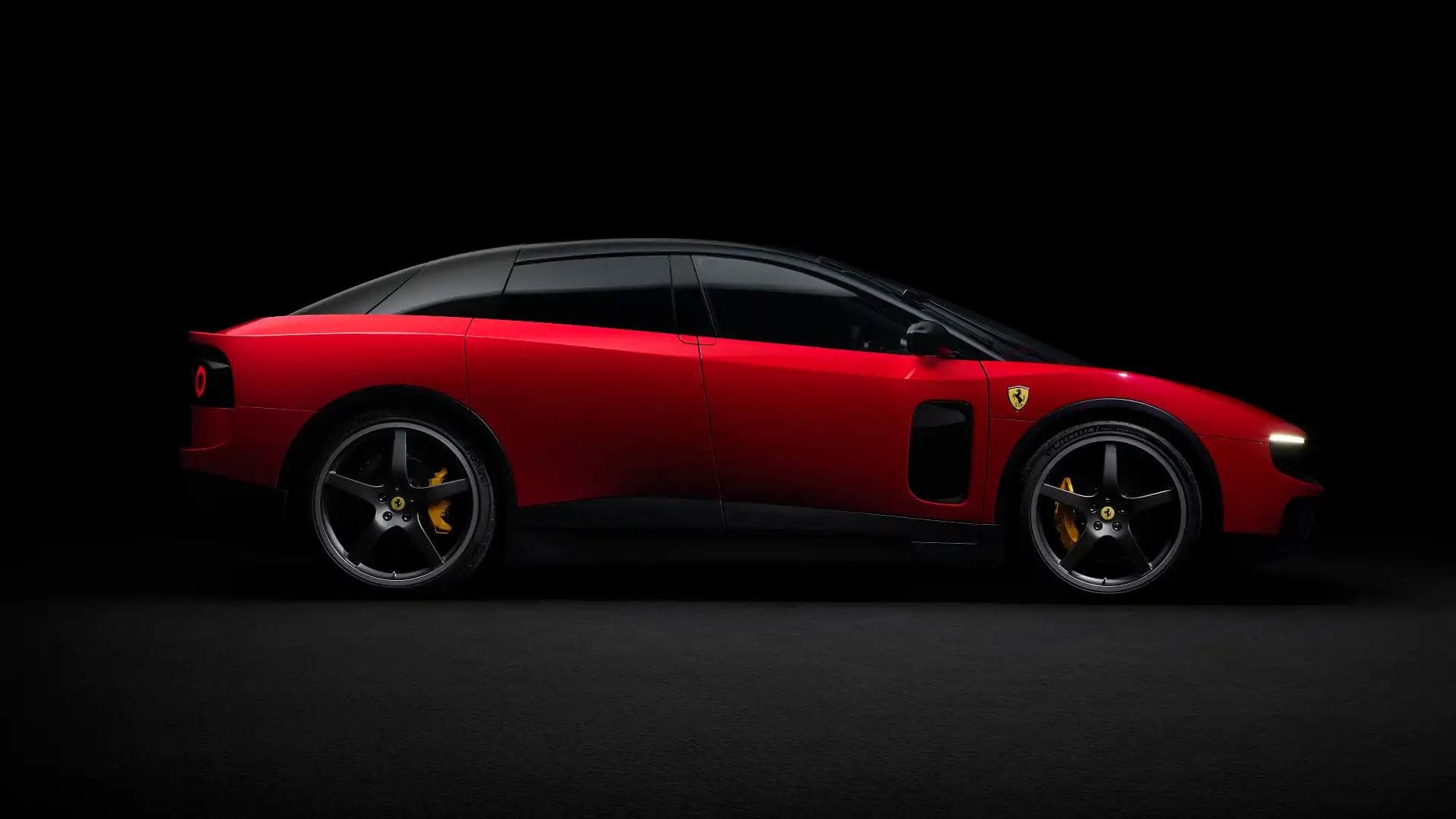
At 5,026mm long, 1,999mm wide, and 1,544mm tall, the Luce is marginally longer than the Purosangue but narrower and lower. Its centre of gravity sits 95mm lower than the Purosangue, thanks to the battery being mounted in the floor.
Ferrari Luce vs Purosangue: Dimensions
Dimension | Ferrari Luce | Ferrari Purosangue | Difference |
Length | 5,026mm | 4,973mm | 53mm longer |
Width | 1,999mm | 2,028mm | 29mm narrower |
Height | 1,544mm | 1,589mm | 45mm lower |
Wheelbase | 2,961mm | 3,018mm | 57mm shorter |
Kerb weight | 2,260kg | 2,180kg | 80kg heavier |
Powertrain: 12 motors, 122kWh battery, 800V architecture
The Luce runs on a bespoke platform developed specifically for this car. The 122kWh gross battery pack comprises 210 cells in series across 15 modules, with an energy density of 305Wh/kg. The 800V architecture supports up to 350kW DC fast charging, with ports on both sides.
There are 12 electric motors in total, three per wheel. Four handle traction and regeneration; the remaining eight manage active suspension damping and steering control. The four traction motors are derived from the Ferrari F80, using permanent magnet synchronous technology with radial flux. Front motors spin to 30,000rpm; rear to 25,500rpm.
Total power in launch control is 772kW (1,050cv). Torque at the motors is 990Nm, rising to 11,500Nm at the wheels via step-down gearing in each wheel's independent gearbox. Front motors contribute 210kW and 280Nm; rear motors 620kW and 710Nm. The car is all-wheel drive, with front motors decoupling in Range mode for efficiency.
Performance and drive modes
The Luce covers 0–100km/h in 2.5 seconds and 0–200km/h in 6.8 seconds. Top speed is 260km/h in standard configuration, rising to 310km/h in the top performance mode. WLTP range is claimed at over 530km, though higher performance modes will reduce that figure.
Launch mode is activated by a roof-mounted handle. Pulling it floods the cabin with orange light and displays instructions for the full-power run. The driver manages delivery through the e-Manettino, which modulates power and traction, and the five-position Manettino covering Ice, Wet, Dry, Sport, and ESC Off. Three power modes are available: Range, Tour, and Perfo.
The Luce does not simulate gearshift changes. Instead, steering wheel paddles adjust available torque in five increments: the right increases torque while maintaining progressive acceleration feel; the left increases energy recovery and the sensation of deceleration. The Vehicle Control Unit updates targets 200 times per second.
The closest rival in this segment is the Mercedes-AMG GT63, which produces 860kW from three axial-flux motors and can charge at up to 600kW. The Luce counters with lower kerb weight, a more complex 12-motor architecture, and higher wheel torque.
Ferrari Luce vs Mercedes-AMG GT63: Key Specs
Spec | Ferrari Luce | Mercedes-AMG GT63 |
Power output | 772kW (1,050cv) | 860kW |
Torque (at motors) | 990Nm (11,500Nm at wheels) | 2,000Nm |
0-100km/h | 2.5 sec | 2.1 sec (with rollout) / 2.4 sec |
0-200km/h | 6.8 sec | 6.4 sec |
Top speed | 310km/h (performance mode) | 300km/h (optional Driver's Package) |
WLTP range | 530km+ | Up to 696km |
Battery capacity | 122kWh (gross) | 106kWh |
Max DC charging | 350kW | 600kW |
Architecture | 800V | 800V (AMG.EA) |
Number of motors | 12 (4 traction, 8 suspension/steering) | 3 (axial-flux) |
Drive type | AWD (front decouples in Range mode) | AWD |
Kerb weight | 2,260kg | 2,460kg |
Seats | 5 | 4 |
Rear-wheel steering | Yes | Yes |
Wheel size | 23" front / 24" rear | Not confirmed |

Wheels, brakes, and chassis
The Luce runs the largest staggered wheel diameters ever fitted to a series-production Ferrari road car: 23 inches at the front with 265/35 R23 tyres, and 24 inches at the rear with 315/30 R24 tyres. Two wheel designs are available: a lightweight traditional five-spoke, or a more aerodynamic turbine-style. Brakes are carbon-ceramic, measuring 390mm front and 372mm rear.
The chassis combines hollow castings, extrusions, and aluminium. The rear subframe is elastically mounted using rubber bushings, the first such arrangement in Ferrari's history, to limit vibration and impact forces reaching the cabin. Semi-virtual double wishbone suspension with a high-mounted upper arm is fitted front and rear, alongside independent rear-wheel steering.

Interior: Apple-influenced HMI and a five-seat first for Ferrari
The Luce is the first Ferrari to seat five. Eliminating the central tunnel frees up space for that fifth seat. The interior draws heavily on Ive and Newson's work at Apple, and Ferrari describes it as a new benchmark for Human Machine Interface integration.
Starting the car involves placing a heavy rectangular key into a magnetic holder. The digital binnacle houses a pair of Samsung OLED displays behind glass in an aluminium rounded rectangle, presenting three circular dials: the centre always shows the speedometer with a mechanical needle rotating 360 degrees; the others display energy use, regeneration, or a multi-selection dial.
The central display is mounted on a swivel and tilts toward driver or passenger via an aluminium handle. Physical toggles handle climate; a glass dial adjusts volume. Rear passengers have their own screen for climate and speed. The audio system features 21 speakers, 3,000W of amplification across 24 channels.
Materials are described as honest and pure: recycled anodised aluminium, Corning Gorilla Glass, and premium leather.


Sound: authentic, not simulated
Ferrari's engineers chose not to simulate a petrol engine sound. Instead, a precision accelerometer mounted at the centre of each axle captures real motor vibrations, which are filtered and amplified in a similar way to an electric guitar, producing a dynamic soundtrack that reflects what the car is actually doing. The system is patented.
Sound level is tied to the e-Manettino and paddle use. It is emitted both inside and outside the cabin. A proper assessment will have to wait until the car is available to drive.
Built in Maranello, Italy: 60+ patents and in-house manufacturing
Ferrari has engineered and manufactured every major component in-house at Maranello. More than 60 patents were registered during development. Ferrari has also committed to servicing all electric components under its Ferrari Forever philosophy.
Kerb weight is 2,260kg, which is 4 per cent more than the V12 Purosangue at 2,180kg, though comparable to a BMW i4 M50 (2,290kg) or Porsche Taycan (over 2,300kg).

Pricing and availability
Ferrari has not announced pricing for any market. The company has indicated the Luce will cost more than the Purosangue, which starts at around $1.1 million in Australia. No on-sale date has been confirmed, though the model designation of 2027 suggests deliveries are expected to begin next year. Ferrari has confirmed the Luce will be sold alongside its existing petrol and hybrid models.
Stay up to date with the latest EV news. Add Zecar as a preferred source on Google.

About the author

Danny is a consultant and entrepreneur working at the cutting edge of the electric vehicle and energy transition. He is passionate about educating and helping consumers make better decisions through data.
