
Hyundai Ioniq 5 AWD Charging Speed, Time and Cost
Medium SUV · 2024 – 2025FBT exemptV2L
- Usable Battery
- 74kWh
- AC Charging
- 11kW
- DC Charging
- 233kW
- 10–80% Time
- 18min
The Hyundai Ioniq 5 AWD charges at up to 233 kW on a DC fast charger and 11 kW on AC. It takes about 18 minutes to charge from 10 to 80% and 11.2 hours to charge from empty on a 7 kW home charger. It has a 74 kWh NMC battery.
Hyundai Ioniq 5 AWD Key Battery and Charging Specs
| Usable Battery | 74 kWh |
|---|---|
| Battery Chemistry | NMC |
| Charge Port | Type 2 (AC), CCS2 (DC) |
| Charge Port Location | Right Side (Rear) |
| 0 to 100% at Home (7 kW) | 11.2 hrs |
| Efficiency | 163 Wh/km |
The Hyundai Ioniq 5 AWD uses a 74 kWh NMC battery. For daily driving, charge to 80 to 90% and save 100% for long trips (LFP vs NMC vs NCA batteries explained). Check your owner's manual for Hyundai's advice.
Compare the best home EV charger in Australia and work out how much electric car charging costs for your driving.
Hyundai Ioniq 5 AWD Charging Times
Hyundai Ioniq 5 AWD Max Charging Speed
| Type | Max Speed |
|---|---|
| AC charging speed | 11 kW |
| DC charging speed (peak) | 233 kW |
How Long Does a Hyundai Ioniq 5 AWD Take to Charge?
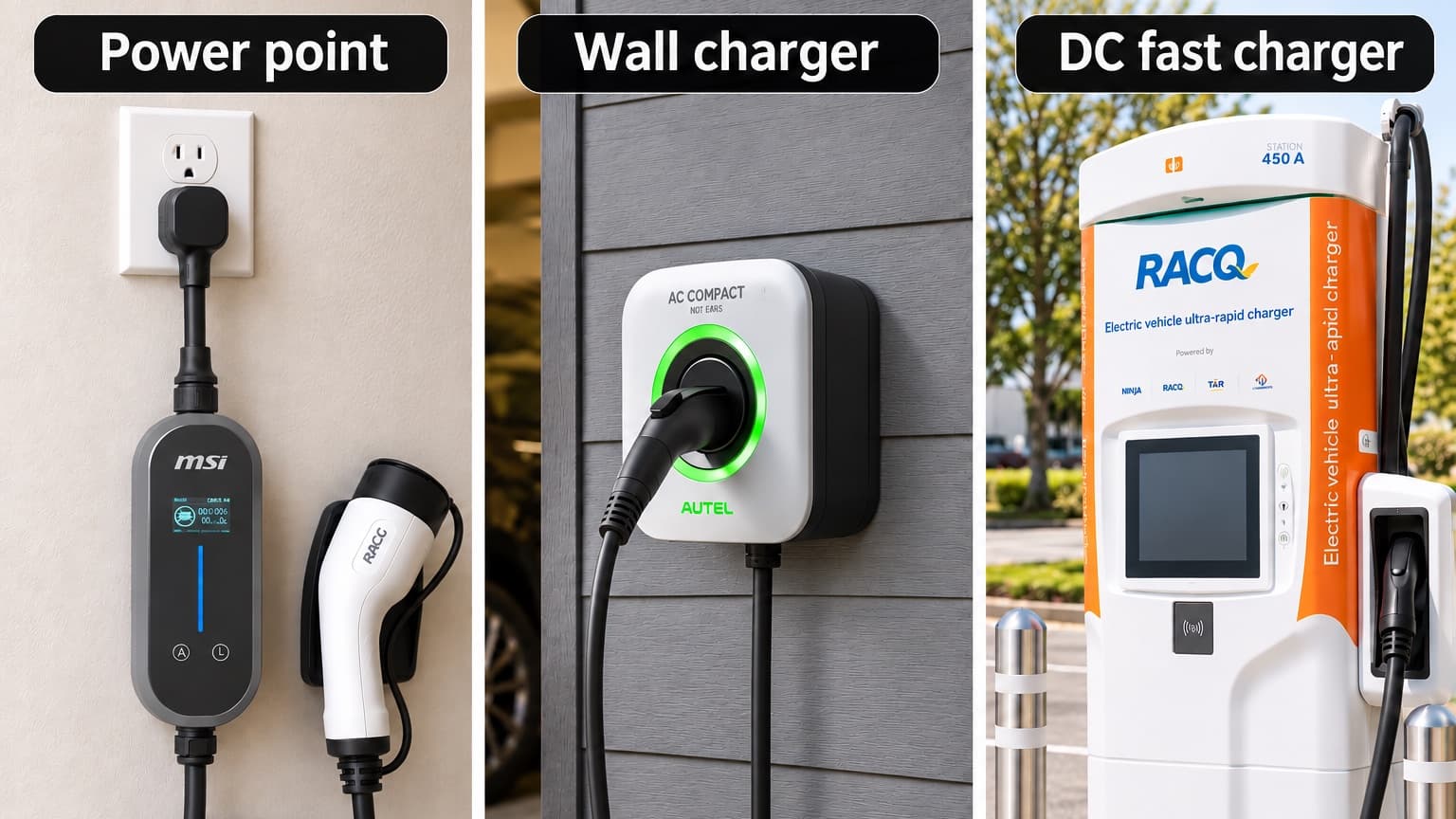
| Charger | Power Used | Time | Range Added |
|---|---|---|---|
| 10A power point (2.3 kW) | 2.3 kW | 34.0 hrs (0 to 100%) | 14 km per hour |
| 15A power point (3.6 kW) | 3.6 kW | 21.8 hrs (0 to 100%) | 22 km per hour |
| 7 kW home wall charger | 7 kW | 11.2 hrs (0 to 100%) | 43 km per hour |
| 11 kW three-phase charger | 11 kW | 7.1 hrs (0 to 100%) | 67 km per hour |
| 50 kW DC fast charger | 47.5 kW | 65 min (10 to 80%) | 73 km in 15 min |
| 150 kW DC fast charger | 142.5 kW | 22 min (10 to 80%) | 219 km in 15 min |
| 350 kW DC ultra-fast charger | 172.7 kW | 18 min (10 to 80%) | 265 km in 15 min |
Icons: grey = power point, green outline = home charger, dark = public DC fast charger.
Best Home Charger for the Hyundai Ioniq 5 AWD
A 7 kW single-phase wall charger suits the Hyundai Ioniq 5 AWD. It charges the battery from empty to full in 11.2 hrs and adds about 43 km of range every hour. If your home already has three-phase power, an 11 kW charger uses the Hyundai Ioniq 5 AWD's full AC speed and charges it in 7.1 hrs.
Find the Right Charger for Your Hyundai Ioniq 5 AWD
See the real charging speed each home charger gets with this car. 3 quick questions.
| Detail | 7 kW Single Phase | 11 kW Three Phase |
|---|---|---|
| 0 to 100% | 11.2 hrs | 7.1 hrs |
| Range per hour | 43 km | 67 km |
| Needs three-phase power | No | Yes |
| Typical installed cost | $1,200 to $2,800 | $1,800 to $3,500 with existing three-phase power. $4,000 to $12,000+ if your home needs converting |
Installed costs are indicative for Australia and include the charger and standard installation. A switchboard upgrade, if needed, can add $900 to $3,500.
Does the Hyundai Ioniq 5 AWD Come With a Charger?
New EVs like the Hyundai Ioniq 5 AWD normally come with a complimentary portable charger that plugs into a standard 10A power point. It's handy for top-ups but takes about 34.0 hrs to fully charge the battery. A 7 kW wall charger does it in 11.2 hrs.
How Much Does It Cost to Charge a Hyundai Ioniq 5 AWD?
A full charge costs $5.18 at home on an EV plan at $0.07/kWh, and $25.90 on a typical flat tariff of $0.35/kWh. At a public DC charger at up to $0.70/kWh it costs $51.80. A petrol medium SUV uses about 10.2 L/100 km, which at $2.00 a litre costs $20.40 per 100 km.
| Where You Charge | Full Charge | Per 100 km | Per Year | Saving vs Petrol |
|---|---|---|---|---|
| Petrol medium SUV | Not applicable | $20.40 | $3,060 | Not applicable |
| Home, flat rate $0.35/kWh | $25.90 | $5.71 | $856 | $2,204 |
| Home, EV plan $0.07/kWh | $5.18 | $1.14 | $171 | $2,889 |
| Public DC $0.70/kWh | $51.80 | $11.41 | $1,712 | $1,348 |
Icons: grey = petrol, green outline = home charging, dark = public charging.
Per year is based on 15,000 km a year.
Switching from a flat tariff to an EV plan saves about $685 a year on charging the Hyundai Ioniq 5 AWD at home.
Hyundai Ioniq 5 AWD Fast Charging Rank and Road Trip Charging
The Hyundai Ioniq 5 AWD ranks 6 of 9 medium SUV EVs priced within $10,000 of it for DC fast charging power.
| Rank | Vehicle | Price | Peak DC (kW) | 10–80% time |
|---|---|---|---|---|
| 1 | IM IM6 Performance | $80,990 | 396 | 21 min |
| 2 | Mercedes-Benz GLB 350 4MATIC electric | $86,200 | 320 | 22 min |
| 3 | Hyundai Ioniq 5 Elite RWD | $81,200 | 263 | 17 min |
| 3 | Kia EV6 AWD | $87,660 | 263 | 17 min |
| 3 | Hyundai Ioniq 5 N Line Premium AWD | $91,700 | 263 | 17 min |
| 6 | Hyundai Ioniq 5 AWD | $85,000 | 233 | 18 min |
Hyundai Ioniq 5 AWD 500 km and 1,000 km Road Trips
Using Zecar's estimated highway range of 354 km and an average of 100 km/h: A 500 km trip needs 1 fast charging stop of about 18 minutes, for a total trip time of about 5 hr 18 min. A 1,000 km trip needs 3 fast charging stops of about 18 minutes each, 54 min in total, for a total trip time of about 10 hr 54 min.
| Trip | Charging stops | Charging time | Total trip time |
|---|---|---|---|
| 500 km | 1 | 18 min | 5 hr 18 min |
| 1,000 km | 3 | 54 min | 10 hr 54 min |
Total trip time is driving at an average of 100 km/h plus charging time. Estimates assume a start at 100%, arrival at no less than 10% and charging from 10% to 80% at a 150 kW-capable charger. Real times vary with weather, speed, load and charger.
Plan your trip costs with the EV charging calculator →Hyundai Ioniq 5 AWD Bidirectional Charging (V2X): V2L, V2H and V2G
- V2L powers appliances from the car's socket.
- V2H powers your home during an outage or peak pricing.
- V2G sends energy back to the grid.
| Feature | Supported | Max Output |
|---|---|---|
| V2L | Yes | 3.6 kW |
| V2H | No | |
| V2G | No |
The Hyundai Ioniq 5 AWD supports V2L and can power appliances up to 3.6 kW. It does not support V2H or V2G.
Hyundai Ioniq 5 AWD Charging FAQ
11.2 hrs for 0 to 100% on a 7 kW home charger, and 18 minutes for 10 to 80% at a DC charger of 233 kW or more.
11 kW on AC and 233 kW on DC, adding about 265 km of range in 15 minutes on a fast charger.
Type 2 for AC and CCS2 for DC, on the right side (rear).
$5.18 at home on an EV plan, $25.90 on a flat tariff, or $51.80 at a public DC charger (compare EV energy plans).
Yes, at Superchargers open to non-Tesla EVs, using its CCS2 plug, so check the Tesla app for which sites are open.
Yes, up to 3.6 kW, but it doesn't support V2H or V2G.
Track the Hyundai Ioniq 5
Get Ioniq 5 price drops, offers and news by email.